
Trust Signals
Key Takeaways
- Thymosin Alpha-1 (Ta1) is the only immune-focused peptide with positive human RCT data and regulatory approval (Zadaxin, approved in over 35 countries at 1.6 mg twice weekly subcutaneously).
- BPC-157 reduces pro-inflammatory cytokines in rodent gut and injury models but has zero completed human RCTs for any immune endpoint as of mid-2026.
- LL-37, the single human cathelicidin, kills gram-positive and gram-negative bacteria directly and modulates TLR signaling, but systemic toxicity at therapeutic doses is a real barrier to injectable use.
- Product purity is the largest practical risk: endotoxin contamination in injectable research peptides can cause fever, chills, and sepsis-like reactions regardless of the peptide's intended mechanism.
- No immune peptide has demonstrated benefit in healthy, immunocompetent adults in a controlled trial. The human evidence base is concentrated in immunocompromised, septic, or chronically infected populations.
What Is the Best Peptide for Immune System Support?
Table of Contents
- Evidence Ledger: All Major Immune Peptides Graded
- Thymosin Alpha-1: The Mechanism With Numbers
- BPC-157: Gut Integrity and Immune-Adjacent Effects
- LL-37: The Human Antimicrobial Peptide
- TB-500 (Thymosin Beta-4 Fragment): What the Name Confusion Costs You
- What Most Pages Get Wrong About Immune Peptides
- The Chemistry Behind Storage Rules
- Honest Head-to-Head: Peptides vs. Real Alternatives
- Operational Guide: How to Read a COA and Dose Correctly
- FAQ
- Sources
Evidence Ledger: All Major Immune Peptides Graded
| Peptide | Best Evidence Type | Human Trials? | Effect Direction | Confidence | Key Caveat |
|---|---|---|---|---|---|
| Thymosin Alpha-1 (Ta1) | Multiple human RCTs, systematic reviews | Yes, hundreds of patients | Pro-immune, T-cell maturation, mortality benefit in sepsis trials | Moderate-High | Most RCTs in diseased/immunocompromised populations; healthy-adult data absent |
| LL-37 | Human ex vivo, Phase I/II topical/inhaled trials | Limited, mostly topical/local delivery | Antimicrobial, immunomodulatory, pro-healing | Low-Moderate | Systemic injectable use constrained by dose-dependent toxicity |
| BPC-157 | Rodent models, in vitro | No RCTs for immune endpoints | Anti-inflammatory, gut-integrity support | Low | Rodent GI pharmacology does not map cleanly to human immune outcomes |
| TB-500 (TB4 Frag 17-23) | Rodent, in vitro | No | Anti-inflammatory, wound healing, some NK cell modulation in animals | Very Low | Fragment of Thymosin Beta-4; often confused with Thymosin Alpha-1 |
| Selank | Small Russian RCTs, animal models | Limited, small samples | Anxiolytic plus modest IFN-alpha upregulation reported | Very Low | Trials largely from single research group; not independently replicated |
| MOTS-c | Animal, in vitro metabolic/immune crosstalk | Phase I only (metabolic endpoints) | Metabolic regulation, secondary anti-inflammatory | Very Low | Immune effects in humans are entirely inferred from mechanism |
Thymosin Alpha-1: The Mechanism With Numbers
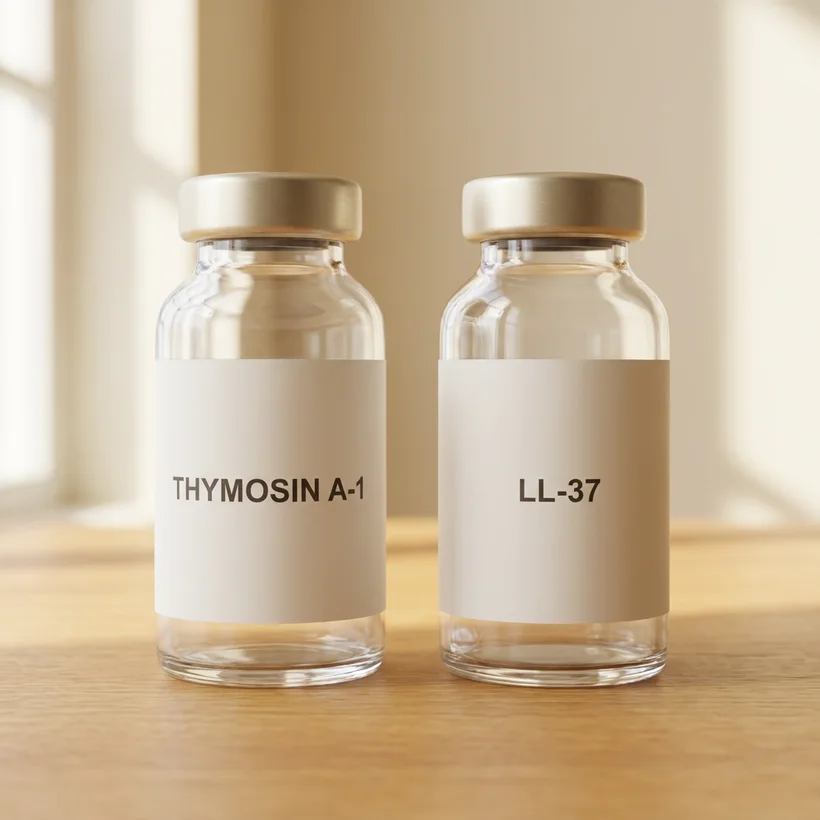
Ta1 is a 28-amino-acid peptide naturally secreted by thymic epithelial cells, originally isolated by Allan Goldstein's group in the 1970s. The synthetic version (thymalfasin) is sold as Zadaxin. Here is what the mechanism actually shows, with honest caveats attached:
From the FormBlends catalog
Immune Defense
Immune modulation with antimicrobial support. · Bundle from $381 · provider-reviewed peptide bundle.
View Immune Defense →- T-cell maturation: Ta1 promotes differentiation of immature thymocytes toward CD4 and CD8 T-cell lineages by upregulating terminal deoxynucleotidyl transferase (TdT) and T-cell surface markers. This was demonstrated in thymus-deprived animal models; human thymic effects are inferred rather than directly imaged.
- TLR9 signaling: Ta1 activates plasmacytoid dendritic cells through TLR9, driving IL-12 production. IL-12 in turn polarizes naive T-cells toward Th1 responses. The TLR9 binding has been demonstrated in human PBMC cultures.
- MHC class I upregulation: Ta1 increases surface expression of MHC class I on virus-infected and tumor cells, improving cytotoxic T-lymphocyte recognition. This is a plausible mechanism for its hepatitis B efficacy but the direct link in patients has not been imaged prospectively.
- Sepsis RCT data: A 2013 meta-analysis by Wu et al. (Critical Care Medicine) pooled data from multiple Chinese RCTs in sepsis patients and found a statistically significant reduction in 28-day mortality with Ta1 vs. placebo. The ETASS trial (a later, more rigorous European study) showed improvements in T-cell reconstitution markers in severe sepsis. Effect sizes were meaningful but the evidence quality is rated moderate due to high proportion of single-country trials.
- Hepatitis B: Published RCTs comparing Ta1 plus lamivudine vs. lamivudine alone in chronic HBV showed higher HBeAg seroconversion rates with combination therapy in some trials. Independent replication is present but effect magnitude varies.
BPC-157: Gut Integrity and Immune-Adjacent Effects
BPC-157 is a 15-amino-acid synthetic peptide derived from a sequence in human gastric juice protein. It has no endogenous circulating form. Its immune relevance comes primarily from gut-immunity crosstalk:
- Rodent studies show reduced TNF-alpha and IL-6 in colitis and injury models after BPC-157 administration, with some data on improved intestinal mucosal barrier function.
- A healthy gut epithelial barrier reduces systemic bacterial translocation, which is a real immune mechanism. The jump from rodent gut healing to "immune booster" in humans is several inferential steps removed from the data.
- Oral bioavailability in rodent models is reported as low, which creates a significant translational problem. If a peptide is rapidly cleaved by gastrointestinal proteases before absorption, the dose reaching systemic circulation differs substantially from the administered dose.
- No completed human RCT exists for immune endpoints. There are registered trials for inflammatory bowel conditions, but results are not published as of this review.
LL-37: The Human Antimicrobial Peptide
LL-37 is the only member of the cathelicidin family expressed in humans. It is 37 amino acids long, cationic, and amphipathic. Its immune functions are direct and mechanistically strong:
- Disrupts bacterial membranes through electrostatic interaction with anionic lipopolysaccharide (LPS), effective against both gram-positive and gram-negative organisms in vitro at concentrations in the low micromolar range.
- Binds and neutralizes LPS directly, potentially dampening endotoxin-driven inflammation.
- Activates formyl peptide receptor-like 1 (FPRL1) on immune cells, promoting chemotaxis and wound healing.
- Has antiviral activity against enveloped viruses demonstrated in cell culture models.
- The clinical barrier is dose-dependent hemolytic toxicity. At concentrations effective against bacteria systemically, LL-37 disrupts red blood cell membranes. Current evidence supports local delivery (topical skin, inhaled for lung infections) where therapeutic concentrations can be achieved without systemic exposure.
TB-500: What the Name Confusion Costs You
TB-500 is a synthetic fragment corresponding to approximately residues 17 to 23 of Thymosin Beta-4. Despite both having "thymosin" in the name, Thymosin Beta-4 and Thymosin Alpha-1 are entirely different proteins with different gene sources, different receptors, and different functions.
Thymosin Beta-4 is an actin-sequestering peptide primarily involved in cell migration, wound healing, and angiogenesis. Its immune effects in animals include some modulation of inflammatory cytokines and NK cell activity, but these are secondary to its primary structural role. Conflating TB-500 with Ta1 based on the shared "thymosin" label is one of the most common errors in the peptide community and can lead someone to buy a tissue-repair peptide when they want an immunomodulator.
What Most Pages Get Wrong About Immune Peptides
The single most consistent error across competitor content is applying immune peptide evidence from diseased populations to healthy individuals. Every persuasive statistic for Ta1, including sepsis mortality data and hepatitis B seroconversion rates, comes from people with documented immune impairment. Extrapolating that to a healthy 35-year-old wanting to "boost" their immune system is not supported by any published trial.
The second major omission is endotoxin risk. Injectable peptide products synthesized by chemical means carry contamination risk. Lipopolysaccharide (bacterial endotoxin) is a byproduct of some synthesis processes and is pyogenic even at nanogram quantities. A user injecting a research peptide with high endotoxin levels may experience fever, rigors, and systemic inflammatory response entirely caused by the contamination, not the peptide. No mainstream peptide review page discusses this hazard in specific terms.
Third: stability after reconstitution is routinely understated. Once a lyophilized peptide is reconstituted in aqueous solution, peptide bond hydrolysis and aggregation begin. At refrigerator temperature this is slow; at room temperature it accelerates meaningfully. "Use within 28 days" is a conservative operational rule, not a precise kinetic measurement for any specific peptide. The exact degradation rate for reconstituted Ta1 in bacteriostatic water at 4 degrees Celsius is not publicly characterized to our knowledge; treat the 28-day window as a maximum, not a guarantee.
The Chemistry Behind Storage Rules
Why keep lyophilized peptides away from UV light? Several amino acids, particularly tryptophan, phenylalanine, and tyrosine, absorb UV radiation and undergo photoxidation. This does not break the peptide backbone directly but oxidizes side chains, altering receptor binding. Ta1 contains a phenylalanine residue at position 1 that contributes to its biological activity. UV damage is slow at typical indoor light levels but accelerates with direct sunlight or UV sterilization lamps.
Why avoid repeated freeze-thaw? Each freeze-thaw cycle creates ice crystals that mechanically stress peptide aggregates and promotes denaturation of tertiary structure in larger peptides. For short peptides under roughly 30 amino acids like Ta1 and BPC-157, tertiary structure is minimal, so freeze-thaw damage is primarily from ice-crystal disruption of the aqueous solution consistency and concentration uniformity rather than protein unfolding. Still, single-use aliquots drawn before freezing is the operationally sound approach.
Why use bacteriostatic water rather than sterile water for reconstitution? Bacteriostatic water contains 0.9 percent benzyl alcohol, a preservative that inhibits microbial growth in the vial after the stopper is punctured repeatedly. Sterile water is single-use by design; multiple draws from a sterile water vial introduce contamination risk. The benzyl alcohol itself is stable and does not react with peptide sequences at standard concentrations.
Honest Head-to-Head: Peptides vs. Real Alternatives
| Agent | Mechanism | Human RCT Evidence | Regulatory Status | Practical Access | Where the Peptide Loses |
|---|---|---|---|---|---|
| Thymosin Alpha-1 (Ta1) | T-cell maturation, TLR9, IL-12 | Yes, sepsis and chronic viral infections | Approved drug (35+ countries), not FDA-approved | Compounded or imported | No healthy-adult RCT; cost is high vs. vaccines |
| Vaccines (e.g., flu, pneumococcal) | Antigen-specific adaptive immune priming | Extensive phase III trials, decades of data | FDA-approved | Widely available, low cost | Antigen-specific only; peptide wins on breadth of immune activation |
| Low Dose Naltrexone (LDN) | Opioid receptor antagonism, glial modulation | Small RCTs in Crohn's, MS, fibromyalgia | Off-label prescription drug | Compounded prescription | Autoimmune focus rather than infectious immunity; more evidence than most peptides |
| Zinc supplementation | Cofactor for 300+ immune enzymes | Multiple RCTs in zinc-deficient populations | OTC supplement | Universal, very low cost | Benefit mainly in deficient individuals; peptide wins in T-cell specificity |
| BPC-157 | Gut barrier, anti-inflammatory cytokines | None for immune endpoints | Research chemical | Widely sold online, variable purity | Loses to all above on evidence; gut-repair use case is genuinely distinct |
Operational Guide: How to Read a COA and Dose Correctly
What a legitimate COA must contain for injectable peptide use:
- HPLC purity: look for 98 percent or above. Values below 95 percent suggest significant impurity load.
- Mass spectrometry (MS) result: the detected molecular weight must match the theoretical molecular weight of the peptide within instrument tolerance (typically plus or minus 1 Da). This confirms you have the correct peptide, not an analog or truncated sequence.
- Endotoxin (LAL test): for anything intended for injection, endotoxin should be below 1 EU per mg. Some suppliers report EU per mL after reconstitution; verify the calculation.
- Issuing lab: must be a named, independent third-party analytical laboratory. A COA from "our internal QC team" is not independently verifiable.
Reconstitution math for Ta1 (1.6 mg dose):
- Standard vial: 5 mg lyophilized powder.
- Add 3.1 mL bacteriostatic water to get a concentration of approximately 1.6 mg per mL.
- Draw 1.0 mL per injection for the 1.6 mg dose used in published trials.
- This gives roughly 3 doses per vial before accounting for waste in the needle hub (draw a small excess).
What a degraded peptide looks like: Reconstituted solution should be clear and colorless. Visible particulates, cloudiness, or a yellow to brown tint indicate aggregation, contamination, or oxidation. Do not inject a visually abnormal solution.
FAQ
What is the best peptide for immune system support overall?
Thymosin Alpha-1 (Ta1) has the strongest human clinical evidence for immune modulation, with multiple randomized controlled trials in sepsis and viral infections. It is the only immune-focused peptide approved as a drug (Zadaxin) in over 35 countries, making it the most defensible first choice when the goal is measurable immune enhancement.
How does Thymosin Alpha-1 work in the immune system?
Ta1 is a 28-amino-acid peptide derived from prothymosin-alpha. It promotes maturation and differentiation of T-cells, upregulates MHC class I expression on tumor and virus-infected cells, and enhances NK cell activity. It signals through Toll-like receptor 9 (TLR9) and activates dendritic cells to increase IL-12 production.
Is BPC-157 an immune peptide?
BPC-157 has anti-inflammatory effects demonstrated in rodent models, reducing pro-inflammatory cytokines in injury and gut models. However, it has no completed human RCTs for immune endpoints. It is better characterized as a tissue-repair and gut-integrity peptide with secondary immune-adjacent effects rather than a direct immunomodulator.
What is the difference between Thymosin Alpha-1 and Thymosin Beta-4 (TB-500) for immunity?
These are structurally unrelated despite sharing the thymosin name. Thymosin Alpha-1 directly stimulates T-cell maturation and has human RCT evidence for immune support. Thymosin Beta-4 (TB-500 is a synthetic fragment) primarily promotes actin polymerization and tissue repair, with only animal and in-vitro immune data. For immune goals, Ta1 is clearly superior in evidence quality.
Can LL-37 be used as an immune peptide?
LL-37 is the only human cathelicidin antimicrobial peptide and has direct antimicrobial, antiviral, and immunomodulatory activity demonstrated in lab and early human studies. Its clinical use is limited by systemic toxicity at higher doses and delivery challenges. Current evidence supports topical or inhaled applications more than systemic injection.
What dose of Thymosin Alpha-1 is used in clinical trials?
The dose used in the majority of published trials and the approved Zadaxin product is 1.6 mg subcutaneously, administered twice weekly. Sepsis trials have explored higher doses. Duration ranges from 4 weeks for acute viral infection protocols to 6 months or longer for chronic hepatitis regimens.
Are immune peptides safe?
Thymosin Alpha-1 has a well-characterized safety profile across thousands of patients in clinical trials with injection-site reactions being the most common adverse effect. Research peptides like BPC-157 and TB-500 lack systematic human safety data. The primary risk with any non-approved research peptide is product purity: contaminated or mislabeled products from unregulated suppliers pose real harm.
Do immune peptides require a prescription?
Thymosin Alpha-1 (Zadaxin) is a prescription drug in countries where it is approved. In the United States it is not FDA-approved and exists in a regulatory gray zone as a research compound. BPC-157, TB-500, and LL-37 are not approved drugs anywhere and are sold as research chemicals in most markets. A licensed physician can prescribe compounded Ta1 in some US states.
How do I verify peptide purity from a supplier?
A reputable supplier should provide a Certificate of Analysis (COA) from an independent third-party lab showing HPLC purity (look for at least 98 percent), mass spectrometry confirmation of molecular weight, and endotoxin testing (LAL test, below 1 EU/mg for injectable-grade). A COA from the supplier's own internal lab is a red flag.
What is the best peptide for autoimmune conditions?
Low Dose Naltrexone (LDN) is not a peptide but is the best-evidenced small-molecule immunomodulator for autoimmune conditions. Among peptides, Thymosin Alpha-1 has shown immune-normalizing rather than purely stimulating effects in some chronic disease models, but evidence for autoimmune indications specifically is limited and preliminary. Consult a specialist before use.
Can I stack immune peptides?
There is no clinical trial evidence for stacking immune peptides. Combining two T-cell stimulators theoretically risks overactivation. Some practitioners combine Ta1 with BPC-157 for gut-immunity protocols, but this is entirely protocol-level clinical judgment with no RCT backing. Safety data for combinations is absent.
How should immune peptides be stored?
Lyophilized (freeze-dried) peptide powder is stable at room temperature for weeks to months if kept dry and away from UV light. Once reconstituted in bacteriostatic water, most immune peptides including Ta1 should be refrigerated at 2 to 8 degrees Celsius and used within 28 to 30 days. Repeated freeze-thaw cycles degrade peptide bonds and should be avoided.
Sources
- Wu J, Zhou L, Liu J, et al. The efficacy of thymosin alpha1 for severe sepsis (ETASS): a multicenter, single-blind, randomized and controlled trial. Critical Care. 2013;17(1):R8.
- Goldstein AL, Goldstein AS. From lab to bedside: emerging clinical applications of thymosin alpha 1. Expert Opinion on Biological Therapy. 2009;9(5):593-608.
- Garaci E. Thymosin alpha1: a historical overview. Annals of the New York Academy of Sciences. 2007;1112:14-20.
- Zanetti M. Cathelicidins, multifunctional peptides of the innate immunity. Journal of Leukocyte Biology. 2004;75(1):39-48.
- Vandamme D, Landuyt B, Luyten W, Schoofs L. A comprehensive summary of LL-37, the factotum human cathelicidin peptide. Cellular Immunology. 2012;280(1):22-35.
- Sikiric P, Seiwerth S, Rucman R, et al. Stable gastric pentadecapeptide BPC 157: novel therapy in gastrointestinal tract. Current Pharmaceutical Design. 2011;17(16):1612-1632.
- Goldstein AL, Hannappel E, Sosne G, Kleinman HK. Thymosin beta4: a multi-functional regenerative peptide. Basic properties and clinical applications. Expert Opinion on Biological Therapy. 2012;12(1):37-51.
- Zhang Y, Li J, Mo X, et al. Thymosin alpha 1 combined with antiviral therapy for the treatment of chronic hepatitis B: a systematic review and meta-analysis. Antiviral Research. 2020;183:104920.
- Chung TW, Kim SJ, Choi HJ, et al. Cathelicidin LL-37 and its potential therapeutic applications. Biomolecules and Therapeutics. 2020;28(3):220-230.
- United States Pharmacopeia. Bacterial Endotoxins Test chapter 85. USP-NF. Current edition.
Footer Disclaimers
Platform: FormBlends is an informational publishing platform. Nothing on this page constitutes medical advice, diagnosis, or treatment. Consult a licensed healthcare provider before beginning any peptide or supplement protocol.
Research Compound Notice: Most peptides discussed on this page (BPC-157, TB-500, LL-37, Selank, MOTS-c) are sold as research chemicals and are not approved by the FDA or equivalent regulatory bodies for human use. Thymosin Alpha-1 (Zadaxin) is approved in over 35 countries but is not FDA-approved in the United States.
Results Disclaimer: Individual results vary. The evidence cited applies to specific patient populations studied in clinical trials. Results in healthy adults cannot be inferred from disease-population trial data.
Trademark Notice: Zadaxin is a registered trademark of SciClone Pharmaceuticals. All other product names referenced are the property of their respective owners. FormBlends has no affiliation with any peptide manufacturer referenced herein.
Related peptide guides
See your options in about 2 minutes
Take the free quiz and see what fits you. Quick, private, and no commitment to continue.
See my options →