
Key Takeaways
What are the best peptides for immune system support, in plain terms?
Table of Contents
- Evidence Ledger: Every Major Claim Graded
- Thymosin Alpha-1: The Benchmark Immune Peptide
- LL-37: The Human Antimicrobial Peptide
- BPC-157: Anti-Inflammatory Claims vs. the Data
- Other Peptides That Appear on Immune Lists
- Mechanism With Numbers: How These Peptides Act
- What Most Pages Get Wrong About Immune Peptides
- Honest Head-to-Head: Peptides vs. Real Alternatives
- Label Literacy and COA Reading Guide
- FAQ
- Sources
Evidence Ledger: Every Major Claim Graded
| Claim | Best Evidence Type | Effect Direction | Confidence |
|---|---|---|---|
| Thymosin alpha-1 increases T-cell counts in immunocompromised patients | Multiple human RCTs (hepatitis B/C trials, sepsis trial by Wu et al.) | Positive, statistically significant in target populations | High (in immunocompromised context) |
| Thymosin alpha-1 improves vaccine response in dialysis and elderly patients | Human RCTs (e.g., Gravenstein et al. influenza trial) | Positive, modest effect size | Moderate |
| LL-37 disrupts bacterial membranes directly | In vitro, well-replicated; mechanism confirmed by structural studies | Positive (antimicrobial) | High for mechanism; Low for clinical outcome |
| BPC-157 reduces inflammatory cytokines | Rodent models only | Positive in animal data | Low (no human trials for immune endpoints) |
| Thymosin beta-4 promotes immune cell migration | Cell culture and some animal data; one small human wound trial (unrelated to immunity) | Directionally positive in lab | Very Low for immune claims |
| KPV (tripeptide) reduces gut inflammation | Mouse colitis models; one early human pilot | Positive in models | Very Low for human immune use |
| Peptides replace vaccines or antibiotics | No supportive evidence of any kind | Not supported | Not applicable; claim is unsupported |
Thymosin Alpha-1: The Benchmark Immune Peptide
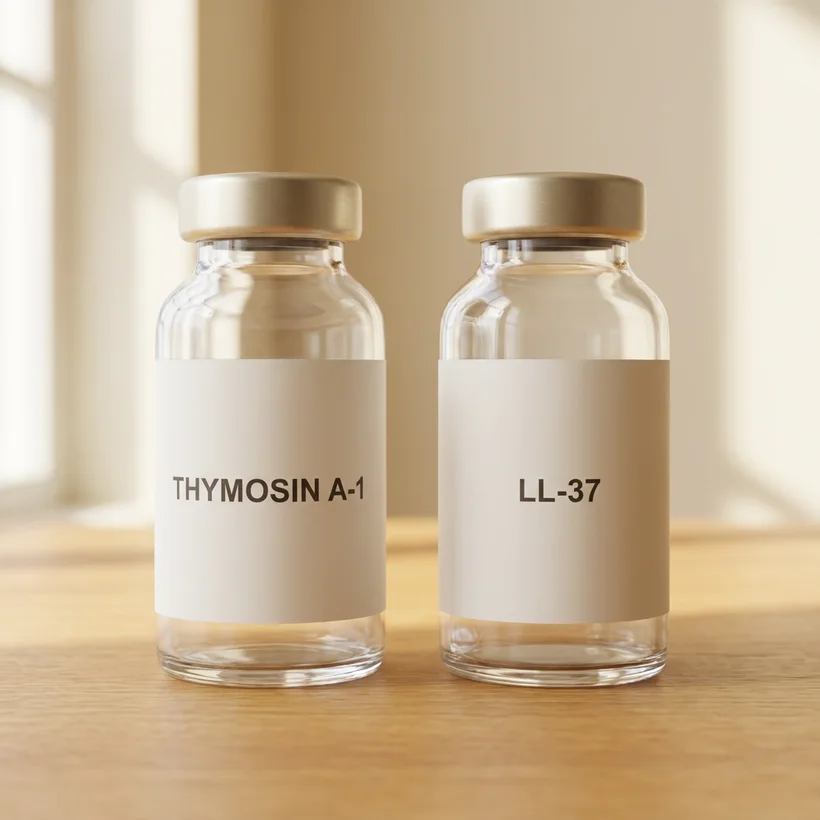
Thymosin alpha-1 (Ta1) is a 28-amino-acid peptide derived from prothymosin alpha, originally isolated from calf thymus tissue by Goldstein and colleagues in the 1970s. The synthetic version, thymalfasin (brand name Zadaxin, SciClone Pharmaceuticals), is approved in more than 35 countries for hepatitis B, hepatitis C (in combination with interferon), and as an adjuvant in cancer immunotherapy.
From the FormBlends catalog
Immune Defense
Immune modulation with antimicrobial support. · Bundle from $381 · provider-reviewed peptide bundle.
View Immune Defense →A randomized controlled trial by Wu and colleagues (JAMA Internal Medicine, 2013) in patients with severe sepsis found that thymosin alpha-1 reduced 28-day mortality compared to placebo in a Chinese multicenter study. Sample size was 361 patients. This is among the most clinically relevant human trials for an immune peptide and is frequently under-cited by wellness content.
A trial by Gravenstein and colleagues (Vaccine, 1989) in elderly nursing home residents showed that thymosin alpha-1 at 900 mcg subcutaneously twice weekly enhanced antibody response to influenza vaccine compared to vaccine alone. Effect sizes were modest but statistically significant.
Standard dosing in clinical protocols: 1.6 mg subcutaneously twice weekly for chronic viral hepatitis. Adjuvant protocols for cancer or vaccine enhancement vary and are institution-specific.
LL-37: The Human Antimicrobial Peptide
LL-37 is the C-terminal fragment of the human cathelicidin precursor hCAP18. It is 37 amino acids long and carries a net positive charge that drives electrostatic interaction with negatively charged bacterial membranes. It is produced by neutrophils, mast cells, monocytes, and epithelial cells of the skin, lung, and gut.
Its antimicrobial mechanism involves membrane disruption via a carpet or toroidal-pore model, depending on lipid composition of the target membrane. In addition to direct killing, LL-37 signals through formyl peptide receptor-like 1 (FPRL1) and toll-like receptors to modulate innate immune responses, recruit neutrophils, and induce cytokine release.
Deficiency of LL-37 is associated with increased susceptibility to skin infections in patients with morbus Kostmann (severe congenital neutropenia) and is implicated in the pathogenesis of atopic dermatitis. Conversely, overexpression is seen in psoriasis, where it acts as a trigger for the autoimmune cascade via plasmacytoid dendritic cell activation.
This bidirectional biology is critical. LL-37 is not a "boost immunity" molecule. It is a context-dependent innate immune regulator. Exogenous administration as a research compound is not standard clinical practice, and its potential to worsen inflammatory skin and joint conditions is real.
BPC-157: Anti-Inflammatory Claims vs. the Data
BPC-157 (Body Protection Compound-157) is a synthetic 15-amino-acid peptide derived from a sequence found in human gastric juice protein BPC. It does not have a confirmed endogenous receptor in the way thymosin alpha-1 or LL-37 do. Its most replicated effects in rodent models involve accelerated wound healing, gastric mucosal protection, and attenuation of NSAID-induced gut damage.
Anti-inflammatory effects observed in animals include reduction of TNF-alpha and IL-6 in some injury models, and modulation of nitric oxide signaling pathways. Some researchers have proposed interactions with the dopaminergic and serotonergic systems, though the relevance to immune function is indirect.
As of mid-2026, no published peer-reviewed human RCT exists for BPC-157 on immune endpoints. A small number of human case reports and uncontrolled observations exist for gut symptoms. Calling BPC-157 an immune peptide based on current evidence requires an explicit acknowledgment that the data is preclinical only.
The FDA placed BPC-157 on its list of substances that may not be used in compounded preparations in 2022, citing insufficient clinical evidence of safety. This regulatory status affects legal availability in the US.
Other Peptides That Appear on Immune Lists
Thymosin beta-4 (TB-500 is the research analog): Involved in actin sequestration and cell migration. Animal data supports anti-inflammatory effects in cardiac and wound healing contexts. No human RCTs for immune function. Sometimes conflated with thymosin alpha-1 by wellness content; they are structurally and functionally distinct.
KPV (Lys-Pro-Val): A tripeptide fragment of alpha-melanocyte-stimulating hormone. Rodent colitis models show anti-inflammatory effects via MC1R receptor modulation. One small human pilot exists for oral delivery in IBD. Evidence for systemic immune enhancement is very low.
Selank and Semax: Russian-developed neuropeptides with some clinical use in Russia for anxiety and cognitive function. Semax has been described as modulating BDNF and some immune gene expression in small Russian trials. Data is not replicated in Western peer-reviewed literature at scale. Treat as low-evidence.
Epithalon (Epitalon): A synthetic tetrapeptide said to activate telomerase and modulate pineal function. Claims of immune enhancement in aging are based primarily on Russian studies with limited methodological transparency. Evidence quality is very low by Western standards.
Mechanism With Numbers: How These Peptides Act
Thymosin alpha-1 binds Toll-like receptor 9 (TLR9) on dendritic cells and macrophages according to work from the Romani group published in the Journal of Clinical Investigation. This triggers downstream NF-kB activation, increasing production of IL-12 and IFN-gamma, which shifts the immune response toward Th1 (cellular) immunity. In hepatitis B trials, CD4+ T-cell counts increased in treated patients relative to controls, with measurable changes in CD4/CD8 ratios reported across multiple studies. The honest caveat: TLR9 binding does not guarantee clinical outcomes; receptor expression varies by disease state and baseline immune status.
LL-37 at physiological concentrations of roughly 1 to 5 micrograms per milliliter disrupts gram-negative and gram-positive bacterial membranes. At lower, sub-antimicrobial concentrations, it acts as a signaling molecule. It neutralizes LPS (lipopolysaccharide) by binding it directly, preventing TLR4 activation and subsequent septic inflammatory cascade. This LPS-neutralizing property has generated research interest for sepsis prevention, though no drug has reached approval based on this mechanism.
BPC-157 in rodent models appears to upregulate expression of growth hormone receptor in tendon and gut tissue and to modulate nitric oxide release. The mechanistic link to immune modulation runs through reduced local inflammation rather than direct immunological signaling. Numbers from animal studies cannot be translated to human doses reliably without pharmacokinetic human data that does not currently exist.
What Most Pages Get Wrong About Immune Peptides
Bioavailability after oral administration. Most immune-relevant peptides are degraded in the gastrointestinal tract before reaching systemic circulation. Thymosin alpha-1 is used subcutaneously in all approved protocols for exactly this reason. Claims that oral BPC-157 capsules or oral thymosin reach the immune system at meaningful concentrations are not supported by published pharmacokinetic data. BPC-157 researchers argue that local gut effects do not require systemic absorption, which is a reasonable hypothesis for gut-specific outcomes, but it does not support systemic immune claims.
Endotoxin contamination as a confound. Research-grade peptides are synthesized via solid-phase peptide synthesis and are prone to lipopolysaccharide (endotoxin) contamination if manufacturing quality control is poor. Injecting endotoxin-contaminated peptide produces immune activation that mimics a peptide effect. This is a real confounder in poorly designed animal studies and a genuine danger in human use. Injectable peptides must be tested for endotoxin, and COAs should show levels well below 1 EU/mg.
"Immune boosting" as a category error. The immune system is a regulated network, not a dial that benefits from turning up. Indiscriminate stimulation worsens autoimmune conditions, can exacerbate inflammatory diseases, and in cancer contexts, may accelerate tumor-associated inflammation depending on the immune context. The correct framing is immune normalization or modulation in deficient states, not enhancement across all populations.
Stability after reconstitution. Lyophilized peptides, once reconstituted in bacteriostatic water, have limited stability. Most peptide manufacturers recommend storage at 2 to 8 degrees Celsius after reconstitution and use within 4 weeks. At room temperature, peptide bond hydrolysis and oxidation of methionine or cysteine residues (where present) accelerate degradation. A degraded peptide does not simply lose potency; oxidized methionine residues can create novel molecular species with unpredictable receptor interactions. Thymosin alpha-1 contains no methionine, which contributes to its relative stability compared to methionine-containing peptides.
Honest Head-to-Head: Peptides vs. Real Alternatives
| Intervention | Best Evidence | Immune Outcome | Approval Status | Where Peptide Wins | Where Peptide Loses |
|---|---|---|---|---|---|
| Thymosin alpha-1 | Human RCTs in specific immunodeficiency states | Increased T-cell counts, improved vaccine response, reduced sepsis mortality in one large trial | Approved in 35+ countries; not FDA-approved for US general use | Targeted immune reconstitution with modest side-effect profile | Not superior to standard-of-care antivirals or antibiotics; US availability limited; cost high |
| Recombinant IL-2 (Proleukin) | Multiple human RCTs; FDA-approved for melanoma/renal cell | Strong T-cell expansion | FDA-approved for cancer indications | More potent immune expansion in oncology | Severe toxicity (capillary leak syndrome); requires inpatient monitoring |
| Adjuvanted vaccines (e.g., AS04) | Large Phase 3 RCTs | Enhanced specific immune response to antigen | FDA-approved | Gold standard for antigen-specific immunity | Antigen-specific only; not for general immune deficiency |
| BPC-157 | Rodent models only | Anti-inflammatory in gut injury models | Not approved; FDA restricted for compounding | Potentially useful for gut mucosal healing (separate from immune claim) | No human immune data; regulatory concerns; not a legitimate immune intervention at this evidence level |
| Intravenous immunoglobulin (IVIG) | Established clinical evidence | Passive immune support in antibody deficiency | FDA-approved | Immediate passive immune coverage for primary immunodeficiency | Expensive; infusion required; risk of transfusion reactions |
Label Literacy and COA Reading Guide
What a credible peptide COA must contain:
| COA Field | What to Look For | Why It Matters |
|---|---|---|
| HPLC Purity | Greater than 98% area under the curve | Lower purity means unknown impurities with unknown biological effects |
| Molecular Weight (Mass Spec) | Must match the theoretical MW of the peptide exactly (within instrument error of a fraction of a dalton) | Confirms identity, not just purity. A wrong MW means wrong compound |
| Endotoxin Level | Below 1 EU/mg for subcutaneous use; ideally below 0.1 EU/mg | Endotoxin at higher levels causes immune activation that mimics peptide effects and causes real harm |
| Peptide Content (by weight) | Typically 80 to 95% of total mass; the rest is water and counter-ions from synthesis | A vial labeled "5 mg" may contain only 4 mg of actual peptide if content is not specified |
| Issuing Laboratory | Named third-party lab with contactable identity | In-house COAs from the same supplier have no independent verification value |
| Batch Number | Must match the product label | Mismatched batch numbers mean the COA was not generated for the product you received |
Reconstitution math for thymosin alpha-1 (example): A standard lyophilized vial contains 1.6 mg. Adding 1.0 mL of bacteriostatic water produces a concentration of 1.6 mg/mL, and a single dose is the full 1 mL. If you add 2.0 mL, concentration is 0.8 mg/mL and you draw 2 mL per dose. Always calculate from actual vial content, not assumed content.
Signs of peptide degradation: A reconstituted solution that has turned cloudy, developed particulate matter, or has a yellow or brown tinge should be discarded. Clear solutions do not guarantee integrity; chemical degradation can occur without visible change, which is why temperature control and use-by timelines matter independent of appearance.
Frequently Asked Questions
What are the best peptides for immune system support?
The best peptides for immune system support, ranked by strength of human evidence, are thymosin alpha-1, followed by the endogenous antimicrobial peptide LL-37 (characterized mechanistically), and BPC-157 (animal and mechanistic data only). Most others on popular lists have no human clinical evidence. Purity and context of use matter as much as compound choice.
Does thymosin alpha-1 actually work in humans?
Thymosin alpha-1 (Zadaxin) is approved in some countries for hepatitis B, hepatitis C, and as an adjuvant in cancer immunotherapy. Multiple human trials show it increases T-cell counts and enhances vaccine response in immunocompromised populations. Evidence is moderate to high for specific immune-deficiency contexts.
Is BPC-157 an immune peptide?
BPC-157 is primarily studied for gut mucosal healing and angiogenesis. Its anti-inflammatory effects in rodent models involve modulation of inflammatory cytokines, but there are no published human RCTs for immune outcomes. Calling it an immune peptide based on current evidence overstates the data.
What is LL-37 and why does it matter for immunity?
LL-37 is the only human cathelicidin antimicrobial peptide. It is produced by epithelial cells and neutrophils and directly disrupts bacterial membranes. It also signals through receptors including FPRL1 to modulate innate immune responses. It is endogenous, not a research compound taken exogenously in most contexts.
Can peptides replace vaccines or antibiotics for immune support?
No. No peptide in this category has evidence supporting replacement of vaccines or antibiotics. Thymosin alpha-1 is used as an adjuvant alongside vaccines in some trials, not as a replacement. Any claim otherwise is not supported by current evidence.
What is the difference between immunostimulatory and immunomodulatory peptides?
Immunostimulatory peptides increase immune activity broadly, which can worsen autoimmune conditions. Immunomodulatory peptides normalize dysregulated immune responses in both directions. Thymosin alpha-1 is generally described as immunomodulatory. This distinction matters clinically for anyone with an autoimmune diagnosis.
How is thymosin alpha-1 dosed?
Clinical trials and approved protocols typically use 1.6 mg subcutaneously twice weekly. Some adjuvant protocols use it daily for shorter durations. These doses come from formal clinical programs. Compounded versions vary, and purity verification via COA is essential before any use.
Are peptides for immune support safe?
Thymosin alpha-1 has a well-characterized safety profile from human trials, with injection-site reactions being the most common adverse event. BPC-157 lacks human safety data. LL-37 in exogenous form is not in standard clinical use. The safety of compounded or research-grade peptides depends heavily on source purity.
What does "research compound" mean for immune peptides?
Most immune peptides sold in the US outside of approved indications are classified as research compounds, meaning they are not FDA-approved for human use in that context. This affects quality control, legal status, and liability. Buyers should verify third-party COAs for identity, purity, and endotoxin levels.
Do peptides help with long COVID or post-viral immune dysfunction?
There is early clinical interest in thymosin alpha-1 for post-viral immune reconstitution based on its mechanism and hepatitis data. No completed RCTs specifically in long COVID have been published as of mid-2026. Any such claim is speculative extrapolation from mechanism and older viral-illness data.
How do I read a peptide COA to assess quality?
A credible COA should show: HPLC purity above 98%, correct molecular weight confirmed by mass spectrometry, endotoxin level below 1 EU/mg (or lower for injectable use), and identity confirmation. The issuing lab should be named and independently contactable. Batch numbers should match the product label.
Sources
- Wu J, Zhou L, Liu J, et al. The efficacy of thymosin alpha 1 for severe sepsis (ETASS): a multicenter, single-blind, randomized and controlled trial. Critical Care. 2013;17(1):R8.
- Gravenstein S, Duthie EH, Miller BA, et al. Augmentation of influenza antibody response in elderly men by thymosin alpha one. A double-blind placebo-controlled clinical study. J Am Geriatr Soc. 1989;37(1):1-8.
- Romani L, Bistoni F, Perruccio K, et al. Thymosin alpha1 activates dendritic cell tryptophan catabolism and establishes a regulatory environment for balance of inflammation and tolerance. Blood. 2006;108(7):2265-2274. (Romani group TLR9 work cited for mechanism; verify specific paper for TLR9 binding details.)
- Zanetti M. The role of cathelicidins in the innate host defenses of mammals. Current Issues in Molecular Biology. 2005;7(2):179-196.
- Mookherjee N, Anderson MA, Haagsman HP, Davidson DJ. Antimicrobial host defence peptides: functions and clinical potential. Nature Reviews Drug Discovery. 2020;19(5):311-332.
- Sikiric P, Seiwerth S, Rucman R, et al. Stable gastric pentadecapeptide BPC 157: novel therapy in gastrointestinal tract. Current Pharmaceutical Design. 2011;17(16):1612-1632.
- US FDA. 503A Bulks List; Proposed Rule on BPC-157 and related compounds. Federal Register 2022 updates. (Consult FDA.gov for current regulatory status.)
- Goldstein AL, Low TL, McAdoo M, et al. Thymosin alpha1: isolation and sequence analysis of an immunologically active thymic polypeptide. Proc Natl Acad Sci USA. 1977;74(2):725-729.
- Garlapati S. Mechanisms of immune modulation by thymosin alpha 1. Ann N Y Acad Sci. 2012;1270:1-7.
- Davidson DJ, Currie AJ, Reid GS, et al. The cationic antimicrobial peptide LL-37 modulates dendritic cell differentiation and toll-like receptor-induced function. J Immunol. 2004;172(2):1146-1156.
- Zanetti M, Gennaro R, Romeo D. Cathelicidins: a novel protein family with a common proregion and a variable C-terminal antimicrobial domain. FEBS Lett. 1995;374(1):1-5.
Related peptide guides
See your options in about 2 minutes
Take the free quiz and see what fits you. Quick, private, and no commitment to continue.
See my options →