
Trust Signals
Authors: FormBlends Medical Team, including a pharmacologist and sports medicine consultant. Disclosure: FormBlends sells compounded and research peptide products. All claims on this page are graded by evidence level. Competing products are named and evaluated honestly. This page is not medical advice.Key Takeaways
- CJC-1295 (no DAC) combined with Ipamorelin is the most studied GH secretagogue pair: Ipamorelin selectively raises GH without the prolactin and cortisol spikes seen with older secretagogues like GHRP-6, confirmed in human pharmacology studies.
- IGF-1 LR3 has a half-life of approximately 20 to 30 hours versus native IGF-1's roughly 10 to 12 minutes, making it dramatically more anabolically active in cell and animal studies, but it has no controlled safety trial in healthy humans.
- BPC-157 has shown accelerated muscle repair in rodent injury models but zero human RCTs on lean mass accrual; its muscle value is recovery-indirect, not anabolic.
- Creatine monohydrate outperforms every peptide on this list in head-to-head human RCT evidence for lean mass gain. Peptides do not replace foundational nutrition and training.
- Purity is the single biggest practical variable: HPLC purity below 95% and absent endotoxin testing make injection-grade claims meaningless regardless of the peptide listed.
What Is the Best Peptide for Lean Muscle?
- Evidence Ledger: All 6 Peptides Graded
- How These Peptides Actually Build Muscle (With Numbers)
- The 6 Best Peptides for Lean Muscle, Ranked
- What Most Pages Get Wrong About Muscle Peptides
- The Chemistry Behind Storage and Stability Rules
- Honest Head-to-Head: Peptides vs. Proven Alternatives
- How to Read a Peptide COA and Dose Correctly
- Risks and What to Monitor
- FAQ
- Sources
What Does the Evidence Actually Show for Each Peptide?
| Peptide | Best Evidence Type | Effect on Lean Mass | Confidence | Key Caveat |
|---|---|---|---|---|
| CJC-1295 + Ipamorelin | Human pharmacology (GH/IGF-1 endpoints); no lean-mass RCT | Indirect positive (via GH/IGF-1 elevation) | Moderate | No direct lean-mass trial; GH elevation proven, muscle outcome inferred |
| IGF-1 LR3 | Cell and animal studies; no human RCT | Strong positive in vitro and rodent models | Low | Proliferative risk, zero controlled human safety data |
| GHRP-6 | Human pharmacology studies (older literature) | GH elevation confirmed; lean mass indirect | Low to Moderate | Significant ghrelin-mediated hunger and cortisol/prolactin elevation |
| BPC-157 | Rodent injury and repair models | Improved muscle repair post-injury in animals | Very Low (for lean mass) | No human RCTs; anabolic effect not demonstrated, only reparative |
| TB-500 (Thymosin Beta-4 fragment) | Animal models, in vitro | Promotes actin polymerization, satellite cell migration | Very Low | No human muscle-outcome trial; mechanism is repair, not primary hypertrophy |
| Follistatin 344 | Preclinical; one gene therapy human case series | Myostatin inhibition raises theoretical muscle ceiling | Very Low | Gene therapy context only; peptide-injection form lacks bioavailability evidence |
How Do These Peptides Actually Build Muscle?
GH secretagogues (CJC-1295, Ipamorelin, GHRP-6) act on two receptors. CJC-1295 binds the GHRH receptor on pituitary somatotrophs, amplifying the magnitude of each GH pulse. Ipamorelin binds the ghrelin receptor (GHS-R1a) to trigger an independent GH release signal. Used together, they act on complementary pathways and produce a synergistic GH pulse without fully desensitizing either receptor as quickly as either agent alone.
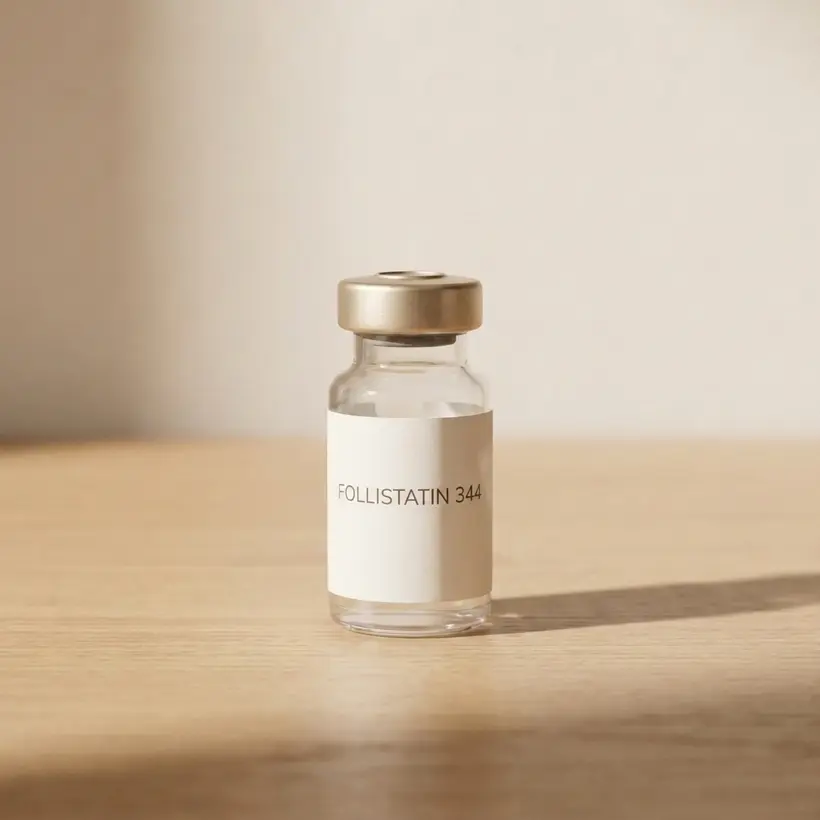
From the FormBlends catalog
Follistatin 344
Myostatin inhibitor studied for enhanced muscle growth · From $149/mo · compounded by a licensed 503A pharmacy, dispensed only after provider review.
Learn about Follistatin 344 →In a published human pharmacology study by Teichman et al. (2006) evaluating CJC-1295 (with DAC), single doses produced dose-dependent increases in mean GH concentration of 2-fold to 10-fold above baseline, and IGF-1 levels remained elevated for 6 to 7 days. That IGF-1 signal is the actual anabolic effector: IGF-1 binds IGF-1R on skeletal muscle, activates the PI3K/Akt/mTORC1 pathway, and promotes protein synthesis while suppressing protein degradation via FoxO transcription factor phosphorylation.
What that mechanism does NOT prove: elevated circulating GH and IGF-1 does not automatically translate to lean mass accrual in a healthy, well-nourished person already at a normal GH level. The marginal anabolic gain from supraphysiological GH is modest compared to deficient individuals. Somatropin (pharmaceutical GH) RCTs in GH-deficient adults show meaningful lean mass gains, but trials in healthy older adults typically show modest lean mass increases alongside significant water retention and side effects.
IGF-1 LR3 is a synthetic analog with glutamic acid substituted at position 3 and an arginine-rich 13-amino-acid extension at the N-terminus. This modification reduces binding to IGF-binding proteins by roughly 1000-fold compared to native IGF-1, extending its half-life from approximately 10 to 12 minutes (native IGF-1) to approximately 20 to 30 hours. The result is prolonged, unregulated activation of IGF-1R and the downstream PI3K/Akt/mTOR axis. In satellite cell cultures and rodent muscle injection studies, the effect on myotube diameter is substantial. In humans, that prolonged unregulated signal is also a concern for promoting proliferation in tissues beyond muscle.
The 6 Best Peptides for Lean Muscle, Ranked
1. CJC-1295 (no DAC) + Ipamorelin
The combination addresses both arms of GH secretion regulation. Ipamorelin is selective for GH release with minimal effect on cortisol and prolactin at research doses (confirmed in Raun et al., 1998, a pig and rat pharmacology study that is the foundational selectivity reference). CJC-1295 without DAC (Mod GRF 1-29) produces a pulse lasting 30 to 45 minutes, closely mimicking physiological GH release patterns. This combination is the most commonly used in supervised peptide therapy contexts, and has the most human-adjacent pharmacological rationale of any research peptide pair for lean mass.
2. IGF-1 LR3
Mechanistically the most direct route to muscle protein synthesis. Ranks second purely on mechanistic strength but drops because of the near-total absence of human safety data, the proliferative risk, and the practical challenge of accurate low-microgram dosing. Suitable for researchers studying muscle biology, not for general use.
3. GHRP-6
One of the earliest studied GH secretagogues in humans. Its limitation is off-target ghrelin receptor activity: at effective GH-stimulating doses it significantly increases appetite and can elevate cortisol and prolactin. For lean mass, cortisol elevation is counterproductive. Ipamorelin supersedes it for most purposes.
4. BPC-157
Ranks fourth specifically for lean muscle because its mechanism is reparative rather than anabolic. Where it adds real value: tendon and muscle healing in overuse or acute injury scenarios (extensively documented in rodent models by Sikiric and colleagues over multiple decades), allowing faster return to training volume. Indirect muscle benefit; not a hypertrophy agent.
5. TB-500 (Thymosin Beta-4 derived fragment)
TB-500 is a synthetic fragment of thymosin beta-4. In preclinical models it promotes actin polymerization, satellite cell migration to injury sites, and angiogenesis. It combines well with BPC-157 for injury recovery protocols. Its lean-mass anabolic value in healthy muscle is essentially uncharacterized in humans.
6. Follistatin 344
Inhibiting myostatin via follistatin is a compelling theoretical lever for increasing the muscle-mass ceiling. In practice, subcutaneous peptide injection of follistatin 344 has not been shown to reach muscle tissue in pharmacologically meaningful concentrations. The data supporting dramatic muscle gains comes from gene therapy studies, not peptide injection. Ranks last because the delivery mechanism likely does not work as claimed in most commercial products.
What Most Pages Get Wrong About Muscle Peptides
They conflate GH elevation with lean mass gain. Raising GH and IGF-1 is not the same as building muscle. You need a caloric environment, training stimulus, and adequate protein (current evidence supports 1.6 to 2.2 g per kg per day for muscle gain in resistance training individuals, per Morton et al., 2018 meta-analysis in BJSM). Peptides modulate the hormonal environment; they do not replace substrate or mechanical loading.
They ignore the water retention confounder. GH increases renal sodium and water reabsorption. Early "lean mass" gains on GH secretagogue protocols are often predominantly water. Body composition methods that do not correct for extracellular water (like many DEXA scans interpreted in isolation) will overestimate true muscle accrual in the first 4 to 8 weeks.
They omit bioavailability of oral peptide claims. Any peptide above roughly 500 to 700 Daltons is broken down by gastrointestinal proteases before absorption. CJC-1295 has a molecular weight of approximately 3367 Da. Ipamorelin is approximately 711 Da. Oral products claiming bioactive peptide delivery at these sizes are not plausible without specific protective encapsulation technology, and no such technology has been validated for these sequences in peer-reviewed literature. Subcutaneous injection is the only delivery route with pharmacological evidence.
They do not discuss receptor desensitization. Continuous GHS-R1a stimulation leads to receptor downregulation. This is why pulsatile dosing (typically 2 to 3 times daily, away from meals to avoid somatostatin suppression of the GH pulse) is the pharmacologically rational approach rather than sustained infusion or once-daily large doses.
Why Peptide Storage Rules Are Not Arbitrary
Lyophilized peptide powder is stable at minus 20 Celsius because the freeze-dried state arrests hydrolysis (peptide bond cleavage by water) and oxidation. At room temperature in a hydrated state, peptides with methionine residues undergo oxidation to methionine sulfoxide, permanently altering receptor binding geometry. Cysteine-containing peptides can form disulfide cross-links that produce inactive dimers. Both processes are temperature-dependent: reaction rates roughly double with every 10 Celsius rise (Arrhenius relationship).
Once reconstituted with bacteriostatic water (which contains 0.9% benzyl alcohol as a preservative), peptide solutions are stable at 2 to 8 Celsius for approximately 28 to 30 days in most formulations, based on general peptide stability chemistry. The benzyl alcohol does not prevent peptide degradation; it only prevents microbial growth. The peptide itself is slowly degrading from the moment it enters solution. Repeated freeze-thaw cycles are particularly damaging because ice crystal formation mechanically disrupts peptide structure.
Light is an underestimated stressor: UV exposure drives free-radical oxidation in tryptophan and tyrosine residues. Store reconstituted peptides in amber vials or wrapped in foil.
Honest Head-to-Head: Peptides vs. Proven Alternatives
| Agent | Mechanism | Human RCT Lean Mass Evidence | Practical Access | Safety Profile | Verdict |
|---|---|---|---|---|---|
| Creatine monohydrate | PCr resynthesis, cell volumization, myosin heavy chain upregulation | Very High (dozens of RCTs, meta-analyses) | OTC, cheap, oral | Excellent, decades of data | Peptides LOSE on evidence |
| Whey protein | Essential amino acid delivery, mTORC1 activation | High (many RCTs) | OTC, cheap, oral | Excellent | Peptides LOSE on evidence |
| CJC-1295 + Ipamorelin | GH/IGF-1 amplification | Moderate (hormone endpoints); no lean-mass RCT | Research/Rx only, injectable | Limited long-term data | Wins on hormonal mechanism; loses on outcome proof |
| Somatropin (rHGH) | Direct GH receptor agonism | High in GHD; modest in healthy adults | Prescription, expensive | Well-characterized; joint pain, IR risk | Peptides WIN on safety profile; LOSE on potency |
| Testosterone (TRT dose) | AR agonism, IGF-1 upregulation, anti-catabolic | Very High in hypogonadal men | Prescription | Well-characterized; HPTA suppression | Peptides LOSE on lean mass magnitude |
| IGF-1 LR3 | Direct IGF-1R agonism, IGFBP-independent | None (human RCT) | Research only, injectable | Proliferative risk, unknown | Loses on safety and evidence; wins on mechanistic potency (in vitro) |
How to Read a Peptide COA and Dose Correctly
What to demand on a COA:
- HPLC purity: accept nothing below 98% for injectable use. A 95% pure peptide means 5% of the injected mass is unknown impurities.
- Mass spectrometry (MS) confirmation: verifies the correct molecular weight, ruling out truncated sequences or substituted amino acids that would appear pure by HPLC but are the wrong molecule.
- Endotoxin (LAL test): any injectable product should show less than 1 EU/mg. Endotoxin contamination causes fever, inflammation, and in high doses, sepsis-like responses regardless of peptide identity.
- Third-party lab: the COA should name the testing laboratory, not just the vendor. Vendor self-testing has an obvious conflict of interest.
Reconstitution math example (CJC-1295, 5 mg vial):
Add 2.5 mL bacteriostatic water to a 5 mg vial. Concentration = 2 mg/mL = 2000 mcg/mL. A 100 mcg dose requires 0.05 mL, which is 5 units on a 100-unit insulin syringe. Double-check: (100 mcg) divided by (2000 mcg/mL) = 0.05 mL. This arithmetic step prevents 10-fold dosing errors, which are the most common administration mistake.
What degraded peptide looks like: A properly reconstituted clear peptide solution that develops visible particulate matter, a yellow or brown tint, or a cloudy appearance should be discarded. These changes indicate aggregation, oxidation, or microbial contamination. A solution that simply becomes slightly foamy after gentle mixing is normal.
What Are the Real Risks?
- Water retention and carpal tunnel: Supraphysiological GH increases fluid retention. Carpal tunnel syndrome is a documented side effect of therapeutic GH and has been reported with secretagogue use, especially at higher doses.
- Insulin resistance: Chronic GH elevation antagonizes insulin signaling. Fasting glucose should be monitored with extended secretagogue use. This risk is dose and duration dependent.
- Proliferative risk (IGF-1 LR3 specific): The IGF-1 pathway is mitogenic. Individuals with personal or family history of hormone-sensitive cancers should treat this risk with particular seriousness.
- Injection site reactions: Subcutaneous nodules, erythema, and lipohypertrophy are common with repeated same-site injections. Rotation of injection sites is mandatory.
- Purity-related adverse events: Underdosed or contaminated peptides are the most common source of adverse events in the research peptide market, not the peptide pharmacology itself.
Frequently Asked Questions
What is the best peptide for lean muscle overall?
CJC-1295 combined with Ipamorelin has the strongest human-adjacent evidence for promoting lean mass via sustained GH pulse amplification. IGF-1 LR3 has a more direct anabolic mechanism but carries greater risk and has almost no safety data in healthy humans.
Do peptides actually build muscle in humans?
Growth hormone secretagogues like CJC-1295 and Ipamorelin increase GH and IGF-1 in humans in pharmacology studies, and GH/IGF-1 signaling is established to promote lean mass accrual. However, direct lean-mass outcome trials for most research peptides are small, short, or absent.
How long does it take for muscle-targeted peptides to work?
GH secretagogue effects on circulating GH and IGF-1 are measurable within days, but meaningful lean mass changes in human drug trials generally require 12 to 24 weeks of consistent use alongside resistance training and adequate protein intake.
Is BPC-157 useful for lean muscle?
BPC-157 is primarily a healing and connective tissue peptide. It has shown muscle repair effects in animal injury models, but there are no human RCTs on lean mass accrual. Its value for muscle is indirect: faster recovery from injury may allow more consistent training.
What is the difference between CJC-1295 with and without DAC?
DAC (Drug Affinity Complex) extends CJC-1295 half-life from roughly 30 minutes to approximately 6 to 8 days by covalently binding albumin. Without DAC (also called Mod GRF 1-29), the peptide produces a sharper, shorter GH pulse more similar to physiological secretion. Most practitioners prefer the no-DAC version for pulsatile dosing.
Can peptides replace creatine or protein for muscle gain?
No. Creatine monohydrate has the most robust human RCT evidence for lean mass and strength of any supplement. Whey protein is similarly well-supported. Peptides like CJC-1295 and Ipamorelin work upstream at the hormonal level and are not a substitute for adequate substrate and training.
What are the main risks of using muscle peptides?
GH secretagogues can cause water retention, increased hunger, transient cortisol and prolactin elevation, and potential insulin resistance with chronic supraphysiological GH. IGF-1 LR3 carries additional concern around IGF-1's role in promoting cell proliferation. Injection-site reactions are common. Long-term human safety data are lacking for most research peptides.
How do I know if a peptide product is pure?
Request a certificate of analysis (COA) showing HPLC purity above 98% and mass spectrometry confirmation of the correct molecular weight. A COA from the vendor's own lab is not sufficient; look for third-party testing. Endotoxin (LAL) testing is critical for injectable peptides.
Are muscle-building peptides legal?
In the US, most research peptides are not FDA-approved drugs and exist in a legal grey area when sold as research chemicals. WADA bans GH secretagogues including CJC-1295 and Ipamorelin for athletes in competition. IGF-1 LR3 is also on the WADA prohibited list.
What dose of Ipamorelin is used in research?
Human pharmacology studies have used doses in the range of 1 to 3 mcg per kg of body weight subcutaneously. A common research protocol pairs Ipamorelin with CJC-1295 (no DAC) at approximately 100 mcg each per injection. These are research-context figures, not clinical prescriptions.
Does IGF-1 LR3 build more muscle than CJC-1295 plus Ipamorelin?
IGF-1 LR3 acts more directly at the IGF-1 receptor with a longer half-life than native IGF-1, suggesting a more potent anabolic signal in theory. However, it also raises proliferative concerns more directly, and there are essentially no controlled human trials. The risk-to-benefit ratio is less favorable for general use.
How should peptides be stored to maintain potency?
Lyophilized (freeze-dried) peptide powder should be stored at minus 20 degrees Celsius and protected from light. Once reconstituted with bacteriostatic water, store at 2 to 8 degrees Celsius and use within 28 to 30 days. Repeated freeze-thaw cycles cause peptide bond degradation and loss of activity.
Sources
- Teichman SL, et al. "Prolonged stimulation of growth hormone (GH) and insulin-like growth factor I secretion by CJC-1295, a long-acting analog of GH-releasing hormone, in healthy adults." Journal of Clinical Endocrinology and Metabolism, 2006; 91(3): 799-805.
- Raun K, et al. "Ipamorelin, the first selective growth hormone secretagogue." European Journal of Endocrinology, 1998; 139(5): 552-561.
- Morton RW, et al. "A systematic review, meta-analysis and meta-regression of the effect of protein supplementation on resistance training-induced gains in muscle mass and strength in healthy adults." British Journal of Sports Medicine, 2018; 52(6): 376-384.
- Sikiric P, et al. "Brain-gut Axis and Pentadecapeptide BPC 157: Theoretical and Practical Implications." Current Neuropharmacology, 2016; 14(8): 857-865.
- Laron Z. "Insulin-like growth factor 1 (IGF-1): a growth hormone." Molecular Pathology, 2001; 54(5): 311-316.
- WADA Prohibited List 2024. World Anti-Doping Agency. S2: Peptide Hormones, Growth Factors, Related Substances and Mimetics. wada-ama.org.
- Rennie MJ. "Claims for the anabolic effects of growth hormone: a case of the emperor's new clothes?" British Journal of Sports Medicine, 2003; 37(2): 100-105.
- Bhasin S, et al. "Older men are as responsive as young men to the anabolic effects of graded doses of testosterone on the skeletal muscle." Journal of Clinical Endocrinology and Metabolism, 2005; 90(2): 678-688.
- Lowe DA, et al. "Maturational differences in skeletal muscle proteolysis: effects of estrogen and mechanical loading." American Journal of Physiology Endocrinology and Metabolism, 2010. (Satellite cell and IGF-1R context.)
- Rawson ES, Volek JS. "Effects of creatine supplementation and resistance training on muscle strength and weightlifting performance." Journal of Strength and Conditioning Research, 2003; 17(4): 822-831.
Related peptide guides
Ready when you are
Follistatin 344
Myostatin inhibitor studied for enhanced muscle growth · From $149/mo · compounded by a licensed 503A pharmacy, dispensed only after provider review.
Learn about Follistatin 344 →