Last month a patient named Derek in Scottsdale called his compounding pharmacy three days after his first CJC-1295 injection. He'd been prescribed the no-DAC version at 100 mcg before bed, stacked with ipamorelin. But a buddy at his gym had told him to just pin once a week "like I do." Derek had read his buddy's protocol, noticed the buddy was on the DAC version at 1 mg twice weekly, and nearly copied the schedule with his own vial. "I figured CJC is CJC," he told the pharmacist. It isn't. That mix-up would have meant skipping six out of seven daily pulses or, worse, injecting a wildly wrong dose.
These two forms of CJC-1295 share a name, share a receptor, and share almost nothing else in practice. CJC-1295 with DAC (Drug Affinity Complex) has a half-life of 6 to 8 days. CJC-1295 without DAC (often labeled Modified GRF 1-29) has a half-life of about 30 minutes. They produce fundamentally different growth hormone signaling patterns and require completely different dosing protocols.
CJC-1295 is not FDA-approved. It is a compounded research peptide dispensed by licensed pharmacies for individual patients under a valid prescription. Individual results vary.
What the DAC Actually Does (and Why It Matters)
Natural GHRH lasts about 7 minutes in circulation. Modified GRF 1-29 stretches that to roughly 30 minutes through a handful of amino acid substitutions, but it's still short-acting. The DAC modification, developed by ConjuChem and described in Teichman SL et al. (2006), attaches a maleimidopropionic acid group that latches onto albumin in your blood. Think of it like tying a small boat to an oil tanker: the peptide rides albumin's slow clearance rate, extending its active life from minutes to days.
The trade-off is simple. The DAC version is convenient (one or two injections per week) but produces a sustained, relatively flat signal at the GHRH receptor. The no-DAC version requires daily dosing but mimics the body's natural pulsatile release pattern. Neither is wrong. They're different tools.
The Comparison at a Glance
| Feature | DAC | No-DAC | |---|---|---| | Half-life | 6 to 8 days | ~30 minutes | | Typical dose per injection | 0.5 to 1 mg | 100 to 300 mcg | | Weekly total | 1 to 2 mg | 700 to 6,300 mcg | | Injection frequency | 1 to 2 times weekly | 1 to 3 times daily | | GH pattern | Sustained baseline elevation | Pulsatile | | IGF-1 pattern | Sustained elevation | Pulsatile elevation | | Convenience | High | Moderate | | Same-syringe with ipamorelin | No (separate schedule) | Yes | | Reported water retention | More | Less | | Longevity-focused preference | Less common | More common |
The IGF-1 Question Nobody Agrees On
Here's where the real debate lives. The DAC version lifts IGF-1 and keeps it elevated across the week. The no-DAC version spikes IGF-1 with each injection, then lets it taper before the next pulse.
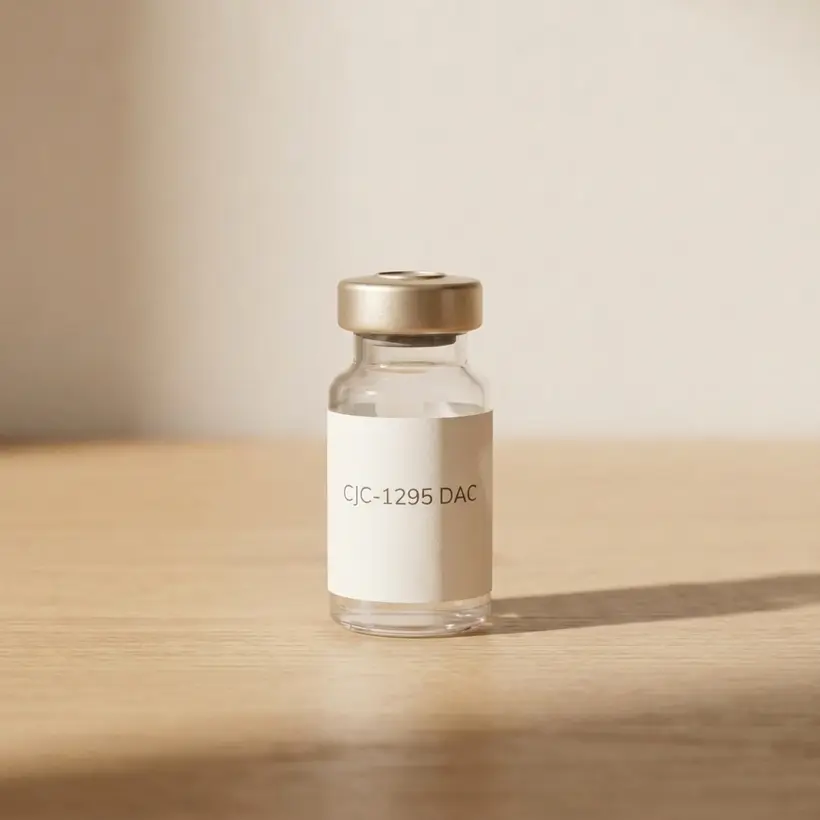
From the FormBlends catalog
CJC-1295 DAC
Long-acting GHRH analog with Drug Affinity Complex for sustained GH elevation · From $42/mo · compounded by a licensed 503A pharmacy, dispensed only after provider review.
Learn about CJC-1295 DAC →Total weekly IGF-1 exposure may end up comparable between the two. But the shape of that exposure differs, and some longevity-focused researchers care a lot about shape. Their reasoning:
- Pulsatile signaling more closely mirrors natural physiology.
- Sustained IGF-1 elevation has been associated in some research with less favorable aging markers.
- Prolonged receptor stimulation may increase the risk of receptor downregulation over time.
I'll be honest: this is still an open argument, not a settled fact. The clinical data on long-term IGF-1 patterning from compounded peptides in healthy adults is thin. But if you're the type of person who picks CJC-1295 specifically for anti-aging reasons, the pulsatile camp's logic is at least coherent, and it's the direction most longevity-oriented clinicians seem to lean.
Who Tends to Pick DAC
The DAC version makes sense for people who:
- Hate daily injections and won't stay compliant with them
- Are comfortable with a sustained signal pattern
- Want a simple schedule (pin Monday and Thursday, done)
- Are stacking with daily ipamorelin anyway (DAC provides the baseline, ipamorelin provides the pulse)
- Have long-duration training blocks and want steady recovery support across the week
Who Tends to Pick No-DAC
The no-DAC version makes sense for people who:
- Prioritize pulsatile, physiologically native signaling
- Don't mind daily subcutaneous injections (they get routine fast)
- Want to combine CJC and ipamorelin in the same syringe, same timing, one shot
- Are longevity-focused and want to avoid sustained IGF-1 elevation
- Want maximum dosing flexibility (titration up or down, post-workout timing, etc.)
For most patients starting their first compounded peptide protocol, the no-DAC + ipamorelin same-syringe stack is the most common entry point. It's simpler to learn, simpler to adjust, and simpler to stop if you don't like how it feels.
How They Stack Differently
DAC + Ipamorelin means two separate injection schedules. DAC goes in twice a week (say Monday and Thursday). Ipamorelin goes in daily, usually before bed. You're tracking two calendars.
No-DAC + Ipamorelin means one injection schedule. Same syringe, same timing, one stick per day. For someone who's never reconstituted a peptide before, this is meaningfully easier to manage.
The Mistakes That Keep Coming Up
This list exists because every one of these errors actually happens:
- Treating DAC and no-DAC as interchangeable. The dosing patterns differ by orders of magnitude.
- Using no-DAC at DAC-style doses. That's a massive overdose.
- Using DAC at no-DAC-style doses. That's a massive underdose.
- Splitting a DAC dose into daily microdoses. This defeats the entire pharmacokinetic model the DAC version was built on.
- Running no-DAC once a week. You lose the daily pulse pattern that is the whole point.
- Stacking both versions together. They hit the same receptor. It's redundant, not additive.
Side Effects, Cycling, and Cost
Both versions share a broadly clean tolerability profile, with no meaningful cortisol or prolactin elevation reported. The differences are minor. DAC users more commonly mention water retention and a mild sustained tingling. No-DAC users more commonly report vivid dreams at bedtime dosing and occasional transient flushing. Most people tolerate either version without issues.
Standard cycling for both: 8 to 12 weeks on, 4 weeks off. One nuance with DAC is that its long half-life means the signal keeps fading for roughly two weeks into your "off" window before fully clearing. Some clinicians build that tail into the timing.
On cost, pricing varies by pharmacy and quantity, but total weekly spend tends to land in a similar range. DAC costs a bit more per milligram but you inject less often. No-DAC costs a bit less per milligram but you inject daily. It's roughly a wash. The real variable is whether you value convenience or dosing control.
Switching Between Versions
If you're moving from DAC to no-DAC (or the other way), treat it as starting fresh. Finish your current dose interval. Begin the new version at a low starting dose. Titrate up. Don't overlap the two protocols. It's not complicated, but it does require a clean break rather than a mid-cycle swap.
FAQ
How do I know which version my pharmacy dispensed?
Read the label. "CJC-1295 with DAC" or "CJC-1295 DAC" is the long-acting version. "CJC-1295 no-DAC," "Modified GRF 1-29," or "MOD GRF 1-29" is the short-acting version. If you're not 100% sure, call the pharmacist before your first injection.
Can I use one version's dosing schedule with the other?
No. The dosing patterns differ by orders of magnitude. This is the single most dangerous confusion in the CJC-1295 space. A DAC-style dose of no-DAC would be a massive overdose. A no-DAC-style dose of DAC would be a massive underdose. Always confirm your version before you draw.
Which version is safer?
Neither is inherently safer. Side-effect profiles differ slightly, but both are well-tolerated when dosed correctly for the version you're actually holding.
Can I stack DAC and no-DAC together?
There's no documented rationale. Both act on the GHRH receptor. Combining them is redundant, not synergistic.
Which version produces faster results?
Subjective response timelines are broadly comparable. The difference in user reports between versions is usually smaller than the difference between two individuals on the same version. Genetics, sleep quality, training load, and baseline GH status all matter more than which form you picked.
Do I need bloodwork on both versions?
Yes. IGF-1 at baseline and at 4 to 6 weeks is standard practice regardless of which version you're using. The draw timing may matter more with no-DAC (trough vs. post-dose), so coordinate with your prescribing clinician.
Is one version better for recovery from training?
Anecdotally, DAC users report more consistent day-to-day recovery, while no-DAC users report sharper post-workout benefits when timed around training. Neither claim has strong clinical evidence behind it. Pick the version that fits your lifestyle and compliance pattern first.
Related Reading
---
Disclaimer: CJC-1295 is not FDA-approved. It is a compounded research peptide dispensed by licensed pharmacies for individual patients under a valid prescription. This article is for educational purposes and does not constitute medical advice. Individual results vary. Always consult a licensed prescribing clinician before starting any compounded peptide protocol.
Citation: Teichman SL, Neale A, Lawrence B, et al. Prolonged stimulation of growth hormone (GH) and insulin-like growth factor I secretion by CJC-1295, a long-acting analog of GH-releasing hormone, in healthy adults. J Clin Endocrinol Metab. 2006;91(3):799-805.
Ready when you are
CJC-1295 DAC
Long-acting GHRH analog with Drug Affinity Complex for sustained GH elevation · From $42/mo · compounded by a licensed 503A pharmacy, dispensed only after provider review.
Learn about CJC-1295 DAC →