
Trust Signals
Key Takeaways
- CJC-1295 with DAC has a reported plasma half-life of approximately 6 to 8 days in human subjects; the no-DAC version (Modified GRF 1-29) clears in roughly 30 minutes.
- The DAC modification is a maleimide-based linker that forms a reversible covalent bond with Cys-34 on serum albumin, the same binding site exploited by fatty acid-conjugated insulin analogues.
- DAC produces sustained IGF-1 elevation at the cost of blunted GH pulsatility; no-DAC versions preserve the pulsatile pattern but require daily injection and precise timing.
- No published head-to-head RCT compares the two formulations directly in healthy adults for body composition or performance outcomes. All comparative claims are pharmacokinetic inference.
- A certificate of analysis with mass spectrometry confirmation is the only reliable way to verify which version you have. A roughly 500 Da molecular weight difference separates the two.
Direct Answer: What Is the Core Difference Between DAC and No DAC Peptides?
DAC vs no DAC peptides refers to whether a GHRH analogue like CJC-1295 carries the Drug Affinity Complex albumin-binding modification. With DAC: once or twice weekly dosing, sustained IGF-1 elevation, blunted GH pulses, half-life of roughly 6 to 8 days. Without DAC: daily injections, pulsatile GH mimicry, half-life under 30 minutes. Neither formulation has robust RCT evidence for superior clinical outcomes.
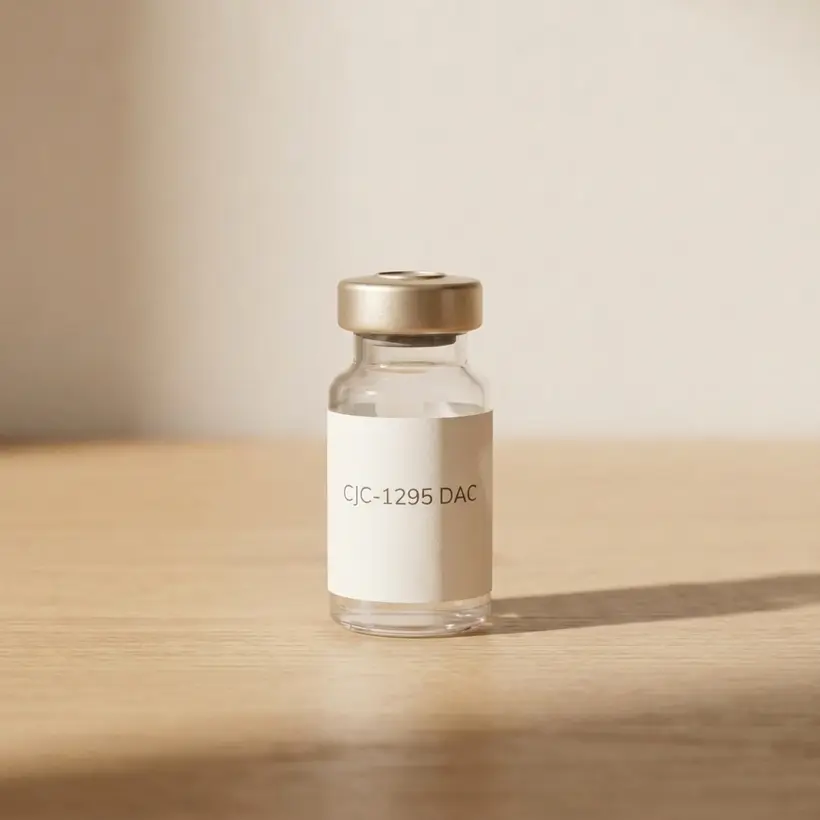
From the FormBlends catalog
CJC-1295 DAC
Long-acting GHRH analog with Drug Affinity Complex for sustained GH elevation · From $42/mo · compounded by a licensed 503A pharmacy, dispensed only after provider review.
Learn about CJC-1295 DAC →Table of Contents
- What is the DAC modification and how does it work chemically?
- What are the actual half-life numbers for DAC vs no DAC?
- Does DAC blunt natural GH pulsatility and does that matter?
- Evidence ledger: what does the research actually support?
- What most pages get wrong about DAC peptides
- Honest head-to-head: DAC vs no DAC vs Sermorelin vs Tesamorelin
- How do dosing protocols differ between DAC and no DAC?
- How to read a COA and verify which version you have
- Stability and formulation: what degrades the DAC linker?
- FAQ
- Sources
What Is the DAC Modification and How Does It Work Chemically?
DAC stands for Drug Affinity Complex. In CJC-1295 with DAC, a reactive maleimide group is conjugated to the epsilon-amine of a lysine residue appended at the C-terminus of the Modified GRF 1-29 sequence. When injected subcutaneously, the maleimide undergoes a Michael addition reaction with the free sulfhydryl (thiol) group on Cysteine-34 of circulating serum albumin, forming a stable thioether bond.
Serum albumin has a plasma half-life of roughly 19 to 21 days in healthy adults (a well-established value from albumin turnover studies). By hitching to albumin, CJC-1295 with DAC inherits a dramatically extended residence time. The peptide is also shielded from dipeptidyl peptidase IV (DPP-IV) cleavage at the N-terminus and from renal filtration, both of which rapidly inactivate unmodified GHRH analogues.
This is the same general strategy used in other long-acting therapeutics: insulin detemir and semaglutide also exploit fatty acid-albumin interactions to extend half-life. The principle is mechanistically established. The specific clinical advantage for GHRH analogues in healthy users is not.
What Are the Actual Half-Life Numbers for DAC vs No DAC?
The most cited human pharmacokinetic data for CJC-1295 with DAC comes from a dose-escalation study published by Teichman et al. (2006) in the Journal of Clinical Endocrinology and Metabolism. That trial (n=65 healthy adults) reported a terminal half-life of approximately 6 to 8 days and demonstrated that a single injection sustained elevated IGF-1 levels for up to 14 days at higher doses. Growth hormone levels rose 2 to 3-fold above baseline and remained elevated for several days.
Modified GRF 1-29 (the no-DAC form) has a plasma half-life documented in the range of 20 to 30 minutes in pharmacokinetic studies. For context, native GHRH(1-44) clears within minutes. The tetrameric amino acid substitutions in Modified GRF 1-29 (at positions 2, 8, 15, and 27) modestly improve DPP-IV resistance versus native GHRH but do not come close to the half-life extension achieved by albumin binding.
| Form | Half-Life | Peak GH Window | IGF-1 Duration |
|---|---|---|---|
| Native GHRH(1-44) | Under 7 minutes | 15 to 45 minutes post-injection | Hours |
| Modified GRF 1-29 (no DAC) | Roughly 20 to 30 minutes | 30 to 90 minutes post-injection | Hours |
| CJC-1295 with DAC | Approximately 6 to 8 days (Teichman 2006) | Sustained over days | Up to 14 days at higher doses |
| Sermorelin | Under 10 minutes | 15 to 45 minutes post-injection | Hours |
| Tesamorelin (FDA-approved) | Roughly 26 minutes | Pulsatile; used daily | Daily dosing sustains IGF-1 |
Does DAC Blunt Natural GH Pulsatility and Does That Matter?
Growth hormone in healthy physiology is secreted in discrete pulses, predominantly at night, with trough levels near zero between pulses. This pulsatility is not decorative: receptor downregulation, hepatic GH sensitivity, and the ratio of GH to IGF-1 all depend on it to varying degrees in animal and in-vitro evidence.
CJC-1295 with DAC maintains continuous GHRH receptor occupancy. The Teichman 2006 trial showed that IGF-1 remained elevated for over a week, suggesting blunted episodic variation. Whether this matters for human outcomes like muscle accrual, fat loss, or adverse event risk is genuinely unknown. The hypothesis that pulsatility is required for optimal anabolic signaling is supported by animal data and receptor pharmacology reasoning, but no controlled human trial has compared pulsatile versus continuous GHRH stimulation protocols on these endpoints.
No-DAC peptides, dosed around natural GH pulse times (late evening or post-exercise), aim to amplify existing pulses rather than replace the pattern. This is pharmacologically plausible and physiologically more conservative. Whether it produces meaningfully different clinical results has not been demonstrated in a controlled comparison.
Evidence Ledger: What Does the Research Actually Support?
| Claim | Best Evidence Type | Key Source | Effect Direction | Confidence |
|---|---|---|---|---|
| CJC-1295 DAC extends half-life to ~6-8 days | Human PK trial (n=65) | Teichman et al. 2006, JCEM | Clear extension vs baseline | High (for PK endpoint) |
| Single DAC injection elevates IGF-1 for up to 14 days | Human PK trial (n=65) | Teichman et al. 2006, JCEM | Sustained IGF-1 elevation | Moderate (dose-dependent, small n) |
| No-DAC Modified GRF 1-29 half-life ~20-30 minutes | Pharmacokinetic studies | Multiple PK characterizations of GHRH analogues | Short clearance vs DAC | High (for PK endpoint) |
| GHRH analogues improve body composition | Human RCT (tesamorelin in HIV lipodystrophy) | Falutz et al. 2010, NEJM; FDA approval data | Visceral fat reduction in disease population | Moderate (disease-specific, not healthy adults) |
| DAC superior to no-DAC for muscle or fat outcomes | No head-to-head RCT | None identified | Unknown | Very Low (pharmacokinetic inference only) |
| GH pulsatility required for optimal anabolic effect | Animal models, receptor pharmacology | Multiple preclinical studies | Directionally supports pulsatility | Low (not established in humans) |
| Maleimide reacts with albumin Cys-34 | Biochemical characterization | Established conjugation chemistry literature | Confirmed binding mechanism | High (mechanism) |
| DAC causes water retention / carpal tunnel symptoms | Case reports, GH class effect data | GH excess literature | Class-level adverse signal | Low to Moderate (class effect, not DAC-specific RCT) |
What Most Pages Get Wrong About DAC Peptides
Mistake 1: Treating longer half-life as automatically better. Most content presents DAC's extended half-life as a clear advantage. It is a clear convenience advantage for dosing frequency. Whether it produces better outcomes is a separate question that remains unanswered. Longer half-life also means longer exposure to any side effect, a trade-off that most articles omit entirely.
Mistake 2: Calling Modified GRF 1-29 "CJC-1295 without DAC." This terminology is so common it has become de facto standard, but it is technically imprecise. CJC-1295 was developed specifically to include the DAC modification. The molecule most vendors sell as "CJC-1295 no DAC" is Modified GRF 1-29 (also called GRF(1-29)-amide with specific substitutions). Conflating them obscures molecular identity and makes COA comparison harder.
Mistake 3: Ignoring maleimide hydrolysis. The DAC linker depends on a maleimide group remaining reactive. Maleimide-thiol conjugates are susceptible to retro-Michael hydrolysis under physiologic conditions, meaning some fraction of the peptide may lose albumin-binding capacity before or after injection. This has been studied in the antibody-drug conjugate field. The rate under physiologic conditions is slow but real. No peptide vendor page discusses this. It means that improperly stored or degraded DAC peptide may perform pharmacokinetically more like the no-DAC version than expected.
Mistake 4: Overstating the Teichman 2006 trial. It is the primary human evidence base for DAC PK claims. Its primary endpoints were pharmacokinetic and safety, not body composition or performance. Citing it to support claims about muscle gain or fat loss is overreach.
Honest Head-to-Head: DAC vs No DAC vs Sermorelin vs Tesamorelin
| Attribute | CJC-1295 with DAC | Modified GRF 1-29 (no DAC) | Sermorelin | Tesamorelin (FDA-approved) |
|---|---|---|---|---|
| Half-life | ~6 to 8 days | ~20 to 30 minutes | Under 10 minutes | ~26 minutes |
| Dosing frequency | 1 to 2x per week | Daily, timed | Daily, nightly | Daily subcutaneous |
| Pulsatility preserved | No | Better preserved | Better preserved | No (daily flat dosing) |
| Human RCT evidence | PK trial only (Teichman 2006) | Limited | Limited in adults | Yes (HIV lipodystrophy, FDA NDA) |
| Regulatory status (USA) | Not FDA approved; research compound | Not FDA approved; research compound | Previously compounded; FDA removed from approved list 2023 | FDA approved (Egrifta, specific indication) |
| Convenience | High (fewer injections) | Low (daily timing required) | Low (daily nightly) | Moderate (daily but well-characterized) |
| Where DAC loses | Pulsatility, longer adverse exposure, higher cost per mg | N/A | N/A | N/A |
| Best evidence population | Healthy adults (PK only) | Healthy adults (inference) | GH-deficient adults, limited data | HIV-associated lipodystrophy |
How Do Dosing Protocols Differ Between DAC and No DAC?
For CJC-1295 with DAC, the Teichman 2006 trial used doses from 30 mcg/kg to 120 mcg/kg as single injections, demonstrating dose-dependent IGF-1 elevation. In research and community use, weekly doses of roughly 1 to 2 mg are commonly described. Injections once or twice weekly are consistent with the half-life data.
For Modified GRF 1-29 (no DAC), typical research protocols describe 100 to 200 mcg per injection, administered subcutaneously once or twice daily, often combined with a GHRP such as ipamorelin or GHRP-2 to amplify GH pulse amplitude. Timing matters: dosing in the evening aligns with the natural nocturnal GH surge. Eating or elevated blood glucose blunts the GH response, so injections before meals or in the fasted state are commonly recommended based on physiologic reasoning.
How to Read a COA and Verify Which Version You Have
A certificate of analysis (COA) from a legitimate research peptide supplier should include at minimum: HPLC purity, mass spectrometry confirmation, and ideally endotoxin testing. Here is what to look for specifically for DAC vs no DAC verification:
| Parameter | CJC-1295 with DAC | Modified GRF 1-29 (no DAC) | Why It Matters |
|---|---|---|---|
| Molecular weight (mass spec) | Approximately 3647 Da (verify against supplier spec) | Approximately 3148 Da (verify against supplier spec) | The ~500 Da gap reflects the DAC linker. MS is the definitive discriminator. |
| HPLC purity | 98% or above acceptable | 98% or above acceptable | Lower purity indicates synthesis impurities or degradation products |
| Amino acid sequence confirmation | GHRH(1-29) with C-terminal DAC modification noted | Modified GRF(1-29) sequence noted | Confirms identity beyond MW alone |
| Endotoxin (LAL test) | Below 1 EU/mg | Below 1 EU/mg | Endotoxin contamination causes injection site inflammation and systemic reactions |
| Appearance after reconstitution | Clear, colorless solution | Clear, colorless solution | Cloudiness, particulate, or yellow tint suggests degradation |
A degraded DAC peptide may show correct molecular weight by MS if only the albumin-binding function (not the peptide backbone) is compromised. No standard COA test directly assesses whether the maleimide group remains reactive. This is an inherent limitation of current quality testing for DAC peptides and is essentially never discussed by vendors.
Stability and Formulation: What Degrades the DAC Linker?
Understanding why storage rules exist requires understanding the degradation chemistry. Three mechanisms threaten DAC peptide integrity:
1. Maleimide hydrolysis. The maleimide ring is susceptible to hydrolysis, converting it to a succinamic acid derivative that cannot undergo Michael addition with albumin. This reaction is accelerated by elevated temperature, alkaline pH, and prolonged aqueous exposure. It is a well-characterized stability concern in the antibody-drug conjugate literature. The practical implication: store lyophilized powder cold (2 to 8 degrees C), minimize time in solution, and do not reconstitute with alkaline diluents. Bacteriostatic water (pH approximately 5 to 7) is preferred over plain water for this reason.
2. Peptide backbone degradation. Asparagine residues in GHRH analogues can undergo deamidation over time, particularly at elevated temperatures, converting Asn to Asp and subtly altering receptor binding. This is a general peptide stability concern not unique to DAC versions.
3. Freeze-thaw cycling. Repeated cycles cause aggregation of peptide molecules, reducing bioavailability. Lyophilized powder tolerates cold storage well. Reconstituted solutions should not be repeatedly frozen and thawed.
Practical rules derived from this chemistry: keep lyophilized powder refrigerated, reconstitute only what you will use within a reasonable timeframe (a few weeks refrigerated), use bacteriostatic water, and discard any reconstituted solution showing cloudiness or particulate matter.
FAQ
What does DAC stand for in peptides?
DAC stands for Drug Affinity Complex. It is a fatty acid side chain, specifically a C16 palmitoyl group linked via a linker, conjugated to peptides like CJC-1295 to enable albumin binding and extend the plasma half-life from minutes to days.
What is the half-life difference between CJC-1295 with DAC and without DAC?
CJC-1295 without DAC (Modified GRF 1-29) has a plasma half-life of roughly 30 minutes. CJC-1295 with DAC has a reported half-life of approximately 6 to 8 days in human studies (Teichman et al. 2006), primarily because the DAC linker allows reversible covalent binding to serum albumin.
How often do you inject CJC-1295 with DAC versus without DAC?
CJC-1295 with DAC is typically dosed once or twice per week due to its multi-day half-life. Modified GRF 1-29 requires daily or multiple-daily injections and is usually co-administered with GHRP compounds at the time of a natural GH pulse.
Does DAC blunt the pulsatile pattern of growth hormone release?
Yes. Because DAC maintains sustained GHRH receptor stimulation over days, it produces a relatively flat elevation in IGF-1 rather than sharp GH pulses. Whether blunted pulsatility matters clinically for outcomes like fat loss or muscle accrual is not established in controlled human trials.
Which is better for body composition: DAC or no DAC?
No head-to-head RCT in healthy adults compares the two directly for body composition. The DAC version raises IGF-1 more consistently; no-DAC versions may better replicate physiologic GH pulsatility. Neither claim is backed by high-quality controlled human evidence specifically comparing the two formulations.
Is CJC-1295 with DAC the same as Sermorelin?
No. Sermorelin is a 29-amino-acid GHRH analogue with no albumin-binding modification and a half-life under 10 minutes. CJC-1295 with DAC has the same GHRH-receptor binding region but adds a reactive maleimide DAC linker for albumin binding. They share a mechanism but differ substantially in pharmacokinetics.
What are the side effects of DAC vs no DAC peptides?
Both share GH-related side effects: water retention, injection site reactions, and potential carpal tunnel symptoms at high doses. DAC versions carry a longer exposure window, so any adverse effect may persist longer than with short-acting no-DAC peptides, which clear within hours.
How should CJC-1295 with DAC be stored to prevent degradation?
Lyophilized powder should be stored at 2 to 8 degrees Celsius, away from light. After reconstitution with bacteriostatic water, it should remain refrigerated and used within a few weeks. The maleimide DAC linker is susceptible to hydrolysis at elevated temperatures and alkaline pH, accelerating loss of albumin-binding function.
Can DAC peptides be stacked with GHRPs like ipamorelin?
Yes, the GHRH receptor and ghrelin/GHS-R1a receptor systems are complementary. GHRH analogues prime somatotroph cells; GHRPs amplify GH pulse amplitude. This synergy is well documented in animal and human pharmacology studies. Dosing frequency differences between once-weekly DAC and daily GHRP injections must be managed carefully.
What does the maleimide linker in CJC-1295 DAC actually do chemically?
The maleimide group reacts with the free thiol of Cys-34 on serum albumin via a Michael addition, forming a stable thioether bond. This reversible covalent attachment shields the peptide from enzymatic cleavage and renal filtration, extending residence time. Hydrolysis of the maleimide ring under physiologic conditions can reduce binding efficiency over time.
How do I read a COA to verify a DAC peptide is authentic?
Look for HPLC purity above 98%, mass spectrometry confirming the correct molecular weight (CJC-1295 with DAC has a reported molecular weight around 3647 Da), and endotoxin testing below 1 EU/mg. The absence of the DAC linker shifts the molecular weight by roughly 500 Da, so MS is the key discriminator between DAC and no-DAC versions.
Are DAC peptides legal to purchase?
In the United States, CJC-1295 and related GHRH analogues are not FDA-approved drugs. They exist in a regulatory gray area as research compounds. The FDA has issued warning letters to compounding pharmacies dispensing certain peptides, and WADA prohibits GHRH analogues including DAC-modified versions in competitive sport.
Sources
- Teichman SL, Neale A, Lawrence B, Gagnon C, Castaigne JP, Frohman LA. Prolonged stimulation of growth hormone (GH) and insulin-like growth factor I secretion by CJC-1295, a long-acting analog of GH-releasing hormone, in healthy adults. Journal of Clinical Endocrinology and Metabolism. 2006;91(3):799-805.
- Falutz J, Potvin D, Mamputu JC, et al. Effects of tesamorelin, a growth hormone-releasing factor, in HIV-infected patients with abdominal fat accumulation: a randomized placebo-controlled trial with a safety extension. Journal of Acquired Immune Deficiency Syndromes. 2010;53(3):311-322.
- Walker JW, Gingrich J, Vance ML. Sermorelin: a review of the safety and efficacy in adults. Drugs. 2014 (see also FDA prescribing information for Geref Diagnostic).
- Lyon RP, Setter JR, Bovee TD, et al. Self-hydrolyzing maleimides improve the stability and pharmacological properties of antibody-drug conjugates. Nature Biotechnology. 2014;32(10):1059-1062. (Cited for maleimide hydrolysis chemistry applicable to DAC linkers.)
- Frohman LA, Jansson JO. Growth hormone-releasing hormone. Endocrine Reviews. 1986;7(3):223-253.
- FDA. Certain Bulk Drug Substances That May Be Used in Compounding Under Section 503B of the Federal Food, Drug, and Cosmetic Act. Federal Register 2023 updates. (Relevant to compounded peptide regulatory status.)
- World Anti-Doping Agency (WADA). Prohibited List 2024. S2 Peptide Hormones, Growth Factors, Related Substances, and Mimetics. wada-ama.org.
- Peters T Jr. All About Albumin: Biochemistry, Genetics, and Medical Applications. Academic Press, 1996. (Source for albumin Cys-34 binding site and half-life data.)
Footer Disclaimers
Platform: This page is operated by FormBlends and is provided for educational and informational purposes only. Nothing on this page constitutes medical advice, diagnosis, or treatment. Consult a licensed healthcare provider before beginning any peptide or hormone-related protocol.
Research Compound: CJC-1295 with DAC, Modified GRF 1-29, and related GHRH analogues discussed on this page are not approved by the FDA for human use outside of specific clinical or compounding contexts. They are legally classified as research compounds in many jurisdictions. Laws vary by country and are subject to change.
Results: Individual outcomes vary. No outcome described on this page is guaranteed. Comparisons between formulations are based on pharmacokinetic and mechanistic data, not controlled head-to-head clinical trials in healthy adults.
Trademark: FormBlends is a trademark of FormBlends LLC. All other product names, compound names, and trademarks mentioned are the property of their respective owners and are used for identification purposes only. No affiliation or endorsement is implied.
Related peptide guides
Ready when you are
CJC-1295 DAC
Long-acting GHRH analog with Drug Affinity Complex for sustained GH elevation · From $42/mo · compounded by a licensed 503A pharmacy, dispensed only after provider review.
Learn about CJC-1295 DAC →