
Trust Signals
Key Takeaways
- The only controlled human pharmacokinetic data for CJC-1295 with DAC comes from Teichman et al. (2006), which used weight-based dosing (30-120 mcg/kg), not the flat 1 mg/week figure common in research communities.
- CJC-1295 with DAC has a half-life of approximately 6-8 days in humans; daily dosing of the DAC form is pharmacologically redundant and distorts normal GH pulsatility.
- CJC-1295 without DAC (Mod GRF 1-29) has a half-life of roughly 30 minutes and requires entirely different dosing logic: 100 mcg per injection, multiple times daily.
- Reconstitution errors are the most common source of dose miscalculation; always verify mcg/mL concentration before drawing volume.
- No human long-term safety data exists for any sustained CJC-1295 protocol; all chronic dosing extrapolates from short-duration trials and animal data.
What Is the Right CJC-1295 Dosage?
For CJC-1295 with DAC, the most evidence-adjacent protocol is approximately 1,000 mcg (1 mg) once per week subcutaneously, extrapolated from pharmacokinetic data in Teichman et al. (2006). For CJC-1295 without DAC, 100 mcg per injection 2-3 times daily is the standard research protocol. The correct dose depends entirely on which variant you have; confusing them is a genuine risk.
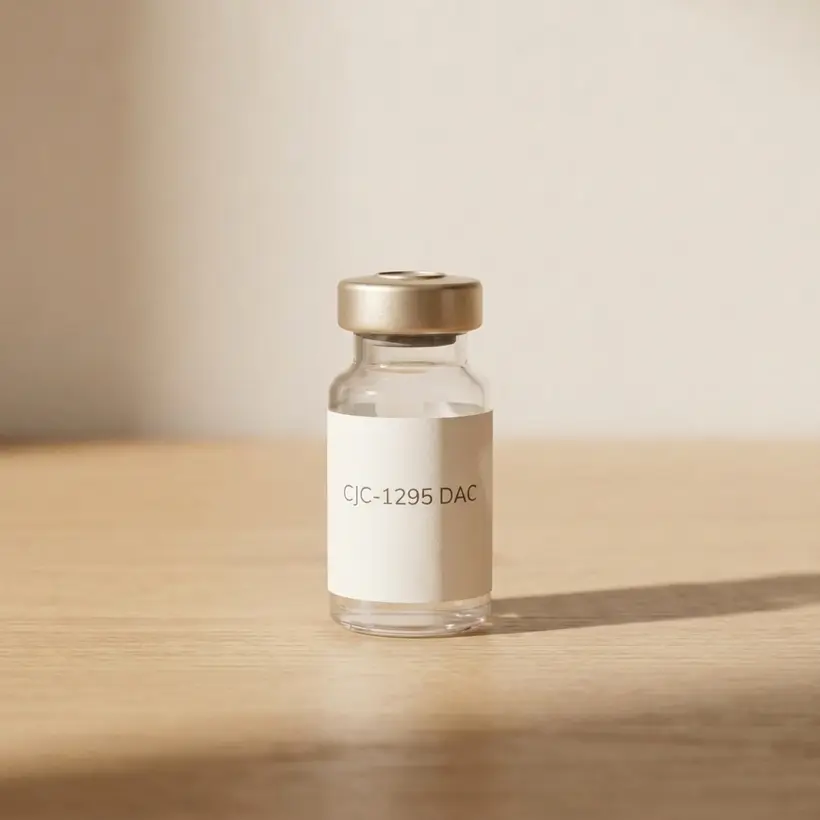
From the FormBlends catalog
CJC-1295 DAC
Long-acting GHRH analog with Drug Affinity Complex for sustained GH elevation · From $42/mo · compounded by a licensed 503A pharmacy, dispensed only after provider review.
Learn about CJC-1295 DAC →- DAC vs No-DAC: Why the Variant Changes Everything About Dose
- Mechanism With Numbers: How CJC-1295 Affects GH and IGF-1
- Evidence Ledger: What the Science Actually Supports
- CJC-1295 Dosage Chart: DAC and No-DAC Side by Side
- What Most Pages Get Wrong About CJC-1295 Dosing
- Reconstitution and Injection Volume Math
- Why the Storage Rules Exist: The Chemistry of Peptide Degradation
- Honest Head-to-Head: CJC-1295 vs Sermorelin vs Tesamorelin
- Label and COA Literacy: Reading What You Actually Bought
- Frequently Asked Questions
- Sources
DAC vs No-DAC: Why the Variant Changes Everything About Dose
CJC-1295 is a synthetic analogue of growth hormone-releasing hormone (GHRH). It exists in two fundamentally different pharmacological forms, and dosing one like the other is a meaningful error.
CJC-1295 with DAC (Drug Affinity Complex)
The DAC modification attaches a lysine-maleimidoproprionic acid linker to the peptide, allowing it to covalently bind serum albumin. Albumin acts as a circulating reservoir, releasing the peptide slowly. The result is a half-life of approximately 6-8 days in humans per the Teichman 2006 data. This means a single weekly injection maintains sustained GH-axis stimulation throughout the week. Dosing this form daily stacks drug on top of drug and eliminates the pulsatile GH release pattern that the pituitary normally produces.
CJC-1295 without DAC (Modified GRF 1-29 / Mod GRF 1-29)
Without the albumin-binding modification, the peptide retains only the amino-acid substitutions at positions 2, 8, 15, and 27 that resist dipeptidyl peptidase IV (DPP-IV) cleavage. These substitutions extend the half-life from roughly 2 minutes (native GHRH) to approximately 30 minutes. This form must be injected close to the desired GH pulse window (typically before sleep or pre-exercise) and dosed multiple times per day to achieve sustained elevation.
Mechanism With Numbers: How CJC-1295 Affects GH and IGF-1
CJC-1295 binds and activates the GHRH receptor (GHRHR) on somatotroph cells in the anterior pituitary. Receptor activation increases intracellular cAMP, which stimulates synthesis and pulsatile release of growth hormone. GH then acts on the liver to induce IGF-1 secretion.
In Teichman et al. (2006), a single subcutaneous injection of CJC-1295 with DAC in healthy adults produced:
- Mean GH levels elevated above baseline for up to 6 days post-injection
- IGF-1 increases of 1.5- to 3-fold above baseline, depending on dose (30, 60, or 120 mcg/kg cohorts)
- Multiple injections over 28 days sustained IGF-1 at 1.5- to 2-fold above baseline throughout the study period
What these numbers do NOT prove: A sustained 2-fold IGF-1 elevation is a pharmacokinetic/pharmacodynamic observation from a short-duration trial in healthy volunteers. It does not establish clinical benefit for body composition, recovery, or aging, and it does not characterize long-term safety of maintaining elevated IGF-1.
Evidence Ledger: What the Science Actually Supports
| Claim | Best Evidence Type | Effect Direction | Confidence |
|---|---|---|---|
| CJC-1295 DAC has a half-life of ~6-8 days in humans | Human PK study (Teichman et al., 2006; n=64) | Established | High |
| Single injection elevates GH for up to 6 days | Human PK/PD study (Teichman et al., 2006) | Positive | High |
| Multiple injections sustain IGF-1 elevation 1.5-2x baseline | Human PK/PD study (Teichman et al., 2006; 28-day period) | Positive | High |
| Mod GRF 1-29 half-life ~30 minutes | Mechanism + animal/in vitro DPP-IV resistance data; short human PK inferred | Established directionally | Moderate |
| CJC-1295 improves body composition or fat loss in humans | No controlled human trial with body composition endpoint | Unknown | Very Low |
| Combination with ipamorelin produces additive GH release | Animal data and mechanistic reasoning (separate GHRH + ghrelin pathways) | Likely positive | Low |
| Chronic use is safe in healthy adults | No long-term human trial; 28-day trial showed mild adverse events only | Insufficient data | Very Low |
| Once-weekly 1 mg flat dose is optimal | Community extrapolation from weight-based PK trial; not directly studied | Plausible, not validated | Very Low |
CJC-1295 Dosage Chart: DAC and No-DAC Side by Side
CJC-1295 with DAC Dosage Chart
| Protocol | Dose Per Injection | Frequency | Weekly Total | Notes |
|---|---|---|---|---|
| Conservative | 500 mcg | Once weekly | 500 mcg | Lower end; extrapolated from PK data |
| Standard (most cited) | 1,000 mcg (1 mg) | Once weekly | 1,000 mcg | Most referenced community protocol |
| Split-dose alternative | 500 mcg | Twice weekly | 1,000 mcg | Same weekly total; smoother theoretical trough |
| Daily dosing (DAC) | Not recommended | Daily | N/A | Pharmacologically redundant given 6-8 day half-life |
CJC-1295 Without DAC (Mod GRF 1-29) Dosage Chart
| Protocol | Dose Per Injection | Frequency | Timing | Notes |
|---|---|---|---|---|
| Minimal | 100 mcg | Once daily | Pre-sleep | Aligned with natural GH pulse |
| Standard | 100 mcg | 2-3x daily | Pre-sleep + pre-workout | Most referenced community protocol |
| Combined with ipamorelin | 100 mcg + 200-300 mcg ipamorelin | 2-3x daily | Pre-sleep; fasted state preferred | No RCT on combined dosing; additive effect plausible |
What Most Pages Get Wrong About CJC-1295 Dosing
1. The human trial used weight-based doses, not flat 1 mg doses
Nearly every blog presents "1 mg per week" as though it is the clinical trial dose. Teichman et al. (2006) used 30, 60, and 120 mcg/kg. For a 75 kg adult, the 120 mcg/kg dose equals 9,000 mcg, a single dose nearly nine times the popular 1 mg/week figure. The 1 mg/week protocol is a community convention, not a clinical finding. This does not mean it is wrong, but its confidence level is very low.
2. "CJC-1295" on a label does not tell you which variant you have
Many suppliers use "CJC-1295" for both the DAC and no-DAC forms. The DAC form carries a lysine-MPAA conjugate visible on a mass spectrometry COA as a higher molecular weight (approximately 3,647 Da for the DAC form versus approximately 3,367 Da for Mod GRF 1-29). If you do not have a mass-spec COA confirming molecular weight, you cannot be certain which you have.
3. Oral and sublingual "CJC-1295" have no supporting pharmacokinetic data
Peptides with more than 5-6 amino acids are poorly absorbed intact through gastrointestinal or oral mucosa due to peptidase degradation and low permeability. CJC-1295 is a 30-amino-acid peptide. Any oral or sublingual product claiming CJC-1295 activity has no published human absorption data. The mechanism of action requires systemic delivery.
4. Pulsatility matters and continuous stimulation is not obviously better
Normal GH secretion is pulsatile. Sustained non-pulsatile GH-axis stimulation (as the long half-life of CJC-1295 DAC provides) may blunt pituitary responsiveness over time. This is a theoretical concern without definitive human data, but it is a legitimate pharmacological consideration absent from most dosage guides.
Reconstitution and Injection Volume Math
Lyophilized CJC-1295 vials come most commonly as 2 mg or 5 mg. Reconstitute with bacteriostatic water (0.9% benzyl alcohol preservative) for multi-draw vials.
Concentration Formula
Concentration (mcg/mL) = Total peptide (mcg) / Volume of water added (mL)
| Vial Size | Water Added | Resulting Concentration | Volume to draw for 1,000 mcg | Volume to draw for 500 mcg |
|---|---|---|---|---|
| 2 mg (2,000 mcg) | 2 mL | 1,000 mcg/mL | 1.0 mL | 0.5 mL |
| 2 mg (2,000 mcg) | 1 mL | 2,000 mcg/mL | 0.5 mL | 0.25 mL |
| 5 mg (5,000 mcg) | 5 mL | 1,000 mcg/mL | 1.0 mL | 0.5 mL |
| 5 mg (5,000 mcg) | 2.5 mL | 2,000 mcg/mL | 0.5 mL | 0.25 mL |
How to Spot a Degraded Vial
- Lyophilized powder should be white to off-white; yellow or brown coloration suggests degradation
- Reconstituted solution should be clear and colorless; cloudiness or particulates indicate contamination or aggregation
- Reconstituted peptide stored at 4 degrees Celsius: use within approximately 28-30 days
- Freeze-thaw cycles degrade peptide integrity; do not repeatedly freeze reconstituted vials
Why the Storage Rules Exist: The Chemistry of Peptide Degradation
The stability rules for CJC-1295 follow from the biochemistry of peptide bonds and the specific vulnerabilities of this sequence.
Heat and aqueous solution: In solution, peptide bonds undergo hydrolysis. The rate of hydrolysis increases substantially with temperature. At 37 degrees Celsius (body temperature), a peptide in aqueous solution degrades far faster than at 4 degrees Celsius (refrigerator). This is why reconstituted peptide requires refrigeration and has a finite use window even when refrigerated.
Lyophilized stability: Removing water by freeze-drying arrests hydrolysis almost entirely. Lyophilized peptide is stable at room temperature for months to years if properly sealed and desiccated. Once water is reintroduced, the clock restarts.
DPP-IV resistance in CJC-1295: Native GHRH is cleaved at position 2 by DPP-IV within roughly 2 minutes in vivo. The amino-acid substitutions in CJC-1295 (particularly Ala at position 2 replaced by 2-aminoisobutyric acid, and substitutions at 8, 15, and 27) block this enzymatic attack by removing the preferred cleavage substrate. This is structural protection, not heat stability; it does not protect the peptide against heat-driven hydrolysis in solution.
Light exposure: Aromatic residues (tryptophan, tyrosine) in peptides are susceptible to photo-oxidation under UV. Store vials in amber or opaque containers or the original packaging.
Honest Head-to-Head: CJC-1295 vs Sermorelin vs Tesamorelin
| Factor | CJC-1295 (DAC) | Sermorelin | Tesamorelin |
|---|---|---|---|
| FDA approval | None | Formerly approved (withdrawn 2008 for commercial reasons, not safety) | Approved for HIV-associated lipodystrophy (Egrifta) |
| Half-life | ~6-8 days | ~10-20 minutes | ~26 minutes (similar albumin-binding technology) |
| Dosing frequency | Once weekly | Once nightly | Once daily (2 mg) |
| Human RCT body composition data | None | Limited (mostly older adults, GH-deficient) | Yes; RCTs in HIV lipodystrophy (trunk fat reduction) |
| IGF-1 elevation evidence | Yes, in humans (Teichman 2006) | Yes, modest in adults | Yes, documented in RCTs |
| Pulsatility preservation | Poor (sustained stimulation) | Better (short half-life follows natural rhythm) | Moderate |
| Regulatory access | Research compound only | Compounded (off-label) in some jurisdictions | Prescription only; narrow indication |
| Where CJC-1295 loses | No clinical endpoint data; no approval; unknown long-term safety | Tesamorelin has stronger clinical evidence; sermorelin has historical clinical use | Tesamorelin wins on evidence quality and regulatory standing |
Label and COA Literacy: Reading What You Actually Bought
A legitimate research-grade peptide should arrive with a certificate of analysis (COA) from an independent third-party laboratory. Here is what to verify:
- Molecular weight confirmation: CJC-1295 with DAC has a molecular weight of approximately 3,647 Da. Mod GRF 1-29 is approximately 3,367 Da. A mass spectrometry result outside a few Daltons of these values indicates a different or impure compound.
- Purity by HPLC: Research-grade peptides should show greater than 98% purity by high-performance liquid chromatography. Anything below 95% is concerning for a product intended for injection.
- Amino acid analysis: Some COAs include an amino acid composition confirming the correct sequence was synthesized.
- Endotoxin testing: For injectables, an LAL (Limulus amebocyte lysate) endotoxin test below accepted limits is critical. Bacterial endotoxins in injected peptides cause pyrogenic reactions.
- Sterility: Lyophilized peptide is not inherently sterile. Reconstitution with bacteriostatic water (not sterile water alone) provides microbial inhibition. High-quality suppliers test for microbial contamination.
If a supplier does not provide a third-party COA or provides only an in-house certificate, treat purity and identity as unverified. The practical consequence of an impure product is unpredictable dosing: a vial labeled 2 mg that is 80% pure contains only 1.6 mg of active peptide, shifting your dose calculations by 20% even before any reconstitution error.
Frequently Asked Questions
What is the standard CJC-1295 DAC dosage per week?
The most commonly cited research protocol for CJC-1295 with DAC is 1,000 mcg (1 mg) once per week administered subcutaneously. Human pharmacokinetic data from Teichman et al. (2006) used weight-based doses of 30, 60, or 120 mcg/kg; the once-weekly 1 mg flat dose used in research communities extrapolates from that data and has not itself been studied in a controlled trial.
What is the CJC-1295 DAC dosage per day?
CJC-1295 with DAC is not appropriately dosed daily. Its half-life of approximately 6-8 days makes daily injections pharmacologically redundant and likely suppressive of normal GH pulsatility. Daily dosing logic applies to CJC-1295 without DAC (Mod GRF 1-29), which has a half-life of roughly 30 minutes and is typically dosed at 100 mcg per injection 2-3 times daily.
What is the difference between CJC-1295 with DAC and without DAC dosing?
CJC-1295 with DAC binds albumin via the Drug Affinity Complex modification, extending its half-life to roughly 6-8 days and allowing once-weekly dosing at approximately 1,000 mcg. CJC-1295 without DAC has a half-life of approximately 30 minutes and requires 100 mcg per injection administered 2-3 times daily, typically timed around sleep or exercise.
How do I read a CJC-1295 dosage chart?
A reliable dosage chart should specify: the variant (DAC or no-DAC), dose per injection in micrograms, injection frequency, weekly total dose, and the volume to draw based on your specific reconstitution concentration. Verify the chart uses micrograms and confirm it matches your vial concentration before drawing any volume.
What dose of CJC-1295 was used in human clinical trials?
Teichman et al. (2006) in the Journal of Clinical Endocrinology and Metabolism used single subcutaneous doses of 30, 60, and 120 mcg/kg of CJC-1295 with DAC in healthy adults (n=64). For a 75 kg adult, the 120 mcg/kg dose equals 9,000 mcg, substantially higher than the community-circulated 1 mg/week flat dose.
Can CJC-1295 DAC be dosed twice per week?
Some protocols use 500 mcg twice weekly to smooth peak-to-trough variation while maintaining the same weekly total. There is no controlled trial comparing once-weekly versus twice-weekly schedules. Given the approximately 6-8 day half-life, twice-weekly dosing would produce gradual accumulation, which may or may not be desirable depending on the protocol goal.
How do I reconstitute CJC-1295 and calculate my injection volume?
Add bacteriostatic water to the lyophilized vial. A common starting point is a 2 mg vial reconstituted with 2 mL water, yielding 1,000 mcg/mL. To inject 1,000 mcg, draw 1.0 mL. To inject 500 mcg, draw 0.5 mL. Formula: dose (mcg) divided by concentration (mcg/mL) equals volume
Related peptide guides
Ready when you are
CJC-1295 DAC
Long-acting GHRH analog with Drug Affinity Complex for sustained GH elevation · From $42/mo · compounded by a licensed 503A pharmacy, dispensed only after provider review.
Learn about CJC-1295 DAC →