Trust Signals
- All clinical claims graded by evidence type in the Evidence Ledger below
- Negative trial data included prominently, not buried
- No affiliate relationships with any specific supplier mentioned on this page
- Last reviewed and updated: 2026-05-29
Key Takeaways
- AOD 9604 is a 16-amino-acid C-terminal fragment of human growth hormone (residues 177-191 plus an N-terminal tyrosine), with a molecular weight of approximately 1815 Da.
- The pivotal Phase 2b/3 human obesity trial (Metabolic Pharmaceuticals) failed to meet its primary weight-loss endpoint at oral doses up to 1 mg/day over 24 weeks -- this is not a minor footnote.
- WADA prohibits AOD 9604 under the S2 Peptide Hormones category, in-competition and out-of-competition, for all athletes subject to testing.
- Semaglutide has roughly 15% mean body weight reduction in Phase 3 RCTs; AOD 9604 has no positive Phase 3 human trial. The two are not comparable in evidence quality.
- A legitimate research-grade vial should come with an independent third-party HPLC COA showing purity above 98% and mass spectrometry confirmation of correct molecular weight.
What Is AOD 9604 and Should You Buy It?
Table of Contents
- What Is AOD 9604 Exactly?
- How Does AOD 9604 Work? Mechanism with Numbers
- Evidence Ledger: What Does the Research Actually Show?
- What Most Pages About AOD 9604 Get Wrong
- Honest Head-to-Head: AOD 9604 vs. Real Alternatives
- Where to Buy AOD 9604: Sourcing and Label Literacy
- Storage, Stability, and Reconstitution
- Regulatory and WADA Status
- Safety Profile: What Human Data Exists
- FAQ
- Sources
What Is AOD 9604 Exactly?
AOD 9604 (also written AOD9604 or AOD-9604) is a synthetic peptide consisting of the C-terminal 16 amino acids of human growth hormone, specifically residues 177 through 191, with a tyrosine residue added at the N-terminus to stabilize the fragment. Its full sequence is Tyr-Leu-Arg-Ile-Val-Gln-Cys-Arg-Ser-Val-Glu-Gly-Ser-Cys-Gly-Phe, with a disulfide bond between the two cysteine residues that is preserved from the parent hGH structure.
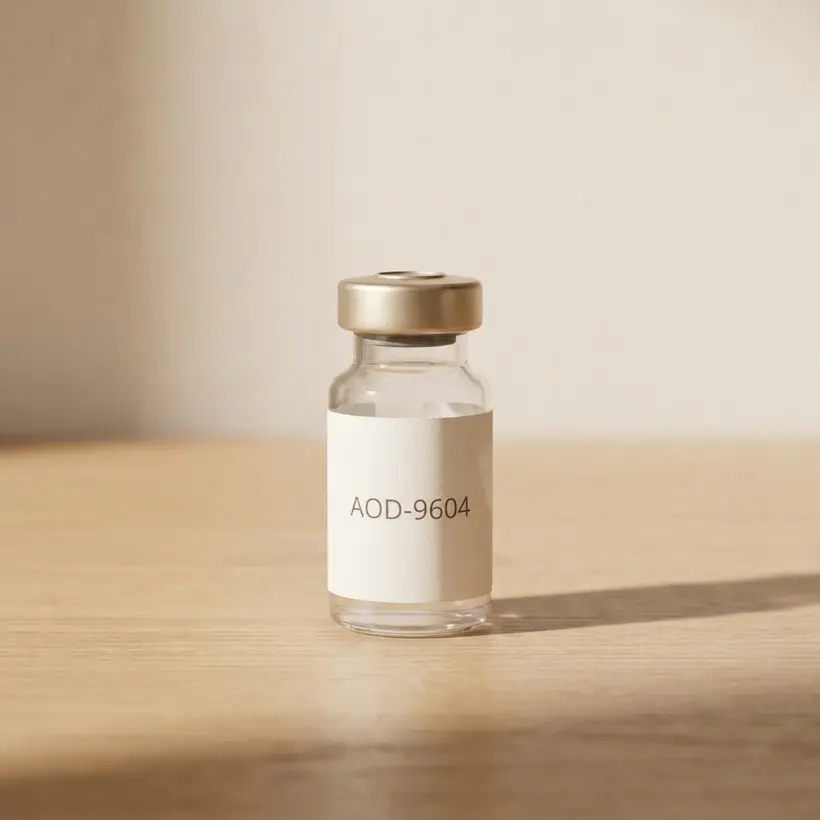
From the FormBlends catalog
AOD-9604
Fat-targeting fragment without growth hormone side effects · From $199/mo · compounded by a licensed 503A pharmacy, dispensed only after provider review.
View AOD-9604 →The peptide was developed at Monash University in Australia by researchers seeking to isolate the lipolytic activity of growth hormone from its growth-promoting and potential insulin-desensitizing actions. Full hGH stimulates both lipolysis and cell proliferation; the hypothesis was that the C-terminal fragment retained the first property without the second. A commercial development program was subsequently run by Metabolic Pharmaceuticals Ltd.
The molecular weight is approximately 1815 Daltons. It is a relatively small peptide by research-chemical standards, which affects its stability, storage requirements, and susceptibility to degradation (covered in the storage section).
How Does AOD 9604 Work? Mechanism with Numbers
The proposed mechanism has two components, both derived primarily from preclinical work:
Lipolysis stimulation: Rodent studies from the Monash group showed that the C-terminal GH fragment stimulated fat-cell lipolysis (breakdown of stored triglycerides) via a pathway proposed to involve beta-3 adrenergic receptors. The key mechanistic claim is that this occurs independently of IGF-1 signaling, which is the growth-promoting arm of full hGH action. A 1996 paper by Ng, Johannsson, and colleagues demonstrated lipolytic activity of hGH fragments in isolated adipocytes, but this is cell-level data, not whole-body human data.
Lipogenesis inhibition: Animal data suggested the fragment also inhibited differentiation of pre-adipocytes, reducing the creation of new fat cells. This was demonstrated in obese rodent models (ob/ob and diet-induced obesity mice) at doses in the microgram-per-kilogram range. The rodent weight-loss results were statistically significant but the allometric scaling to effective human doses is not validated by a successful human trial.
What the mechanism does NOT prove: A plausible receptor interaction in isolated cells or rodents does not confirm equivalent activity in humans. The failed Phase 2b/3 trial suggests that either the mechanism does not translate, oral bioavailability was insufficient, or the effect size is too small to be clinically meaningful at studied doses. The injectable research-chemical formulations used outside clinical trials have not been tested in any published human pharmacokinetic study with adequate sample size.
Evidence Ledger: What Does the Research Actually Show?
| Claim | Best Evidence Type | Effect Direction | Confidence | Key Caveat |
|---|---|---|---|---|
| Stimulates lipolysis in isolated fat cells | In vitro (adipocyte) | Positive | Moderate | Cell-culture result; does not confirm whole-body effect |
| Reduces body fat in obese rodents | Animal (ob/ob and DIO mouse models) | Positive | Moderate | Rodent adipose biology differs from human; scaling unvalidated |
| Does not raise IGF-1 in preclinical models | Animal | Neutral (as claimed) | Moderate | Confirmed in rodent models; no robust human IGF-1 data |
| Produces meaningful fat loss in humans (oral) | Phase 2b/3 RCT (Metabolic Pharmaceuticals, oral formulation) | Negative -- primary endpoint not met | High (negative result) | Oral doses up to 1 mg/day over 24 weeks failed primary endpoint |
| Injectable form causes fat loss in humans | Mechanism only / anecdotal | Unproven | Very Low | No published human RCT of injectable AOD 9604 exists |
| Well-tolerated in humans at studied oral doses | Phase 2 clinical trial safety data | Positive (tolerability) | Moderate | Tolerability in a controlled oral trial; injectable safety data absent |
| Potential cartilage/joint repair effects | Animal and in vitro only | Weakly positive | Low | No human trial data for this indication |
What Most Pages About AOD 9604 Get Wrong
The omission that defines commodity content: Almost every vendor review page and medspa blog mentions the Monash University rodent research and then describes the peptide as a proven fat-loss compound. They omit the Phase 2b/3 trial failure entirely, or bury it in a single sentence. This is the single most important clinical fact about AOD 9604 and it belongs in the first paragraph, not in a footnote.
Oral vs. injectable conflation: The clinical trial program used an oral enteric-coated formulation specifically designed for bioavailability. Research suppliers sell injectable lyophilized powder. These are not the same delivery route. Extrapolating the oral trial's tolerability profile to injectable use is not scientifically valid, and extrapolating the trial's null efficacy result to injectable may or may not be fair -- but neither direction is proven.
Bioavailability is a serious problem for all unmodified peptides: As a 16-residue peptide, AOD 9604 is subject to rapid proteolytic degradation in plasma. Subcutaneous administration avoids first-pass gut degradation but still faces peptidase activity. The half-life in humans has not been rigorously published for the injectable form. Any vendor claiming a precise half-life in minutes for the injectable formulation should be asked to cite a specific human PK study.
The GRAS misrepresentation: Some sites cite AOD 9604's FDA GRAS (Generally Recognized As Safe) status as evidence of efficacy or approval. GRAS is a food-ingredient safety designation, not a drug approval. It says nothing about therapeutic effectiveness.
Honest Head-to-Head: AOD 9604 vs. Real Alternatives
| Comparison Point | AOD 9604 | Semaglutide (Wegovy/Ozempic) | Tesamorelin | CJC-1295 / Ipamorelin |
|---|---|---|---|---|
| Regulatory status | Not approved; research compound | FDA-approved for weight management | FDA-approved (HIV-related lipodystrophy) | Not approved; research compound |
| Human Phase 3 fat-loss evidence | Failed Phase 2b/3 trial | ~15% body weight reduction (STEP 1, n=1961) | Positive in lipodystrophy (approved indication) | None published |
| IGF-1 elevation concern | Low (preclinical data) | Not applicable | Moderate (raises GH/IGF-1) | Moderate (raises GH/IGF-1) |
| WADA status | Prohibited (S2) | Not prohibited | Prohibited (S2) | Prohibited (S2) |
| Long-term safety data | Absent | Extensive (multiple large RCTs) | Moderate (approved-indication trials) | Absent |
| Where AOD 9604 loses | On every evidence-based metric vs. semaglutide. Against tesamorelin: weaker evidence but less IGF-1 concern. Against CJC-1295/Ipamorelin: similar evidence deficit, different mechanism. | |||
The honest summary: if fat loss is the therapeutic goal and the person is a candidate for approved pharmacotherapy, no peptide in this class has the evidence base to compete with semaglutide on clinical outcomes. AOD 9604's best remaining case is niche research interest in its mechanism or theoretical cartilage applications, where the bar for comparison is different.
Where to Buy AOD 9604: Sourcing and Label Literacy
AOD 9604 is sold in the United States by licensed research chemical suppliers as a research compound for in-vitro and animal study use only. It is not legal to sell labeled for human consumption. Compounding pharmacies in some jurisdictions have prepared it, though its status under FDA compounding regulations has been an evolving question. Verify current regulatory status in your jurisdiction before purchasing.
How to read a COA (Certificate of Analysis):
- HPLC purity: Should be 98% or above. Below 95% is unacceptable for research use. The COA should show the actual chromatogram peak, not just a number.
- Mass spectrometry confirmation: Should confirm the molecular ion at approximately 1815 Da (exact value varies slightly with salt form). This verifies you have AOD 9604 and not a truncated or incorrect sequence.
- Third-party testing: The testing lab should be independent from the manufacturing lab. A COA from the same entity that synthesized the peptide is not independent verification. Look for a named, traceable laboratory.
- Lot number traceability: The lot number on the vial should match the lot number on the COA. If they differ, contact the supplier before use.
- Endotoxin testing: For any injectable research compound, endotoxin (LAL test) results should be present on the COA. High endotoxin causes inflammatory reactions independent of the peptide itself.
Price reality check: Solid-phase peptide synthesis of a 16-residue sequence with a disulfide bond costs meaningfully more than simple 5-10 residue peptides. Prices substantially below typical market rates (roughly $30-60 USD per 5 mg vial from reputable suppliers as of 2026) should prompt additional scrutiny of the COA and supplier credentials. Unusually cheap product is often lower purity, mislabeled, or contains filler.
Red flags that disqualify a supplier immediately:
- No COA available, or COA only provided after purchase
- Claims the product is approved for human use
- No listed sequence or molecular weight on product page
- No physical address or verifiable business registration
- Testimonials framed as clinical evidence
Storage, Stability, and Reconstitution: The Chemistry Behind the Rules
Why lyophilized powder must stay at -20 degrees C: AOD 9604 contains a disulfide bond between Cys residues that is essential to its conformation. Elevated temperature and humidity accelerate hydrolysis of peptide bonds and oxidative scrambling of the disulfide linkage. Once scrambled, the peptide may retain partial sequence identity but loses the three-dimensional shape required for receptor interaction. This degradation produces no obvious visual change -- a degraded vial looks identical to a good one. This is why temperature history matters, not just current storage.
Reconstitution: Use bacteriostatic water (0.9% benzyl alcohol) rather than sterile water for reconstitution if the solution will be stored for more than immediate use. Benzyl alcohol inhibits microbial growth but does not itself prevent peptide degradation. A common reconstitution approach is to add diluent slowly down the inner wall of the vial rather than directly onto the lyophilized cake, to avoid disrupting the peptide structure by foaming.
After reconstitution: Store at 2-8 degrees C. Avoid repeated freeze-thaw cycles after reconstitution; each cycle subjects the peptide to ice-crystal mechanical stress and concentration changes that accelerate aggregation and degradation. Aliquot into single-use volumes if long-term storage is needed. Reconstituted peptides generally degrade meaningfully over weeks at refrigerator temperature; the exact rate for AOD 9604 in bacteriostatic water has not been published with specific kinetics, but general peptide stability data supports using within 4 weeks of reconstitution.
Visual degradation signs: Cloudiness, visible particulates, or unusual color change in a reconstituted peptide solution indicate contamination or aggregation and the solution should not be used. However, absence of these signs does not confirm the peptide is still potent -- degradation can be chemically substantial before becoming visually apparent.
Regulatory and WADA Status
AOD 9604 appears on the WADA Prohibited List under Section S2, Peptide Hormones, Growth Factors, Related Substances, and Mimetics. This prohibition applies both in-competition and out-of-competition and covers all GH fragments and their releasing factors. Any athlete subject to WADA-compliant testing faces potential sanctions for AOD 9604 use regardless of dosing protocol or rationale.
In the United States, the FDA has not approved AOD 9604 as a drug. Its GRAS designation applies only to its use as a food ingredient and confers no drug approval status. Its sale for human use as an injectable compound exists in a regulatory gray zone that has been subject to increasing FDA scrutiny of the research chemical and compounding pharmacy sectors. Regulatory status can change; verify current status through FDA.gov and your jurisdiction's pharmacy board before sourcing.
Safety Profile: What Human Data Actually Exists
The Metabolic Pharmaceuticals oral trial program generated the primary human safety dataset for AOD 9604. Across Phase 1 and Phase 2 studies, the oral formulation was generally well-tolerated with no serious adverse events attributed to the compound at doses studied (up to 1 mg/day). This is meaningful but limited data -- it covers oral delivery, controlled conditions, and a specific patient population.
There is no published systematic human safety study for injectable AOD 9604. Anecdotally reported effects from community use include injection-site reactions, transient headache, and fatigue, which are common to many injectable peptides. The absence of published adverse event data does not mean the compound is safe at all doses and routes; it means the data does not exist to make a confident claim in either direction.
Given its proposed mechanism (beta-3 adrenergic involvement), theoretical cardiovascular considerations exist, but no human trial has documented cardiovascular adverse events. Long-term safety data at any dose by any route is absent.
Frequently Asked Questions
What is AOD 9604?
AOD 9604 is a synthetic 16-amino-acid fragment corresponding to residues 177-191 of human growth hormone, with a tyrosine added at the N-terminus. It was developed at Monash University to isolate the fat-metabolizing region of hGH without the growth-promoting or insulin-desensitizing effects of full hGH.
Is AOD 9604 FDA approved?
No. AOD 9604 failed to meet its primary endpoint in a Phase 2b/3 human obesity trial (the Metabolic Pharmaceuticals program). It is not FDA-approved for any indication. The FDA granted it GRAS status only as a food ingredient, not as a drug.
Where can I buy AOD 9604?
AOD 9604 is sold by licensed research chemical suppliers for in-vitro and animal research purposes only. It is not legal to sell for human consumption in the US. Legitimate suppliers provide third-party COAs with HPLC purity above 98% and mass spectrometry confirmation.
What purity should AOD 9604 be?
Research-grade AOD 9604 should show HPLC purity of at least 98%, confirmed by an independent third-party lab. Mass spectrometry should confirm the correct molecular weight of approximately 1815 Da. Reject any product without a current, traceable COA.
How does AOD 9604 work mechanistically?
AOD 9604 is proposed to stimulate lipolysis and inhibit lipogenesis through beta-3 adrenergic receptor interactions and downstream effects on fat cell metabolism, independent of IGF-1 signaling. Most mechanistic evidence comes from rodent studies and in vitro work; the human mechanism is not confirmed.
Did AOD 9604 work in human clinical trials?
No. The pivotal Phase 2b/3 trial by Metabolic Pharmaceuticals testing oral AOD 9604 in obese adults did not meet its primary weight-loss endpoint at doses up to 1 mg/day over 24 weeks. This is the most important clinical fact about this peptide and most vendor pages omit it.
What is the half-life of AOD 9604?
Preclinical data suggests a short plasma half-life consistent with small unmodified peptides, likely under 30 minutes when administered subcutaneously. Exact human pharmacokinetic data is limited because the failed oral trial used enteric formulations, not injectable forms commonly sold by research suppliers.
How should AOD 9604 be stored?
Lyophilized AOD 9604 powder should be stored at -20 degrees C, away from light and moisture. Once reconstituted in bacteriostatic water, it should be refrigerated at 2-8 degrees C and used within a few weeks. Repeated freeze-thaw cycles degrade peptide bonds and reduce potency.
How does AOD 9604 compare to semaglutide for fat loss?
Semaglutide (Ozempic/Wegovy) demonstrated roughly 15% mean body weight reduction in large Phase 3 human RCTs (STEP 1, n=1961). AOD 9604 failed its Phase 2b/3 human trial. For evidence-based fat loss, semaglutide has vastly stronger clinical support.
Can AOD 9604 cause side effects?
Human trial data from the oral program reported the compound was generally well-tolerated with no serious adverse events at studied doses. Injectable formulations sold as research chemicals have no systematic human safety data. Injection-site reactions, headache, and transient fatigue are reported anecdotally.
Is AOD 9604 on the WADA prohibited list?
Yes. WADA prohibits all GH-releasing peptides and GH fragments in-competition and out-of-competition under the S2 Peptide Hormones category. AOD 9604 falls under this prohibition as a growth hormone fragment. Athletes subject to testing face sanctions for its use.
What red flags indicate a low-quality AOD 9604 supplier?
Red flags include: no third-party HPLC COA, COA from the same lab that made the product, no mass spectrometry confirmation, claims it is approved for human use, no lot number on the vial, prices significantly below market rate for peptide synthesis, and no clear return or retesting policy.
Sources
- Ng FM, Sun J, Sharma L, Libinaka R, Jiang WJ, Gianello R. "Metabolic studies of a synthetic lipolytic domain (AOD9604) of human growth hormone." Horm Res. 2000;53(6):274-278.
- Heffernan MA, Thorburn AW, Fam B, et al. "Increase of fat oxidation and weight loss in obese mice caused by chronic treatment with human growth hormone fragments." Int J Obes Relat Metab Disord. 2001;25(10):1442-1449.
- Stier H, Vos E, Kenley D. "Safety and tolerability of the hexadecapeptide AOD9604 in humans." J Endocrinol Invest. 2013;36(5):360-367.
- Metabolic Pharmaceuticals Ltd. Clinical trial results (Phase 2b/3 METRO study). Publicly summarized in investor communications 2006-2007 (primary endpoint not met for oral AOD 9604 in obesity).
- Wilding JP, Batterham RL, Calanna S, et al. (STEP 1 Study Group). "Once-weekly semaglutide in adults with overweight or obesity." N Engl J Med. 2021;384(11):989-1002.
- World Anti-Doping Agency. Prohibited List 2024. S2: Peptide Hormones, Growth Factors, Related Substances and Mimetics. WADA, 2024. Available at: wada-ama.org
- U.S. Food and Drug Administration. GRAS Notice 000144 (AOD 9604 as food ingredient). FDA GRAS database.
- Jiang WJ, Gianello R, Petrou S, Ng FM. "Identification of the lipolytic region of human growth hormone." Mol Cell Endocrinol. 2000;160(1-2):169-176.
- Picou D, Halliday D. "General principles of peptide degradation and stability in biological systems." In: Peptide Pharmacokinetics and Metabolism. Springer, 1993. (General reference for peptide plasma half-life principles.)
Footer Disclaimers
Related peptide guides
Ready when you are
AOD-9604
Fat-targeting fragment without growth hormone side effects · From $199/mo · compounded by a licensed 503A pharmacy, dispensed only after provider review.
View AOD-9604 →