
Trust Signals
Author: FormBlends Medical Team | Evidence standard: Claims are graded by study type in the evidence ledger below. Speculative claims are labeled as such. No clinical dosing guidance is offered; this page is for research orientation only.
Key Takeaways
- Kisspeptin-10 (KP-10) is a 10-amino-acid C-terminal fragment with a molecular weight of approximately 1,302.5 Da that activates KISS1R (GPR54) with full agonist activity.
- In human IV studies (Dhillo et al., 2005, JCEM), KP-10 at 0.3 to 3.2 nmol/kg produced dose-dependent LH pulses within 15-30 minutes, providing the strongest mechanistic evidence of any peptide acting upstream of GnRH.
- Continuous infusion causes rapid KISS1R desensitization and paradoxical LH suppression -- the single most important clinical gotcha that commodity pages omit.
- Minimum acceptable purity for research use is 98% by HPLC with independent third-party mass spectrometry confirmation of molecular weight.
- Lyophilized powder is stable for 12-24 months at -20°C; reconstituted solution degrades over days at room temperature and must be refrigerated and used promptly.
What Is Kisspeptin and Why Buy Kisspeptin for Research?
Kisspeptin is the protein product of the KISS1 gene and the endogenous ligand for the KISS1R receptor. Researchers buy kisspeptin -- most commonly the kisspeptin-10 fragment -- to study GnRH pulse generation, reproductive neuroendocrinology, and HPG axis regulation. It has a stronger human pharmacology evidence base than most research peptides, but it is not an approved drug and carries no clinical indication.
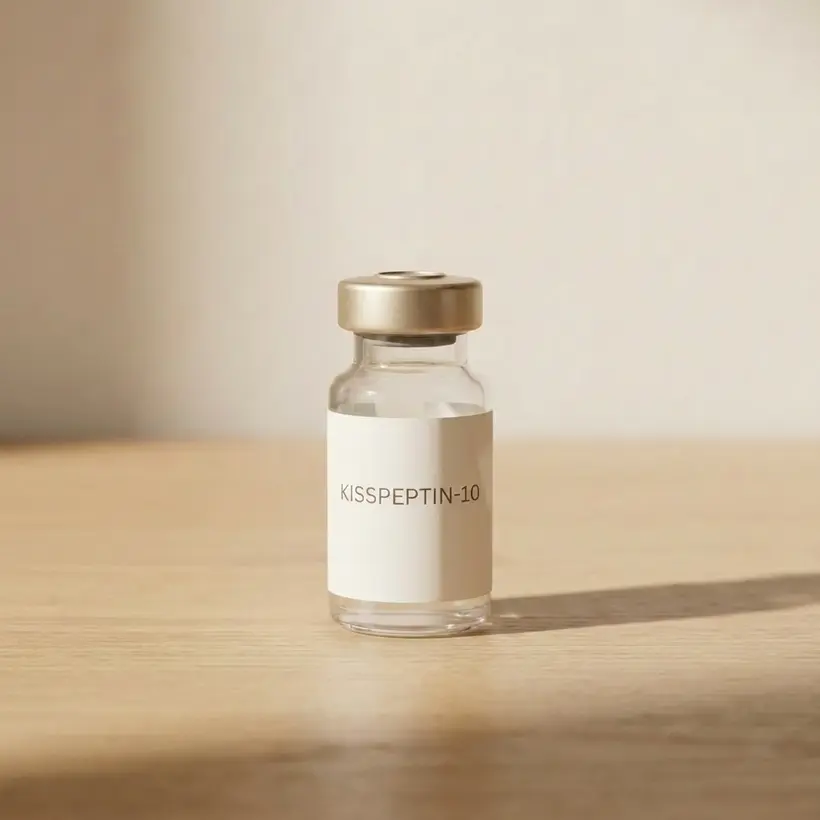
From the FormBlends catalog
Kisspeptin-10
Master regulator of reproductive hormones and sexual arousal · From $49/mo · compounded by a licensed 503A pharmacy, dispensed only after provider review.
Learn about Kisspeptin-10 →Table of Contents
- Mechanism and Specific Numbers: How Kisspeptin Works
- Evidence Ledger: What the Research Actually Shows
- What Most Pages Get Wrong About Kisspeptin
- How to Find Kisspeptin for Sale: Sourcing and Purity Standards
- Label and COA Literacy: How to Read a Kisspeptin COA
- Reconstitution and Dosing Tables
- Stability and Storage: The Chemistry Behind the Rules
- Kisspeptin vs. Alternatives: Honest Head-to-Head
- Known Side Effects and Risk Profile
- Frequently Asked Questions
- Sources
Mechanism and Specific Numbers: How Kisspeptin Works
Kisspeptin peptides share a conserved C-terminal RF-amide motif (Arg-Phe-NH2) that is required for KISS1R binding and activation. KISS1R is a Gq/11-coupled GPCR expressed densely on GnRH neurons in the arcuate nucleus and anteroventral periventricular nucleus of the hypothalamus.
Receptor activation triggers phospholipase C, IP3-mediated calcium release, and protein kinase C signaling, depolarizing the GnRH neuron and driving pulsatile GnRH release into the portal circulation. This GnRH pulse then stimulates pituitary LH and FSH secretion within minutes.
Quantified human pharmacology (Dhillo et al., 2005, JCEM): IV bolus KP-10 at doses from 0.3 to 3.2 nmol/kg produced dose-dependent increases in serum LH. Peak LH responses occurred roughly 15-30 minutes post-injection. FSH responses were smaller and less consistent, consistent with the known shorter half-life of KP-10 (minutes in plasma) relative to the longer FSH stimulation window needed.
What this mechanism does NOT prove: Demonstrating LH pulse generation after a bolus injection does not prove that any subcutaneous self-administration protocol will replicate pituitary effects, normalize testosterone, improve fertility outcomes, or produce any durable hormonal change. The downstream signal depends entirely on GnRH neuron integrity, pituitary responsiveness, and -- critically -- receptor desensitization dynamics.
Evidence Ledger: What the Research Actually Shows
| Claim | Best Evidence Type | Effect Direction | Confidence |
|---|---|---|---|
| KP-10 IV bolus increases LH in healthy men and women | Human RCT / crossover (Dhillo et al., 2005; Jayasena et al., 2009) | Positive, dose-dependent | High |
| Kisspeptin-54 SC infusion triggers LH pulses in women with hypothalamic amenorrhea | Human RCT (Jayasena et al., 2010, PLOS ONE) | Positive | High |
| Continuous kisspeptin infusion causes KISS1R desensitization and LH suppression | Human clinical study (Jayasena et al., 2009, JCEM) | Suppressive (paradoxical) | High |
| Kisspeptin modulates sexual motivation and appetite | Animal studies; limited human functional MRI data | Positive (animal), directional (human fMRI) | Low |
| Kisspeptin improves testosterone in hypogonadal men (chronic use) | No published RCT confirming durable testosterone normalization via peptide alone | Unclear / Not established | Very Low |
| Kisspeptin triggers ovulation in women undergoing IVF (trigger shot use) | Human RCT (Abbara et al., 2020, NEJM Evidence / Abbara et al. series) | Positive, non-inferior to hCG in select patients | Moderate |
| Oral kisspeptin bioavailability | No human PK data; mechanism strongly predicts near-zero oral bioavailability | Not established | Very Low |
What Most Pages Get Wrong About Kisspeptin
The desensitization problem. Every medspa blog and forum post discussing kisspeptin focuses on its ability to raise LH. Almost none of them explain that this effect is acutely self-limiting. Continuous or inappropriately high-frequency administration causes rapid homologous KISS1R downregulation and internalization, driving LH levels below baseline. This is documented in human subjects, not just cell culture. It is the same principle that makes continuous GnRH agonist therapy (leuprolide) a testosterone suppression strategy in prostate cancer -- sustained receptor occupancy abolishes the pulsatile signal required for gonadotropin secretion.
Fragment matters. Vendors selling "kisspeptin" without specifying the fragment length are selling an ambiguous product. KP-10, KP-13, KP-14, and KP-54 all activate KISS1R but differ in plasma half-life, synthesis complexity, and cost. KP-54 has a longer half-life than KP-10 due to greater structural resistance to neutral endopeptidase cleavage. Treating them as interchangeable for dosing is scientifically incorrect.
Oral products do not work. Kisspeptin is a peptide. Without a specialized delivery system, gastric acid and peptidases hydrolyze it before absorption. Any oral kisspeptin product making LH-raising claims has zero credible human PK data to support those claims.
Bioavailability after subcutaneous injection is real but not equivalent to IV. SC administration produces a slower, lower peak concentration than IV bolus. The LH-stimulatory dose-response established in IV human trials does not translate directly to SC dosing equivalents without separate SC PK studies.
How to Find Kisspeptin for Sale: Sourcing and Purity Standards
When you buy kisspeptin-10 for sale from any supplier, the following criteria separate legitimate research-grade material from unverifiable product:
| Criterion | Minimum Standard | Red Flag |
|---|---|---|
| Purity | Greater than or equal to 98% by HPLC | Purity stated without instrument data; less than 95% |
| Identity confirmation | MS confirming MW approximately 1,302.5 Da for KP-10 | No MS data; only HPLC without mass confirmation |
| Testing lab | Named independent third-party lab | In-house testing only; lab not named |
| Endotoxin | Less than 1 EU/mg (LAL test result on COA) | No endotoxin data available |
| Labeling | Research use only, clearly stated | Clinical dosing guidance on product page; disease treatment claims |
| Price plausibility | Consistent with synthesis cost for the purity claimed | Prices dramatically below market; no explanation |
FormBlends supplies research-grade KP-10 meeting these standards with independently verified COAs available prior to purchase.
Label and COA Literacy: How to Read a Kisspeptin COA
Sequence verification: KP-10 sequence is Tyr-Asn-Trp-Asn-Ser-Phe-Gly-Leu-Arg-Phe-NH2. The C-terminal amidation (Phe-NH2) is essential for KISS1R binding. If the COA does not confirm C-terminal amidation or the supplier cannot confirm synthesis included amidation, the peptide may lack activity.
HPLC trace: Look for a single dominant peak representing greater than 98% of integrated area. Multiple peaks or a broad baseline suggest impurities or degradation products. Ask the supplier for the raw chromatogram, not just the percentage summary.
MS data: The expected [M+H]+ for KP-10 (free acid form) is approximately 1,303.5 m/z; amidated form is approximately 1,302.5 Da. A discrepancy suggests incorrect synthesis or missing amidation.
Lot and date: Confirm the COA lot number matches the vial lot number. COAs more than 18 months old at time of purchase raise stability questions even for lyophilized material.
Reconstitution and Dosing Tables
The following tables are for reference in a research laboratory context only. They do not constitute a dosing protocol for human use.
| Vial Size | Diluent Volume Added | Resulting Concentration |
|---|---|---|
| 1 mg KP-10 | 1 mL sterile water | 1,000 mcg/mL (approximately 768 nmol/mL) |
| 1 mg KP-10 | 2 mL sterile water | 500 mcg/mL (approximately 384 nmol/mL) |
| 5 mg KP-10 | 5 mL bacteriostatic saline | 1,000 mcg/mL |
Reconstitution procedure: Add diluent slowly down the side of the vial. Do not inject directly onto the lyophilized cake. Swirl gently; do not vortex. If the peptide does not dissolve fully in sterile water, add a small volume of 0.1% acetic acid before adding the balance of sterile water. Phosphate-buffered saline (PBS) is acceptable; avoid high-pH buffers as alkaline conditions accelerate Asn deamidation.
Stability and Storage: The Chemistry Behind the Rules
Why cold storage matters: Peptide bonds undergo acid- and base-catalyzed hydrolysis. At room temperature, in aqueous solution, this reaction proceeds meaningfully over days to weeks depending on pH and sequence-specific effects. Refrigeration at 2-8°C reduces the hydrolysis rate constant by roughly an order of magnitude relative to 25°C, consistent with the Arrhenius equation. Freezing at -20°C reduces it further.
Why freeze-thaw cycles matter: Each freeze-thaw cycle creates ice crystal formation followed by a brief liquid phase during thawing during which local peptide concentrations increase transiently. This promotes intermolecular interactions and aggregation, particularly around hydrophobic residues (Trp, Phe, Leu in KP-10). Aggregated peptide does not dissolve back to monomer cleanly and loses receptor-binding activity. Aliquoting into single-use volumes before freezing eliminates this problem.
Why alkaline pH accelerates degradation: Asn residues (two present in KP-10) undergo deamidation to Asp under mildly alkaline conditions, changing the charge and backbone geometry at that position. This is a well-characterized peptide degradation pathway. Using a slightly acidic diluent (pH 4-5 via 0.1% acetic acid) suppresses this reaction. However, very low pH can promote Asp-Pro peptide bond hydrolysis if those residues are present -- KP-10 does not contain this motif, so mild acidification is appropriate.
Light sensitivity: The Trp residue (position 3 in KP-10) is susceptible to UV-induced photooxidation. Store vials in amber or opaque containers away from direct light.
Kisspeptin vs. Alternatives: Honest Head-to-Head
| Compound | Mechanism Level | Human Evidence Quality | Regulatory Status | Desensitization Risk | Where Kisspeptin Loses |
|---|---|---|---|---|---|
| Kisspeptin-10 | Upstream of GnRH neuron (hypothalamus) | Moderate-High (acute LH studies) | Research compound only | High with continuous use | Not approved; no durable outcome data; requires intact GnRH axis |
| Gonadorelin (GnRH) | Directly at pituitary GnRH receptor | High (decades of data) | FDA-approved (some formulations) | High with continuous use (same principle) | Kisspeptin loses on approval status, clinical data depth, and predictability |
| hCG (human chorionic gonadotropin) | Directly at testicular LH receptor | High | FDA-approved | Low with standard pulsatile clinical protocols | Kisspeptin loses on approval, direct testosterone evidence, and clinical availability |
| Clomiphene citrate | Estrogen receptor antagonist, increases GnRH pulse frequency | High (decades of oral RCT data) | FDA-approved (fertility) | Low | Kisspeptin loses on oral bioavailability, cost, approval, and clinical familiarity |
| Enclomiphene | Same as clomiphene (active isomer) | Moderate-High (Phase 3 trials) | Not FDA-approved as standalone; under review | Low | Kisspeptin loses on oral delivery and clinical data volume |
Where kisspeptin has a genuine scientific niche: As a research tool for studying upstream HPG axis regulation, and as a potential trigger agent in IVF (reducing OHSS risk vs. hCG) -- the most clinically advanced application with the strongest trial data (Abbara et al.).
Known Side Effects and Risk Profile in Human Studies
Acute IV KP-10 administration in clinical trials was generally well tolerated at doses up to 3.2 nmol/kg. Reported effects in trial populations included mild transient flushing and modest heart rate increases at the highest doses, consistent with vasodilatory effects seen with RF-amide peptides generally. No serious adverse events were attributed to KP-10 in published acute studies.
The most significant physiological risk is not acute toxicity but chronic HPG axis perturbation. Using kisspeptin in a continuous or poorly timed manner can suppress the pulsatile LH signal and produce transient hypogonadism. This effect reverses on discontinuation but the timeline to recovery has not been systematically studied in humans outside a clinical trial context.
Long-term safety data for repeated subcutaneous administration in healthy adults is not available in the published literature. The absence of published harm data does not equal established safety.
Frequently Asked Questions
Sources
- Dhillo WS, Chaudhri OB, Patterson M, et al. Kisspeptin-54 stimulates the hypothalamic-pituitary gonadal axis in male rats. Journal of Clinical Endocrinology and Metabolism. 2005;90(12):6609-6615.
- Jayasena CN, Nijher GM, Chaudhri OB, et al. Subcutaneous injection of kisspeptin-54 acutely stimulates gonadotropin secretion in women with hypothalamic amenorrhea, but chronic administration causes tachyphylaxis. Journal of Clinical Endocrinology and Metabolism. 2009;94(11):4315-4323.
- Jayasena CN, Nijher GM, Abbara A, et al. Twice-weekly administration of kisspeptin-54 for 8 weeks stimulates release of reproductive hormones in women with hypothalamic amenorrhea. Clinical Pharmacology and Therapeutics. 2010;88(6):840-847.
- Abbara A, Jayasena CN, Christopoulos G, et al. Efficacy of kisspeptin-54 to trigger oocyte maturation in women at high risk of ovarian hyperstimulation syndrome (OHSS) during in vitro fertilization (IVF) therapy. Journal of Clinical Endocrinology and Metabolism. 2015;100(8):3077-3084.
- Seminara SB, Messager S, Chatzidaki EE, et al. The GPR54 gene as a regulator of puberty. New England Journal of Medicine. 2003;349(17):1614-1627.
- Kirby HR, Maguire JJ, Colledge WH, Davenport AP. International Union of Basic and Clinical Pharmacology. LXXVII. Kisspeptin receptor nomenclature, distribution, and function. Pharmacological Reviews. 2010;62(4):565-578.
- Roa J, Tena-Sempere M. KiSS-1 system and reproduction: comparative aspects and roles in the control of female gonadotropic axis in mammals. General and Comparative Endocrinology. 2007;153(1-3):132-140.
- Abbara A, Clarke SA, Islam R, et al. A second dose of kisspeptin-54 improves oocyte maturation in women at high risk of ovarian hyperstimulation syndrome: a phase 2 randomized controlled trial. Human Reproduction. 2017;32(9):1915-1924.