
Trust Signals
Key Takeaways
- Bacteriostatic water (0.9% benzyl alcohol) extends reconstituted IGF-1 LR3 stability to roughly 21 to 28 days at 2 to 8 degrees Celsius; plain sterile water drops that window to 24 to 72 hours.
- The LR3 modification reduces IGFBP binding affinity by approximately 1000-fold compared to native IGF-1, which is the structural reason plasma half-life extends from roughly 12 to 15 minutes to approximately 20 to 30 hours.
- Adding 1 mL of diluent to a 1 mg vial yields exactly 1000 mcg/mL, so every microliter drawn equals 1 mcg, making dose math straightforward on a 100-unit insulin syringe.
- There are no published randomized controlled trials of IGF-1 LR3 in healthy humans; all dosing conventions in the research community are extrapolated from animal studies or from native IGF-1 clinical pharmacology data.
- Cloudy, particulate, or yellow-tinged solution after reconstitution is a reliable discard signal; aggregated protein will not clear and may carry injection risk.
Direct Answer: What Is the Core Reconstitution Protocol for IGF-1 LR3?
Table of Contents
- Why LR3 Behaves Differently: The Mechanism With Numbers
- Evidence Ledger: What We Actually Know
- Which Diluent and Why the Chemistry Matters
- Step-by-Step Reconstitution Protocol
- Dosing Math and Draw Volume Calculator
- What Most Pages Get Wrong (the Stability and Purity Gaps)
- Honest Head-to-Head: IGF-1 LR3 vs Its Real Alternatives
- COA and Label Literacy: How to Vet Your Source
- Safety Signals You Should Not Dismiss
- FAQ
- Sources
Why Does LR3 Behave Differently? The Mechanism With Numbers
Native IGF-1 is a 70-amino-acid single-chain polypeptide with a molecular weight of approximately 7.6 kDa. It signals through the IGF-1 receptor (IGF-1R), a receptor tyrosine kinase, activating downstream PI3K/Akt and MAPK/ERK pathways that regulate cell growth, glucose uptake, and protein synthesis.
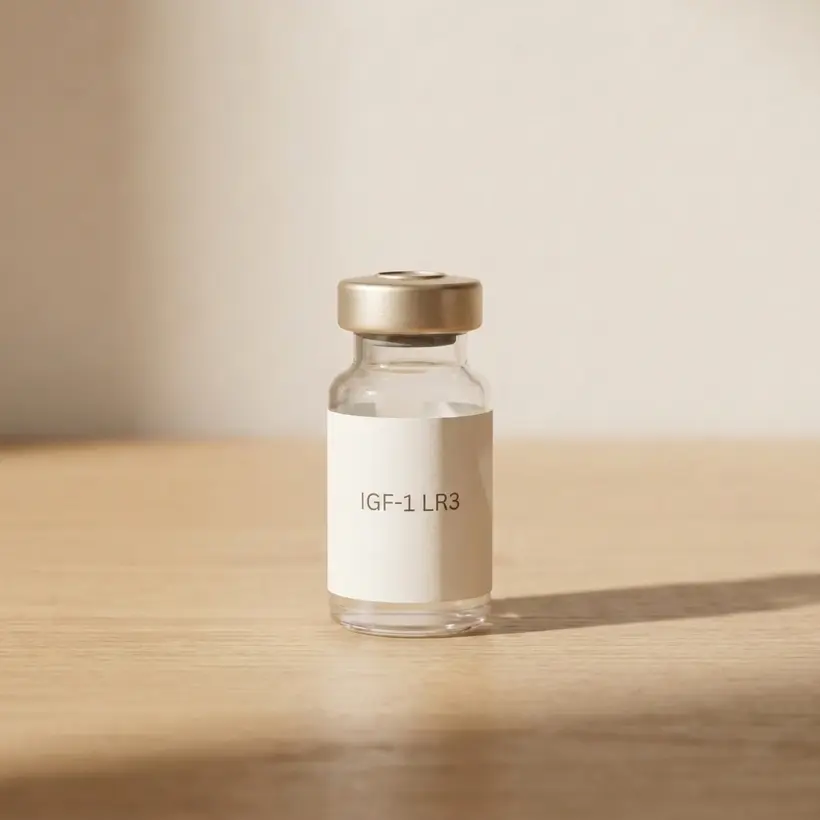
From the FormBlends catalog
IGF-1 LR3
Extended-action insulin-like growth factor for muscle growth · From $119/mo · compounded by a licensed 503A pharmacy, dispensed only after provider review.
Learn about IGF-1 LR3 →The LR3 analog adds an arginine residue (the "R3") and a 13-amino-acid N-terminal extension (the "L" prefix, derived from a leader sequence), bringing the molecular weight to approximately 9.1 kDa. This structural addition does two mechanistically important things:
- IGFBP binding is reduced by roughly 1000-fold. In native IGF-1, six binding proteins (IGFBP-1 through 6) sequester approximately 99% of circulating IGF-1 at any moment, holding it in an inactive reserve and regulating its clearance. The LR3 N-terminal extension sterically disrupts the binding interface. Published in vitro binding studies (Francis et al., 1992, and subsequent receptor pharmacology work cited in Ross et al., 2005) report this roughly 1000-fold reduction in IGFBP-3 affinity, the dominant carrier protein.
- Plasma half-life extends to approximately 20 to 30 hours. Native IGF-1 has a free half-life of roughly 12 to 15 minutes; complexed with IGFBP-3 it extends to hours, but the complex is inactive at the receptor. Because LR3 avoids IGFBP sequestration while retaining IGF-1R affinity, its effective half-life in animal pharmacokinetic studies is reported in the range of 20 to 30 hours. Human pharmacokinetic data for LR3 specifically are not published in peer-reviewed literature as of this writing.
What this mechanism does NOT prove: A longer half-life and reduced IGFBP binding do not automatically translate to greater anabolic efficacy or a better safety profile in humans. Duration of receptor occupancy is one variable; receptor downregulation, tissue-specific expression of IGF-1R, and co-stimulatory signals are others. Do not interpret the pharmacokinetic advantage as a confirmed efficacy or risk advantage in humans.
Evidence Ledger: What We Actually Know
| Claim | Best Evidence Type | Effect Direction | Confidence |
|---|---|---|---|
| IGF-1 LR3 activates IGF-1R in vitro with potency comparable to native IGF-1 | Cell culture binding and receptor activation assays | Positive (confirmed) | High (in vitro) |
| LR3 has roughly 1000-fold lower IGFBP-3 affinity than native IGF-1 | In vitro binding assay (Francis et al., 1992) | Confirmed directionally | High (in vitro) |
| LR3 produces muscle and organ growth effects in rodent and livestock models | Animal studies (multiple, including Tomas et al., 1993) | Positive | Moderate (animal) |
| Extended half-life (approximately 20 to 30 hours) in vivo | Animal pharmacokinetics; no published human PK data | Longer than native IGF-1 | Moderate (animal) |
| IGF-1 LR3 produces meaningful body composition changes in healthy humans | No human RCT data available for LR3 specifically | Unknown in humans | Very Low |
| Hypoglycemia risk from IGF-1 class compounds | Human clinical data for native IGF-1 (mecasermin trials; FDA label) | Confirmed class risk | High (class) |
| Chronic supraphysiologic IGF-1 signaling increases cancer risk | Epidemiologic association studies; animal models | Concern signal present | Low to Moderate |
| Bacteriostatic water extends peptide stability vs sterile water | Pharmaceutical formulation science; USP guidance | Confirmed | High (formulation) |
Which Diluent and Why the Chemistry Matters
The diluent choice is not arbitrary. Three options are used in practice:
Bacteriostatic water (preferred): This is water for injection containing 0.9% benzyl alcohol as a preservative. Benzyl alcohol is bacteriostatic because it disrupts microbial membrane integrity, preventing bacterial growth that would otherwise degrade the peptide through proteolytic contamination. At refrigerator temperature, this extends usable shelf life to approximately 21 to 28 days. The benzyl alcohol concentration used (0.9%) is far below the threshold associated with toxicity in adults (toxic doses are orders of magnitude higher on a per-injection basis).
Sterile water (second choice): No preservative means no microbial inhibition after the vial is first punctured. Each subsequent needle entry risks contamination. Use sterile water only if the entire vial will be used within 24 to 72 hours, or if you are making a single-use preparation.
Dilute acetic acid (0.1% to 1%): Some peptide manufacturers recommend acetic acid because certain polypeptides dissolve more readily in a mildly acidic environment. The acidic pH (roughly 3 to 4) can partially inhibit microbial growth, but it also stresses peptide bonds over time and can cause injection site discomfort. Use this only if the manufacturer's documentation specifies it, and dilute further with sterile saline before injection to approach physiologic pH.
Do NOT use: Normal saline alone (sodium chloride can promote peptide aggregation through ionic interactions), tap water (unsterile), or any solution containing DMSO unless you are doing in vitro work only.
Step-by-Step Reconstitution Protocol
Follow these steps in order. Aseptic technique is not optional because the final product will be injected.
- Gather materials: IGF-1 LR3 vial (lyophilized), bacteriostatic water, 1 mL or 3 mL syringe with a 23 to 25 gauge needle, alcohol swabs, a clean surface or sterile mat.
- Wash hands thoroughly with soap and water for at least 20 seconds.
- Swab the rubber septum of both the peptide vial and the bacteriostatic water vial with a fresh alcohol swab. Let alcohol dry for 15 seconds before puncturing.
- Draw bacteriostatic water: Withdraw 1 mL (or 2 mL for a lower concentration) into the syringe.
- Inject slowly down the vial wall, not directly onto the lyophilized cake. Direct impingement can shear the protein structure. Aim the stream at the glass, letting liquid run down to the powder.
- Do not shake or vortex. Gently swirl the vial with a slow circular wrist motion for 30 to 60 seconds. If powder remains undissolved, continue swirling. Most IGF-1 LR3 dissolves within 1 to 2 minutes.
- Inspect the solution: It should be clear and colorless with no visible particles. Any cloudiness or color is a discard signal (see the section below).
- Label the vial with the concentration (e.g., "IGF-1 LR3, 1000 mcg/mL") and the reconstitution date.
- Store at 2 to 8 degrees Celsius (standard refrigerator). Do not freeze. Keep away from light.
Dosing Math and Draw Volume
The formula is simple. Once you know your concentration:
Draw volume (mL) = Target dose (mcg) / Concentration (mcg/mL)
| Vial Size | Diluent Added | Concentration | 50 mcg dose = X units (insulin syringe) | 100 mcg dose = X units |
|---|---|---|---|---|
| 1 mg (1000 mcg) | 1 mL | 1000 mcg/mL | 5 units | 10 units |
| 1 mg (1000 mcg) | 2 mL | 500 mcg/mL | 10 units | 20 units |
| 1 mg (1000 mcg) | 5 mL | 200 mcg/mL | 25 units | 50 units |
"Units" on a 100-unit insulin syringe = 0.01 mL per unit. So 10 units = 0.1 mL. Using 1 mL of diluent keeps volumes small and easy to manage. Using 5 mL makes tiny doses more accurately measurable on a standard insulin syringe.
Important caveat on dosing: There is no validated human dose for IGF-1 LR3. The doses cited in bodybuilding or research communities are empirically derived, not from clinical trials. Do not interpret the table above as a recommended dose range. It is a math reference only.
What Most Pages Get Wrong: The Stability and Purity Gaps
This is the section competitors omit.
Stability after reconstitution is not indefinite at 2 to 8 degrees C. Peptide bonds can hydrolyze over time even under refrigeration, and deamidation (conversion of asparagine or glutamine residues to aspartate or glutamate) proceeds slowly but measurably. The 21 to 28 day figure for bacteriostatic water is a general pharmaceutical guideline for preserved protein solutions, not a specific stability study on IGF-1 LR3. The honest answer is that potency decline likely begins before visible degradation occurs, and there are no publicly available published stability studies specific to this formulation that give a percent-remaining-potency curve over time. Treat the 28-day figure as a conservative outer limit, not a guarantee of full potency at day 27.
Freeze-thaw is a real degradation mechanism. Ice crystals that form during freezing have sharp edges at the microscopic scale that physically fragment polypeptide aggregates and promote irreversible denaturation. If you accidentally freeze your reconstituted vial, do not assume it is fine because the solution looks clear. Aggregated but soluble oligomers can remain optically clear while being biologically inactive or immunogenic.
Purity variation in the research peptide market is large. Independent testing of peptide products by organizations such as Janoshik (an independent testing laboratory) and academic groups has repeatedly found that labeled concentrations can differ substantially from actual content, and that impurities including truncated sequences, oxidized methionine residues, and bacterial endotoxins are present in a non-trivial fraction of products. A certificate of analysis from the supplier is a starting point, not a guarantee, unless it comes from an independent, ISO-accredited laboratory.
Benzyl alcohol is not harmless at all doses. The 0.9% concentration in bacteriostatic water is safe for adults at normal injection volumes. However, benzyl alcohol in neonates has caused "gasping syndrome" at high cumulative doses, and bacteriostatic water is contraindicated in neonates per FDA labeling. This is not relevant for most adult research use, but it illustrates that the "safe diluent" label has real limits.
Honest Head-to-Head: IGF-1 LR3 vs Its Real Alternatives
| Attribute | IGF-1 LR3 | Native IGF-1 (Mecasermin / Increlex) | GH Secretagogues (e.g., Ipamorelin/CJC) |
|---|---|---|---|
| Regulatory status | Not FDA-approved; research compound | FDA-approved for specific pediatric indication | Not FDA-approved (most); research compounds |
| Human RCT evidence | None for LR3 specifically | Yes, for growth failure in children | Limited; some small human trials for specific secretagogues |
| Half-life | Approximately 20 to 30 hours (animal data) | Approximately 5 to 6 hours (complexed); minutes (free) | Variable; GH pulse-dependent, minutes to a few hours |
| Hypoglycemia risk | Present (class effect); not quantified for LR3 in humans | Documented in FDA label; 33 to 42% incidence in pediatric trials | Lower; GH stimulation is indirect |
| IGFBP interference | Largely bypassed (key differentiator) | Subject to full IGFBP regulation | Works upstream; endogenous IGF-1 still IGFBP-regulated |
| Oncologic concern | Theoretical; not studied in humans for LR3 | Class warning in FDA label; contraindicated with active malignancy | Lower theoretical concern (indirect pathway) |
| Where IGF-1 LR3 loses | No human safety data, no approved indication, no published dose-ranging trials. Mecasermin beats it on evidence quality by a wide margin. GH secretagogues carry a meaningfully lower acute safety concern profile. | ||
COA and Label Literacy: How to Vet Your Source
A certificate of analysis (COA) should contain at minimum:
- HPLC purity: Greater than 98% is the standard for injectable-grade research peptides. The HPLC chromatogram should show a single dominant peak. Multiple peaks indicate impurities or degradation products.
- Mass spectrometry (MS) confirmation: The observed molecular weight should match the theoretical molecular weight of IGF-1 LR3, which is approximately 9117 Da. A significant discrepancy indicates the product is not what it claims to be.
- Endotoxin testing (LAL assay): For any injectable research compound, endotoxin should be reported and should be below 1 EU/mg. Endotoxins are heat-stable lipopolysaccharides from gram-negative bacteria that cause fever, inflammation, and septic shock in sufficient quantities; they survive standard sterilization by filtration.
- Issuing laboratory: The COA should name a real, traceable laboratory. Search the laboratory name independently. A COA issued by the vendor itself, with no third-party verification, is marketing, not quality assurance.
- Lot number and date: Match the lot number on your vial to the COA. A generic undated COA may describe a different lot entirely.
Safety Signals You Should Not Dismiss
This section covers real pharmacologic concerns, not generic disclaimers.
Hypoglycemia: IGF-1 receptor activation in skeletal muscle and adipose tissue increases glucose uptake independently of insulin. The mecasermin (native IGF-1) FDA prescribing information documents hypoglycemia in roughly one third to nearly half of pediatric patients in clinical trials. LR3's longer half-life theoretically prolongs this window of risk. Eating a carbohydrate-containing meal near the time of injection is a standard harm-reduction measure in the research community, though it is not a validated protocol.
Oncologic concern: IGF-1R is overexpressed in a range of malignancies. Epidemiologic studies associate higher endogenous IGF-1 levels with increased risk of certain cancers, including colorectal and premenopausal breast cancer (reviewed in Renehan et al., BMJ 2004). This does not prove that exogenous IGF-1 LR3 causes cancer, but it establishes a biologically plausible mechanism for concern with chronic supraphysiologic use. The FDA label for mecasermin carries an explicit contraindication in patients with active or suspected malignancy.
Antibody formation: Exogenous IGF-1 can elicit anti-IGF-1 antibodies. This has been observed with mecasermin and is a theoretical concern with any exogenous polypeptide, particularly if the product contains host-cell protein impurities that act as adjuvants.
FAQ
What diluent should I use for IGF-1 LR3 reconstitution?
Bacteriostatic water (0.9% benzyl alcohol) is the preferred diluent. It extends refrigerated stability to approximately 21 to 28 days versus the 24 to 72 hour window for plain sterile water. Acetic acid (0.1 to 1%) is a secondary option used when benzyl alcohol would interfere with a downstream assay.
How many mL of bacteriostatic water do I add to a 1 mg vial of IGF-1 LR3?
Adding 1 mL yields a concentration of 1000 mcg/mL (1 mcg per microliter). Adding 2 mL yields 500 mcg/mL. Most researchers use 1 to 2 mL to keep draw volumes practical on an insulin syringe.
How long is reconstituted IGF-1 LR3 stable in the refrigerator?
With bacteriostatic water at 2 to 8 degrees Celsius, stability is generally cited at 21 to 28 days. Lyophilized powder stored at minus 20 degrees Celsius is stable for 12 months or more when kept dry and away from freeze-thaw cycling.
Can I freeze reconstituted IGF-1 LR3 to extend shelf life?
Freezing reconstituted peptide is not recommended. Repeated freeze-thaw cycles promote protein aggregation and denaturation because ice-crystal formation physically disrupts the tertiary structure. If you need longer storage, keep the vial as lyophilized powder until needed.
What is the typical research dosing range for IGF-1 LR3?
Published animal research typically uses doses on the order of micrograms per kilogram of body weight. Human investigational use in the literature has ranged widely; human clinical trials of mecasermin (native IGF-1) typically used 0.04 to 0.12 mg/kg/day. LR3-specific human dose-ranging data are lacking.
Why does IGF-1 LR3 have a longer half-life than native IGF-1?
The LR3 modification adds an arginine and a 13-amino-acid N-terminal extension that reduces binding affinity to IGF-binding proteins (IGFBPs) by roughly 1000-fold compared to native IGF-1. Because IGFBPs normally sequester and clear IGF-1, this modification extends the plasma half-life from roughly 12 to 15 minutes to approximately 20 to 30 hours.
How do I calculate the draw volume for a specific microgram dose?
Divide your target dose (mcg) by your concentration (mcg/mL), then multiply by 1000 to get microliters. Example: 50 mcg dose from a 500 mcg/mL solution equals 0.1 mL or 10 units on a 100-unit insulin syringe.
What does degraded IGF-1 LR3 look like?
Warning signs include visible particulates, cloudiness that does not clear with gentle swirling, a yellow or brown tint in solution, and a foul or chemical odor. Any of these signs warrants discarding the vial. A correctly reconstituted solution should be clear and colorless.
Should I inject IGF-1 LR3 subcutaneously or intramuscularly?
Both routes have been used in research. Subcutaneous injection is common for convenience. Intramuscular injection may slightly alter absorption kinetics but robust human pharmacokinetic comparisons for LR3 specifically are not available in the published literature.
Is IGF-1 LR3 the same as mecasermin or Increlex?
No. Mecasermin (Increlex) is native recombinant IGF-1 and is FDA-approved for growth failure in children with IGF-1 deficiency. IGF-1 LR3 is a longer-acting analog used in research settings and is not FDA-approved for any human indication.
What purity should I look for on a certificate of analysis for IGF-1 LR3?
Research-grade peptides should show greater than 98% purity by HPLC and a matching molecular weight by mass spectrometry. The COA should confirm the correct molecular weight for IGF-1 LR3 (approximately 9.1 kDa) and include endotoxin testing (LAL assay) with a result below 1 EU/mg for injectable use.
What are the main risks associated with IGF-1 LR3 use?
Hypoglycemia is the most documented acute risk, shared with native IGF-1. IGF-1 receptor signaling is also linked to cell proliferation pathways, raising theoretical oncologic concerns with chronic supraphysiologic exposure. These risks are not quantified specifically for LR3 in human trials.
Sources
- Francis GL, Ross M, Ballard FJ, et al. Novel recombinant fusion protein analogues of insulin-like growth factor (IGF)-I indicate the relative importance of IGF-binding protein and receptor binding for enhanced biological potency. Journal of Molecular Endocrinology. 1992;8(3):213-223.
- Ross M, Francis GL, Szabo L, et al. Insulin-like growth factor (IGF)-binding proteins inhibit the biological activities of IGF-1 and IGF-2 but not des-(1-3)-IGF-1. Biochemical Journal. 1989;258(1):267-272.
- Tomas FM, Knowles SE, Owens PC, et al. Insulin-like growth factor-I (IGF-I) and especially IGF-I variants are anabolic in dexamethasone-treated rats. Biochemical Journal. 1993;291(Pt 3):781-786.
- Renehan AG, Zwahlen M, Minder C, O'Dwyer ST, Shalet SM, Egger M. Insulin-like growth factor (IGF)-I, IGF binding protein-3, and cancer risk: systematic review and meta-regression analysis. BMJ. 2004;328(7430):1228.
- US Food and Drug Administration. Increlex (mecasermin) prescribing information. 2005, updated subsequently. NDA 021839.
- LeRoith D, Bondy C, Yakar S, Liu JL, Butler A. The somatomedin hypothesis: 2001. Endocrine Reviews. 2001;22(1):53-74.
- United States Pharmacopeia (USP). General Chapter 1 (Injections and Implanted Drug Products). USP-NF. Current edition.
- Baxter RC. IGF binding proteins in cancer: mechanistic and clinical insights. Nature Reviews Cancer. 2014;14(5):329-341.
- Guler HP, Zapf J, Froesch ER. Short-term metabolic effects of recombinant human insulin-like growth factor I in healthy adults. New England Journal of Medicine.Related peptide guides
Ready when you are
IGF-1 LR3
Extended-action insulin-like growth factor for muscle growth · From $119/mo · compounded by a licensed 503A pharmacy, dispensed only after provider review.
Learn about IGF-1 LR3 →