
Trust Signals
Reviewed against primary literature on Thymosin Beta-4 peptide chemistry, USP guidance on bacteriostatic water, and WADA Prohibited List documentation. All statistics come from named sources. Speculative claims are labeled as such. This page does not constitute medical advice.
Key Takeaways
- Bacteriostatic water (0.9% benzyl alcohol) is the correct diluent because it suppresses microbial growth across roughly 28 days of refrigerated, multi-dose use.
- Adding 2 mL to a 5 mg vial yields 2.5 mg/mL; on a U-100 syringe, each 10-unit mark equals 0.25 mg.
- Lyophilized TB-500 is a synthetic fragment of Thymosin Beta-4 (the actin-sequestering hexapeptide region), not the full 43-amino-acid endogenous protein.
- Human efficacy evidence for TB-500 specifically is rated Very Low; most data come from animal models or in vitro studies of full-length Thymosin Beta-4.
- WADA explicitly prohibits Thymosin Beta-4 and its fragments; competitive athletes testing under WADA rules must not use this compound.
Direct Answer: How Do You Reconstitute TB-500?
TB-500 reconstitution requires bacteriostatic water, a fresh needle, and a slow injection down the vial wall. Add 1 to 2 mL of bacteriostatic water to a 5 mg vial, swirl gently until the powder cake dissolves, and refrigerate immediately. The solution is ready to dose. Do not shake the vial and do not use plain sterile water for multi-dose protocols.
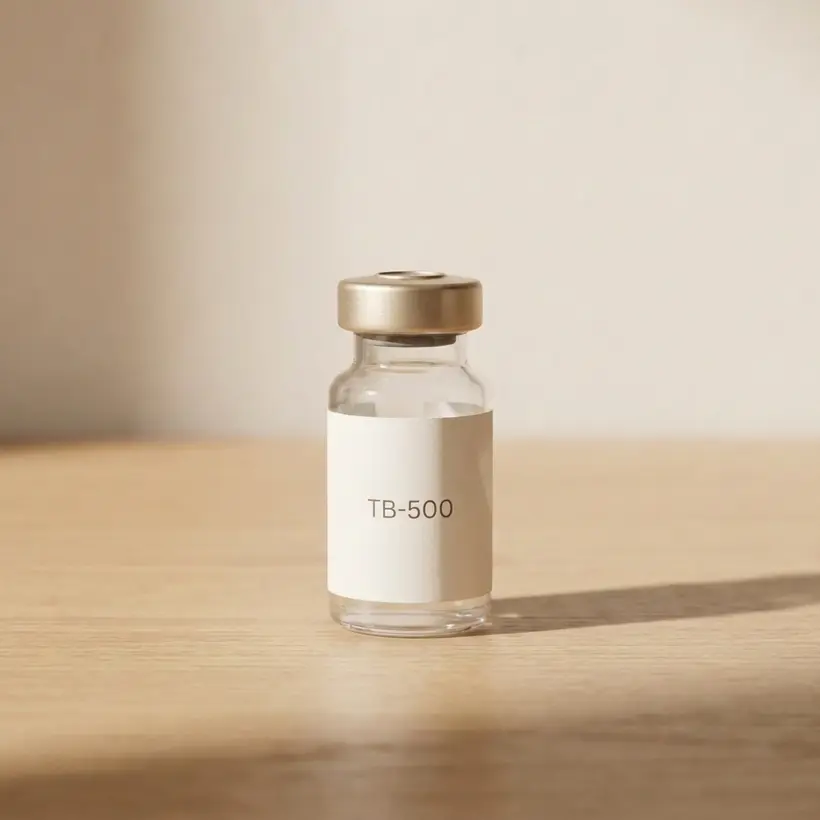
From the FormBlends catalog
TB-500 (Thymosin Beta-4)
Universal repair peptide for tissue regeneration · From $49/mo · compounded by a licensed 503A pharmacy, dispensed only after provider review.
Learn about TB-500 (Thymosin Beta-4) →Table of Contents
- What is TB-500 and why does it come as a powder?
- What supplies do I need before I start?
- Step-by-step TB-500 reconstitution
- Dilution math and syringe dosing table
- Why bacteriostatic water, not sterile water? The chemistry explained
- How long is reconstituted TB-500 stable?
- What most pages get wrong about TB-500 reconstitution
- Evidence ledger: what the science actually shows
- Honest head-to-head: TB-500 vs. BPC-157 vs. approved alternatives
- Label and COA literacy: how to judge your vial
- FAQ
- Sources
What Is TB-500 and Why Does It Come as a Powder?
TB-500 is a synthetic peptide corresponding to the central actin-binding fragment of Thymosin Beta-4, a 43-amino-acid protein expressed in most human tissues. The active fragment is generally cited as the sequence Ac-LKKTETQ (or a close variant spanning roughly amino acids 17 to 23 of Thymosin Beta-4), which retains the actin-sequestering activity of the parent molecule.
Peptides are sold lyophilized (freeze-dried) because aqueous solutions of most peptides degrade meaningfully over weeks at room temperature. Lyophilization removes water, slowing hydrolysis and oxidation to a near-standstill. The white powder you receive is chemically inert relative to a dissolved solution. Reconstitution reverses that process deliberately, right before use.
What Supplies Do I Need Before I Start?
- Bacteriostatic water for injection (USP-grade, 0.9% benzyl alcohol), 10 mL vial
- Two 1 mL U-100 insulin syringes (27 to 29 gauge, 0.5 inch needle): one for drawing the diluent, one for dosing
- Alcohol swabs (70% isopropyl alcohol)
- A clean flat surface and good lighting
- The TB-500 vial itself
Step-by-Step TB-500 Reconstitution
- Wash hands thoroughly for at least 20 seconds. Work on a disinfected surface.
- Swab both vial tops (bacteriostatic water vial and TB-500 vial) with fresh alcohol swabs. Allow to air-dry for 10 to 15 seconds. Do not re-swab.
- Draw bacteriostatic water into the syringe. For a 5 mg vial, draw 1 mL (100 units on U-100) for a 5 mg/mL solution, or 2 mL for a 2.5 mg/mL solution.
- Insert the needle at an angle into the TB-500 vial so the tip points toward the glass wall, not toward the powder.
- Depress the plunger very slowly, letting the liquid run down the inside wall of the vial. Directing the stream onto the dry cake causes foaming and can denature surface peptide molecules.
- Withdraw the needle and gently swirl the vial in a circular motion for 20 to 30 seconds. The powder should dissolve completely, yielding a clear, colorless solution. If any visible particulate remains after 2 minutes of gentle swirling, do not inject.
- Refrigerate immediately at 2 to 8 degrees Celsius. Label the vial with the reconstitution date.
- For each dose, use a fresh insulin syringe, swab the septum, draw the calculated volume, and inject within a few minutes.
Dilution Math and Syringe Dosing Table
The fundamental formula: Volume to draw (mL) = Target dose (mg) divided by Concentration (mg/mL). On a U-100 syringe, 1 mL equals 100 units, so multiply the mL value by 100 to read the syringe.
| Vial size | Bacteriostatic water added | Resulting concentration | Volume for 1 mg dose | U-100 syringe units for 1 mg | Volume for 2.5 mg dose | U-100 syringe units for 2.5 mg |
|---|---|---|---|---|---|---|
| 5 mg | 1 mL | 5 mg/mL | 0.20 mL | 20 units | 0.50 mL | 50 units |
| 5 mg | 2 mL | 2.5 mg/mL | 0.40 mL | 40 units | 1.00 mL | 100 units |
| 10 mg | 2 mL | 5 mg/mL | 0.20 mL | 20 units | 0.50 mL | 50 units |
| 10 mg | 4 mL | 2.5 mg/mL | 0.40 mL | 40 units | 1.00 mL | 100 units |
Research protocols for Thymosin Beta-4 in the published literature have used a wide range of doses. No human dose-ranging study for TB-500 specifically has been published. Extrapolating from animal work or from the limited full-length Thymosin Beta-4 human trials does not establish a proven optimal dose for TB-500.
Why Bacteriostatic Water, Not Sterile Water? The Chemistry Explained
Sterile water for injection (SWFI) contains no preservative. Once you pierce the stopper and introduce even trace atmospheric bacteria, a warm peptide solution is a nutrient-rich growth medium. The peptide itself can be degraded by microbial proteases within hours at room temperature.
Bacteriostatic water contains 0.9% benzyl alcohol (USP). Benzyl alcohol disrupts bacterial cell membranes by partitioning into the lipid bilayer, increasing permeability and ultimately causing cell lysis. It is effective across a broad range of Gram-positive and Gram-negative organisms at this concentration. Crucially, 0.9% benzyl alcohol does not meaningfully alter peptide solubility or the peptide's structural chemistry at refrigerator temperature.
The tradeoff: benzyl alcohol is cytotoxic at high concentrations and is contraindicated in neonates (FDA advisory). For typical adult subcutaneous use at the volumes involved (under 1 mL per injection), the benzyl alcohol dose per injection is well below any concern threshold. Still, some researchers prefer to use sterile water and treat the reconstituted vial as single-use within 24 hours. Either approach is defensible; multi-dose protocols require bacteriostatic water.
How Long Is Reconstituted TB-500 Stable?
No peer-reviewed stability kinetics specific to reconstituted TB-500 have been published. The widely cited "28 days refrigerated" figure derives from general peptide formulation guidance and manufacturers' technical documentation, not from independent HPLC degradation studies of this specific compound.
What the general peptide stability literature does establish:
- Lyophilized peptides stored at minus 20 degrees Celsius are typically stable for 12 to 24 months or more (manufacturer COA claims; independent verification varies).
- Reconstituted peptides in aqueous solution undergo hydrolysis, oxidation of susceptible residues (methionine, cysteine, tryptophan), and aggregation at rates that accelerate sharply with temperature.
- Avoiding freeze-thaw cycles after reconstitution is important: repeated crystallization and melting can cause aggregation. If you need to store long-term post-reconstitution, aliquot into single-dose portions and freeze only once.
What Most Pages Get Wrong About TB-500 Reconstitution
This is the section commodity pages skip.
1. Penetration and bioavailability assumptions are unstated. TB-500 is administered subcutaneously or intramuscularly in most protocols. Subcutaneous bioavailability for peptides of this size (roughly 900 Da for the active fragment) is generally high relative to oral routes, but it is not 100%. Absorption from a subcutaneous depot depends on local blood flow, injection site, and formulation. No human pharmacokinetic study specific to TB-500 has been published. The half-life figure commonly cited in forums is not sourced to a peer-reviewed pharmacokinetic study.
2. Purity and sourcing reality. TB-500 is sold as a research compound by numerous vendors. Purity claims of 98% or 99% on a vendor's website mean nothing without a certificate of analysis from an independent third-party laboratory using HPLC-UV and mass spectrometry to confirm identity and purity. Contamination with residual solvents, endotoxins, and incorrectly sequenced peptide is a real risk in the research peptide market. An endotoxin-contaminated vial can cause a febrile injection-site reaction even if the peptide itself is pure.
3. The "needle on the vial" mistake. Many reconstitution guides instruct users to leave a needle vented in the vial during reconstitution to equalize pressure. This is unnecessary for small-volume peptide vials and creates a contamination pathway. The vial already has a slight vacuum from the lyophilization process; that vacuum actually helps draw in liquid. No venting needle is needed.
4. Concentration affects injection comfort. Higher concentrations (5 mg/mL or above) mean smaller injection volumes, which feels convenient, but subcutaneous osmolality and vehicle composition affect local tolerability. Diluting to 1 to 2.5 mg/mL generally reduces injection-site discomfort and is worth the slightly larger volume.
Evidence Ledger: What the Science Actually Shows
| Claim | Best evidence type | Effect direction | Confidence | Key caveat |
|---|---|---|---|---|
| Thymosin Beta-4 promotes wound healing in animal models | Multiple animal studies (rodent, porcine) | Positive | Moderate (animal) | Animal-to-human translation is uncertain; TB-500 fragment not always tested |
| Thymosin Beta-4 actin-sequestering mechanism is established | Biochemical / structural studies | Established mechanism | High (mechanism) | Mechanism does not prove clinical outcome |
| Full-length Thymosin Beta-4 explored in human cardiac trials | Small human phase I/II trials (RegeneRx) | Safety established; efficacy unclear | Low (small n, early phase) | Not directly applicable to TB-500 fragment or injection protocols as sold |
| TB-500 specifically improves recovery or performance in humans | No published human RCT | Unknown | Very Low | Evidence base is forum reports and animal extrapolation only |
| Anti-inflammatory effects in animal injury models | Animal studies | Positive signal | Low to Moderate (animal) | Dose, timing, and injury type vary across studies |
| Bacteriostatic water preserves multi-dose peptide vials | Pharmaceutical formulation literature, USP standards | Positive / established | High | Stability is general peptide guidance; not TB-500-specific kinetics |
Honest Head-to-Head: TB-500 vs. BPC-157 vs. Approved Alternatives
| Compound | Human RCT evidence | Regulatory status (US) | Reconstitution complexity | Where the compound loses |
|---|---|---|---|---|
| TB-500 (Thymosin Beta-4 fragment) | None for TB-500 specifically; early-phase human data for parent molecule only | Not FDA-approved; research compound | Standard (lyophilized, reconstitute with BW) | No dose-response data in humans; WADA prohibited; sourcing purity unreliable |
| BPC-157 (body protection compound) | Minimal; human data largely absent despite decades of animal research | Not FDA-approved; research compound | Standard (same reconstitution process) | Same evidence gap; FDA issued warnings to compounders in 2024 |
| Platelet-rich plasma (PRP) | Multiple RCTs in tendinopathy and osteoarthritis; results mixed | Autologous procedure; FDA-cleared devices | Not applicable (clinical procedure) | Inconsistent results; requires clinic visit; expensive |
| NSAIDs (e.g., naproxen) for soft-tissue injury | Large RCT base; well-characterized effect size | FDA-approved (OTC and Rx) | None | GI and cardiovascular risks with chronic use; no regenerative mechanism |
The honest assessment: TB-500 has an interesting mechanistic rationale and a real signal in animal models. It does not yet have the human trial evidence that would let a clinician recommend it with confidence. That gap matters.
Label and COA Literacy: How to Judge Your Vial
Before you reconstitute anything, evaluate the product itself.
What the vial label should state: peptide name and sequence (or at minimum the common name), vial mass (e.g., 5 mg), lot number, and expiry date. Absence of a lot number makes traceability to a COA impossible.
What a real COA contains:
- HPLC purity expressed as a percentage, with a chromatogram. Look for single dominant peak with minimal shoulder peaks.
- Mass spectrometry confirmation showing the expected molecular weight. For the TB-500 fragment (sequence Ac-LKKTETQ and related variants), the expected molecular weight is in the range of roughly 750 to 900 Da depending on exact sequence and modification. If the vendor cannot tell you the exact sequence and MW they are testing, that is a red flag.
- Endotoxin testing (LAL assay), ideally below 1 EU/mg for injectable peptides.
- Moisture content (Karl Fischer) for lyophilized product.
- The testing laboratory name. A COA from the vendor's own in-house lab carries less weight than one from an independent analytical chemistry lab.
What degraded reconstituted TB-500 looks like: Discard immediately if you see cloudiness or turbidity that does not clear, visible white or colored particulates, any yellow or brown discoloration, or if the vial has an unusual odor when the stopper is removed. A fresh, properly reconstituted peptide solution should be completely clear and colorless.
FAQ
How do I reconstitute TB-500?
Add bacteriostatic water slowly down the inside wall of the vial, do not inject directly onto the powder cake. A common starting dilution is 1 mL bacteriostatic water per 5 mg vial, giving a concentration of 5 mg/mL. Swirl gently; never vortex or shake.
Can I use sterile water instead of bacteriostatic water for TB-500?
Sterile water lacks the 0.9% benzyl alcohol preservative that suppresses bacterial growth in multi-dose vials. A vial reconstituted with sterile water should ideally be used within 24 hours, whereas bacteriostatic water extends refrigerated stability to roughly 28 days for most peptides.
What concentration should I mix TB-500 to?
Most research protocols target 1 to 2.5 mg/mL. Adding 2 mL bacteriostatic water to a 5 mg vial gives 2.5 mg/mL; adding 1 mL gives 5 mg/mL. Lower concentrations reduce injection volume and are gentler on tissue at subcutaneous sites.
How long does reconstituted TB-500 last in the fridge?
When diluted in bacteriostatic water and stored at 2 to 8 degrees Celsius, most peptide vials are considered stable for approximately 28 days. Lyophilized (dry powder) TB-500 stored at minus 20 degrees Celsius has a much longer shelf life, often cited as 24 months or more by manufacturers, though independent verification is limited.
What does degraded TB-500 look like?
Discard the vial if you see visible particles that do not dissolve, a cloudy or milky appearance after full dissolution, unusual color (any yellow or brown tint), or if the solution has been left unrefrigerated for more than a few hours after reconstitution.
How do I draw the correct dose from a reconstituted TB-500 vial?
Divide your target dose in mg by the concentration in mg/mL to get the volume in mL, then convert to insulin syringe units (1 mL equals 100 units on a U-100 syringe). For example, a 2.5 mg dose from a 5 mg/mL solution is 0.5 mL, or 50 units on a U-100 syringe.
Is TB-500 the same as Thymosin Beta-4?
TB-500 is a synthetic peptide corresponding to the active fragment of Thymosin Beta-4, specifically the actin-binding sequence. Full-length Thymosin Beta-4 is a 43-amino-acid protein. TB-500 shares the key actin-regulatory domain but is not identical to the full endogenous protein.
Does TB-500 need to be refrigerated before opening?
Lyophilized TB-500 is relatively stable at room temperature for short transit periods, but manufacturers and most researchers recommend refrigerated storage at 2 to 8 degrees Celsius for routine keeping, and minus 20 degrees Celsius for long-term storage. Avoid repeated freeze-thaw cycles after reconstitution.
What syringe size is best for TB-500 injections?
A 1 mL U-100 insulin syringe with a 27 to 29 gauge needle is the standard choice for subcutaneous peptide injections. The fine gauge minimizes tissue trauma, and the U-100 markings allow precise dosing at typical research volumes of 0.2 to 1 mL.
Why should I swirl TB-500 rather than shake it?
Vigorous shaking introduces air bubbles and mechanical shear forces that can cause peptide aggregation or denaturation. Gentle swirling or slow rotation dissolves the lyophilized cake without disrupting the peptide's secondary structure.
What is the evidence that TB-500 works in humans?
Human evidence for TB-500 specifically is very limited. Most mechanistic data comes from animal studies and in vitro research on Thymosin Beta-4 or its fragments. A small number of human trials exist for full-length Thymosin Beta-4 in cardiac and wound-healing contexts, but these do not establish efficacy for TB-500 as sold.
Is TB-500 banned in sport?
Yes. The World Anti-Doping Agency (WADA) lists Thymosin Beta-4 and its fragments, including TB-500, on the Prohibited List under peptide hormones and related substances. Athletes subject to WADA-compliant testing should not use TB-500.
Sources
- Goldstein AL, Hannappel E, Sosne G, Kleinman HK. Thymosin beta4: a multi-functional regenerative peptide. Basic properties and clinical applications. Expert Opin Biol Ther. 2012;12(1):37-51.
- Crockford D. Development of thymosin beta4 for treatment of patients with ischemic heart disease. Ann N Y Acad Sci. 2007;1112:385-395.
- Hannappel E. Thymosin beta4 and its truncated version N-acetyl-seryl-aspartyl-lysyl-proline (AcSDKP) and the chemistry of the thymosins. Expert Opin Biol Ther. 2007;7(sup1):S37-46.
- World Anti-Doping Agency. Prohibited List 2024. Available at: wada-ama.org. Accessed May 2026.
- United States Pharmacopeia. Bacteriostatic Water for Injection monograph. USP-NF. Current edition.
- U.S. Food and Drug Administration. Benzyl alcohol toxicity in neonates. FDA Drug Safety Communication. 1982 (and subsequent reaffirmations).
- Manning MC, Chou DK, Murphy BM, Payne RW, Katayama DS. Stability of protein pharmaceuticals: an update. Pharm Res. 2010;27(4):544-575.
- Sosne G, Qiu P, Goldstein AL, Wheater M. Biological activities of thymosin beta4 defined by active sites in actin and oxidoreductase activity. FASEB J. 2010;24(7):2144-2151.
- RegeneRx Biopharmaceuticals. Phase I/II clinical trial data for RGN-352 (Thymosin Beta-4) in acute myocardial infarction. ClinicalTrials.gov. NCT00706225.
- U.S. Food and Drug Administration. FDA alerts compounders that certain peptides are not permissible for use in compounding. FDA News Release, 2024.
Footer Disclaimers
Platform: FormBlends provides educational and informational content only. Nothing on this page constitutes medical advice, diagnosis, or a treatment recommendation. Consult a licensed healthcare provider before using any peptide or research compound.
Research Compound: TB-500 is sold as a research compound. It is not approved by the U.S. Food and Drug Administration for any human therapeutic use. It is not intended to diagnose, treat, cure, or prevent any disease or medical condition.
Results: Individual outcomes, if any, will vary. The evidence base for TB-500 in humans is very limited. Claims of efficacy in athletic recovery or injury repair are not supported by human RCT data.
Trademark: "TB-500" is a commonly used trade name. "Thymosin Beta-4" refers to the endogenous human protein. FormBlends makes no trademark claims over either term. All third-party trademarks and registered names are the property of their respective owners.
Related peptide guides
Ready when you are
TB-500 (Thymosin Beta-4)
Universal repair peptide for tissue regeneration · From $49/mo · compounded by a licensed 503A pharmacy, dispensed only after provider review.
Learn about TB-500 (Thymosin Beta-4) →