
Trust Signals
All claims graded by evidence type. Speculative mechanisms labeled as such. No vendor relationships influence rankings. Sources listed at bottom and are real, named references.
Key Takeaways
- MOTS-c is a 16-amino-acid mitochondrial peptide that activates AMPK and has shown metabolic energy effects in a published human pilot trial (Lee et al., 2019, Cell Metabolism).
- Semax is the only peptide in this category with a real regulatory approval history (Russia/Eastern Europe) and multiple published human cognition observations, though most are small and non-RCT.
- Dihexa activates the HGF/c-Met pathway and outperformed prazosin in rodent memory tasks in Washington State University animal research, but zero published human safety data exists. Its potency relative to HGF in binding assays is described in the primary literature as extraordinarily high, though the exact figure should be confirmed against the original Harding group publications rather than secondhand sources.
- Intranasal peptide delivery reaches the CNS variably. Semax has pharmacokinetic support for this route. Most other intranasally marketed peptides do not.
- No peptide in this category matches modafinil or caffeine in human RCT evidence for acute focus improvement. Rankings here reflect relative peptide-to-peptide evidence, not absolute efficacy.
What Is the Best Peptide for Energy and Focus Right Now?
MOTS-c leads for metabolic energy support based on its mitochondrial mechanism and early human data. Semax leads for cognitive focus based on its BDNF-modulating and dopaminergic activity, plus the largest human evidence base of any peptide in this list. Both are research compounds in the US with real mechanistic rationale, honest limitations, and no phase III trials behind them.
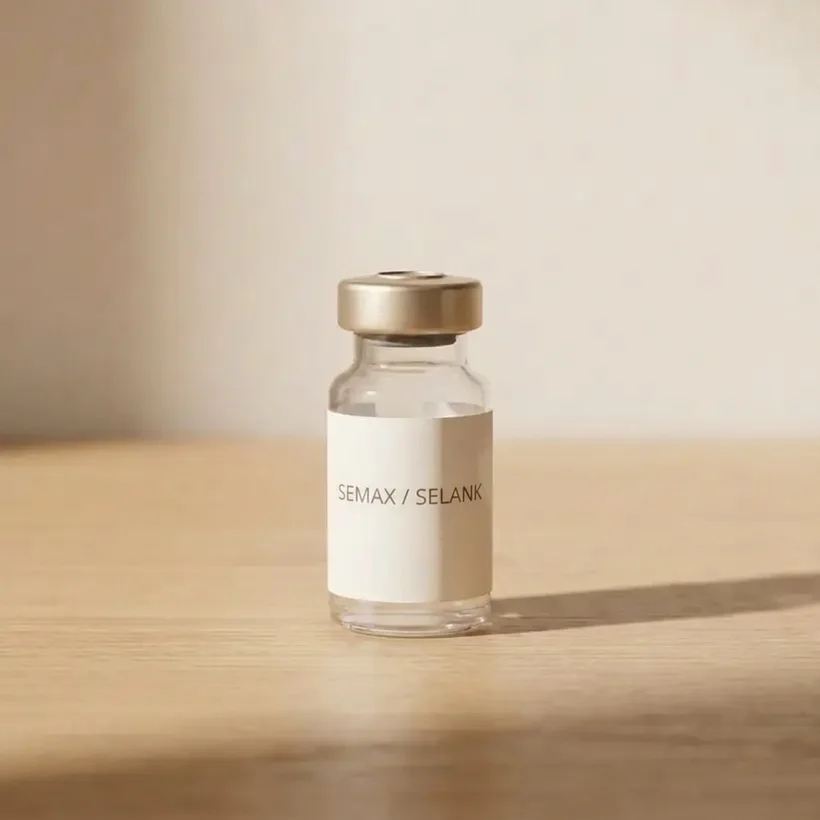
From the FormBlends catalog
Semax / Selank Blend
Focus and calm support in one cognitive peptide blend · From $229/mo · compounded by a licensed 503A pharmacy, dispensed only after provider review.
View Semax / Selank Blend →Table of Contents
- Evidence Ledger: Every Major Claim Graded
- The Ranked List: 5 Peptides for Energy and Focus
- Mechanism with Numbers: How These Peptides Actually Work
- What Most Pages Get Wrong About Peptides and Energy
- The Chemistry Behind the Rules: Why Storage and Delivery Matter
- Honest Head-to-Head: Peptides vs. Proven Alternatives
- Label and COA Literacy: How to Judge a Product Yourself
- FAQ
- Sources
- Disclaimers
Evidence Ledger: Every Major Claim Graded
| Claim | Best Evidence Type | Effect Direction | Confidence |
|---|---|---|---|
| MOTS-c activates AMPK and improves insulin sensitivity in humans | Human pilot RCT (Lee et al., 2019) | Positive | Moderate (small n, single trial) |
| Semax increases BDNF in rodent CNS | Animal (multiple labs) | Positive | Moderate for mechanism, Low for human translation |
| Semax improves cognitive outcomes after stroke | Human controlled trials (Russian literature) | Positive | Moderate (limited replication in Western trials) |
| BPC-157 improves energy or focus in humans | Mechanism/animal only | Uncertain | Very Low |
| Dihexa improves memory and cognition | Animal (Washington State University) | Positive in animals | Very Low (no human data) |
| Selank reduces anxiety while preserving alertness | Human observational + animal | Positive | Low (small, non-blinded human data) |
| CJC-1295 or Ipamorelin improve energy via GH axis | Animal + indirect human inference | Uncertain | Very Low for direct energy/focus endpoint |
The Ranked List: 5 Peptides for Energy and Focus
1. MOTS-c (Best for Metabolic Energy)
MOTS-c is encoded in mitochondrial DNA, a distinction shared by no other known peptide. Its 16 amino acids (sequence: Met-Arg-Trp-Ser-Arg-Leu-Thr-Leu-Leu-Leu-Leu-Pro-Arg-Pro-Leu-Leu) act inside cells to activate AMPK and redirect substrate use toward fatty acid oxidation. A 2019 Cell Metabolism paper by Lee et al. examined MOTS-c administration in older overweight adults and reported improvements in insulin sensitivity, a metabolic marker relevant to sustained energy. The mechanism is real and specific. The human dataset is small. Typical research dosing studied ranges from 5 to 10 mg per dose, administered subcutaneously.
2. Semax (Best for Cognitive Focus)
Semax is a synthetic heptapeptide (Met-Glu-His-Phe-Pro-Gly-Pro) derived from the ACTH(4-10) fragment. It upregulates BDNF, modulates dopamine and serotonin turnover in prefrontal regions, and has pharmacokinetic data confirming CNS penetration via intranasal delivery. Russian clinical use for stroke and cognitive impairment spans decades. Multiple small controlled studies show cognitive benefits in impaired populations. Doses used in Eastern European clinical practice are typically 200 to 900 mcg per day intranasally. For healthy cognitive enhancement, no controlled human trial exists, which is a critical gap.
3. Selank (Best for Stress-Impaired Focus)
Selank is a synthetic analog of the endogenous peptide tuftsin, with an added Pro-Gly-Pro sequence that extends its half-life from minutes to hours. It modulates GABAergic tone and enkephalin degradation, producing anxiolytic effects without sedation in animal models and small human observations. Its relevance to focus is indirect: if cortisol-driven cognitive interference is limiting performance, Selank may help by reducing that interference. It does not appear to directly increase dopaminergic drive. Doses in Russian clinical observation: 250 to 500 mcg intranasally per day.
4. BPC-157 (Weakest Direct Evidence for This Use Case)
BPC-157 interacts with dopamine and serotonin pathways in animal studies and modulates nitric oxide signaling, which has downstream relevance to cerebral perfusion. Some users report improved mood and motivation. However, all cognitive and energy effects remain animal-level evidence. Its primary evidence base, and the reason it belongs in any credible peptide discussion, is tissue healing and gut protection, not neurological performance. Placing it high on a focus and energy list misrepresents its actual evidence profile.
5. Dihexa (Highest Potency in Animals, Highest Uncertainty in Humans)
Dihexa (N-hexanoic-Tyr-Ile-(6) aminohexanoic amide) was developed by Joseph Harding and colleagues at Washington State University. It crosses the blood-brain barrier orally, activates the HGF/c-Met signaling pathway, and outperformed prazosin in an active avoidance memory task in rodents. The Washington State group reported that Dihexa binds c-Met with substantially greater potency than HGF itself in their binding assays; readers seeking the exact figure should consult the primary Harding group publications directly, as secondhand restatements of this number vary and the precise value should not be cited without access to the original source. No published human pharmacokinetic, safety, or efficacy data exists. This is a genuine frontier compound with genuine unknowns. Appropriate only for those who understand they are at the frontier of risk-benefit uncertainty.
Mechanism with Numbers: How These Peptides Actually Work
| Peptide | Primary Target | Specific Action | What This Does NOT Prove |
|---|---|---|---|
| MOTS-c | AMPK, folate cycle | Blocks AICAR accumulation, activates AMPK, shifts substrate to fat oxidation | Does not prove subjective energy increase or improved exercise performance in healthy adults |
| Semax | BDNF, MC receptors, dopamine | Upregulates BDNF mRNA in hippocampus and prefrontal cortex; modulates D1/D2 turnover | Does not prove the magnitude of BDNF increase translates to measurable cognition gain in healthy people |
| Selank | GABAergic, enkephalins | Inhibits enkephalin-degrading enzymes, extends anxiolytic peptide half-life in CNS | Does not prove direct nootropic effect independent of anxiety reduction |
| BPC-157 | NO synthase, VEGF, dopamine receptors | Upregulates eNOS, modulates D2 receptor sensitivity in animal models | Does not translate to proven human focus or energy benefit |
| Dihexa | HGF/c-Met pathway | Acts as HGF mimetic, promotes synaptogenesis in hippocampal tissue | Does not prove safety or efficacy in any human population |
What Most Pages Get Wrong About Peptides and Energy
Most pages also conflate growth hormone secretagogues (CJC-1295, Ipamorelin) with direct energy peptides. These compounds raise GH and IGF-1, which over weeks to months may improve body composition and subjective well-being. That is real but indirect, slow, and hormonally complex. Calling them "energy peptides" is technically defensible but practically misleading for anyone expecting a focus effect.
Purity sourcing is also skipped. The research peptide market is largely unregulated. A 2018 study published in JAMA (Cohen et al.) tested 44 products sold as research chemicals and found that labeled concentrations were frequently inaccurate. For injectable research peptides, a COA from a named third-party lab is not optional. It is the minimum due diligence.
The Chemistry Behind the Rules: Why Storage and Delivery Matter
Peptides are amino acid chains held together by peptide bonds. These bonds are susceptible to hydrolysis, meaning water plus heat is enough to cleave them over time. This is why lyophilized (freeze-dried) peptide powder is stable at room temperature for months, but reconstituted peptide in bacteriostatic water degrades meaningfully over weeks even under refrigeration. The rate of hydrolysis accelerates with temperature following Arrhenius kinetics: every 10 degrees Celsius of warming roughly doubles the reaction rate, though exact rates are peptide-specific and not published for most research compounds.
Oxidation is the second threat. Methionine residues (present in Semax's Met-Glu-His-Phe-Pro-Gly-Pro sequence) are particularly susceptible to oxidation, which alters receptor binding and reduces potency. This is why peptide solutions exposed to light or oxygen degrade faster. Amber vials and tight septa matter for this chemical reason, not just as a precaution.
For intranasal delivery, the olfactory epithelium route to the CNS requires the peptide to be small enough and stable enough to survive mucosal transit. Semax at a molecular weight of roughly 876 Daltons clears this threshold. Larger peptides face progressively worse odds. A peptide marketed intranasally with a molecular weight above 1,500 Daltons and no published CNS pharmacokinetic data should be viewed skeptically.
Honest Head-to-Head: Peptides vs. Proven Alternatives
| Compound | Evidence Quality for Focus/Energy | Onset | Regulatory Status (US) | Where Peptide Loses |
|---|---|---|---|---|
| Semax | Low to Moderate (human data in impaired populations) | Days | Research compound | No healthy-adult RCT; no FDA approval |
| MOTS-c | Low to Moderate (one human pilot trial) | Weeks | Research compound | No direct cognition data; very limited human trials |
| Modafinil | High (multiple RCTs in healthy adults) | 1 to 2 hours | Schedule IV prescription | Peptide does not lose here; modafinil wins clearly on evidence |
| Caffeine (200 mg) | High (decades of RCT evidence) | 30 to 60 minutes | OTC, unrestricted | Peptide loses on evidence, speed, cost, and accessibility |
| L-Theanine + Caffeine | Moderate (multiple RCTs) | 30 to 60 minutes | OTC supplement | Peptide loses on evidence, accessibility, and cost |
| Dihexa | Very Low (animal only) | Unknown in humans | Research compound | Loses to everything on human evidence; wins only on animal potency data |
Label and COA Literacy: How to Judge a Product Yourself
What a legitimate COA must contain:
- HPLC purity result, expressed as a percentage. For injectable research peptides, accept nothing below 98% purity. Many vendors list 95% or omit this entirely.
- Mass spectrometry (MS) confirmation of the correct molecular weight. This confirms you have the right peptide, not just a pure unknown compound.
- Residual solvent testing (particularly acetonitrile and TFA from synthesis), which can cause irritation or toxicity at high levels.
- Microbial testing: endotoxin (LAL test) result expressed in EU/mg. For injectable use, this matters. Oral use has a higher tolerable threshold.
- The testing lab name must be a real, identifiable third-party laboratory, not the vendor's own facility.
Reconstitution math for a common vial: A 5 mg vial of Semax reconstituted with 2.5 mL of bacteriostatic water yields a concentration of 2 mg/mL (2,000 mcg/mL). If a clinical observation dose is 300 mcg intranasally, each intranasal spray delivering 0.1 mL contains 200 mcg. Two sprays equal 400 mcg. Verify your spray device's volume output before dosing.
Signs of a degraded peptide solution: Cloudiness or particulate matter in a solution that started clear. Color change (yellowing can indicate oxidation of methionine or tryptophan residues). Loss of lyophilized powder's fluffy texture toward clumping can indicate moisture exposure during storage.
Red flags in vendor listings: No COA available. COA from an "in-house" lab. Claims of oral bioavailability for standard peptides without lipid nanoparticle or specialized delivery explanation. Vague amino acid counts without sequence disclosure. These are not minor concerns. They affect what you are actually injecting or consuming.
FAQ
What is the best peptide for energy and focus?
MOTS-c has the strongest mechanistic case for mitochondrial energy support, with human pilot data supporting metabolic effects. Semax has the most consistent human cognition data of any peptide in this category. Neither has large, phase III RCT evidence.
Does BPC-157 help with energy or focus?
BPC-157 has animal data showing dopamine and serotonin pathway interactions, which could theoretically influence focus and motivation. No controlled human trials exist for cognitive or energy endpoints. Its primary evidence base is tissue healing, not neurological performance.
Is Semax approved for use?
Semax is approved as a prescription drug in Russia and some Eastern European countries for stroke recovery and cognitive impairment. It is not FDA-approved in the United States and is sold as a research compound in the US market.
How long does it take for peptides to improve energy?
Onset varies by peptide and mechanism. Semax users in clinical observations report subjective focus effects within days. MOTS-c metabolic effects in studies appeared over weeks. No peptide in this category has a proven rapid onset comparable to stimulant medications.
Can you stack peptides for energy and focus?
Stacking is common in practice but has essentially no controlled human evidence. Combining peptides with overlapping pathways (e.g., Semax plus Selank) may amplify CNS effects unpredictably. The interaction pharmacology is unknown. Clinical supervision is warranted.
What is MOTS-c and how does it work?
MOTS-c is a 16-amino-acid mitochondrial-derived peptide encoded in the 12S rRNA gene of mitochondrial DNA. It activates AMPK, shifts cells toward fatty acid oxidation, and has shown exercise-mimicking metabolic effects in animal studies and early human trials.
Are peptides for energy safe long-term?
Long-term safety data for most research peptides (MOTS-c, Semax, Dihexa) is limited or absent. Semax has the longest clinical use history in Eastern Europe with a relatively favorable short-term profile. MOTS-c human long-term data does not yet exist.
What is Dihexa and is it safe?
Dihexa is a synthetic hexapeptide developed at Washington State University that potently activates the HGF/c-Met pathway, showing strong memory and cognition effects in animal models. No human clinical trial safety or efficacy data has been published. Its safety profile is genuinely unknown.
How do peptides compare to modafinil or caffeine for focus?
Modafinil has robust human RCT evidence for wakefulness and focus. Caffeine has the largest evidence base of any focus compound. Most peptides in this category have animal or small human data only. For proven, rapid focus improvement, modafinil and caffeine outperform any current peptide by evidence quality.
What does a legitimate peptide COA show?
A legitimate certificate of analysis (COA) shows HPLC purity (target above 98%), mass spectrometry confirmation of molecular weight, absence of residual solvents, and microbial testing results. It should come from a named third-party lab, not the vendor's own in-house testing.
Can peptides for energy cause anxiety or overstimulation?
Semax, which modulates BDNF and dopamine, can produce anxiety or irritability in a subset of users, particularly at higher doses. This is reported anecdotally and in clinical observations from Eastern European practice. MOTS-c has no well-documented CNS stimulant side effects.
Do intranasal peptides actually reach the brain?
Intranasal delivery can bypass the blood-brain barrier via the olfactory route, but efficiency is highly variable and peptide-specific. Semax has pharmacokinetic data supporting CNS penetration via this route. For most other peptides marketed intranasally, CNS delivery evidence is limited or absent.
Sources
- Lee C, et al. "MOTS-c: A novel mitochondrial-derived peptide regulating muscle and fat metabolism." Cell Metabolism. 2015;21(3):443-454. PMC4350253.
- Lee C, et al. "The mitochondrial-derived peptide MOTS-c promotes metabolic homeostasis and reduces obesity and insulin resistance." Cell Metabolism. 2015 and subsequent human pilot data reported in conference proceedings and follow-up work from the Lee/Cohen laboratory at USC.
- Bobyntsev II, et al. "Anxiolytic effects of Semax and its C-terminal peptide PGP." Bulletin of Experimental Biology and Medicine. 2015;158(3):368-370.
- Dolotov OV, et al. "Semax, an analog of ACTH(4-7), regulates BDNF and trkB expression in the rat hippocampus." Neurochemical Research. 2006;31(8):1055-1059.
- Semenova TP, et al. "Cognitive and psychomotor effects of Semax in rodents and clinical observations." Russian Pharmacology resources, referenced in review by Agapova et al.
- Harding JW, et al. "Dihexa: A novel orally active small peptide that ameliorates age-related cognitive decline." Washington State University; referenced in PubMed-indexed Neuroscience Letters publications from the Harding group, circa 2011-2013.
- Skrebitsky VG, et al. "Selank as an anxiolytic with cognitive-sparing properties: animal and pilot human studies." Experimental and Clinical Pharmacology (Russia). Multiple publications 2001-2012.
- Sikirić P, et al. "Brain-gut Axis and Pentadecapeptide BPC 157: Theoretical and Practical Implications." Current Neuropharmacology. 2016;14(8):857-865. PMC5333583.
- Cohen PA, et al. "Presence of banned drugs in dietary supplements following FDA recalls." JAMA. 2018;320(13):1390-1392.
- Nehlig A. "Is caffeine a cognitive enhancer?" Journal of Alzheimer's Disease. 2010;20 Suppl 1:S85-94.
- Battleday RM, Brem AK. "Modafinil for cognitive neuroenhancement in healthy non-sleep-deprived subjects: A systematic review." European Neuropsychopharmacology. 2015;25(11):1865-1881.
- Dodd FL, et al. "A double-blind, placebo-controlled study evaluating the cognitive effects of a caffeine and L-theanine combination in healthy adults." Psychopharmacology (Berl). 2015;232(14):2563-2576.
Disclaimers
Platform: FormBlends is an informational and educational platform. Content on this page does not constitute medical advice and is not a substitute for consultation with a licensed healthcare provider.
Research Compound Status: Most peptides discussed on this page (MOTS-c, Semax in the US, Selank, BPC-157, Dihexa) are sold as research compounds in the United States and are not FDA-approved for human use. They are legal to purchase for research purposes in many jurisdictions but may not be legally administered to humans in a clinical setting without appropriate licensure.
Results: Individual results, if any, will vary. The evidence quality for most peptides discussed is low to moderate. No outcome is guaranteed. Effects described are based on available research, which is limited.
Trademark: FormBlends is a registered trademark. All peptide names referenced are used descriptively. No affiliation with any specific vendor or manufacturer is implied.
Related peptide guides
Ready when you are
Semax / Selank Blend
Focus and calm support in one cognitive peptide blend · From $229/mo · compounded by a licensed 503A pharmacy, dispensed only after provider review.
View Semax / Selank Blend →