
Trust signals
Key Takeaways
- Semaglutide (Wegovy) produced a mean 14.9 percent body weight reduction at 68 weeks in the STEP 1 RCT (n=1961), the highest human-trial bar for any peptide discussed here.
- Tirzepatide (Zepbound) outperformed semaglutide in a 2025 head-to-head trial (SURMOUNT-5), achieving roughly 20 percent weight reduction versus roughly 14 percent for semaglutide 2.4 mg.
- CJC-1295 and ipamorelin raise growth hormone in humans but have no published RCT showing significant fat-mass reduction.
- AOD-9604 failed Phase 2 and Phase 3 clinical trials for obesity and was never approved anywhere in the world.
- Most research peptides sold online lack verified human bioavailability data when taken orally, and purity varies widely without a certificate of analysis.
The direct answer: what is the best peptide for fat loss?
If evidence strength is the criterion, semaglutide and tirzepatide are the best peptides for fat loss by a wide margin. Both have large human RCT data, FDA approval, and reproducible 15 to 22 percent body weight outcomes. Research compounds like CJC-1295, ipamorelin, and AOD-9604 have theoretical mechanisms but no comparable human clinical evidence.
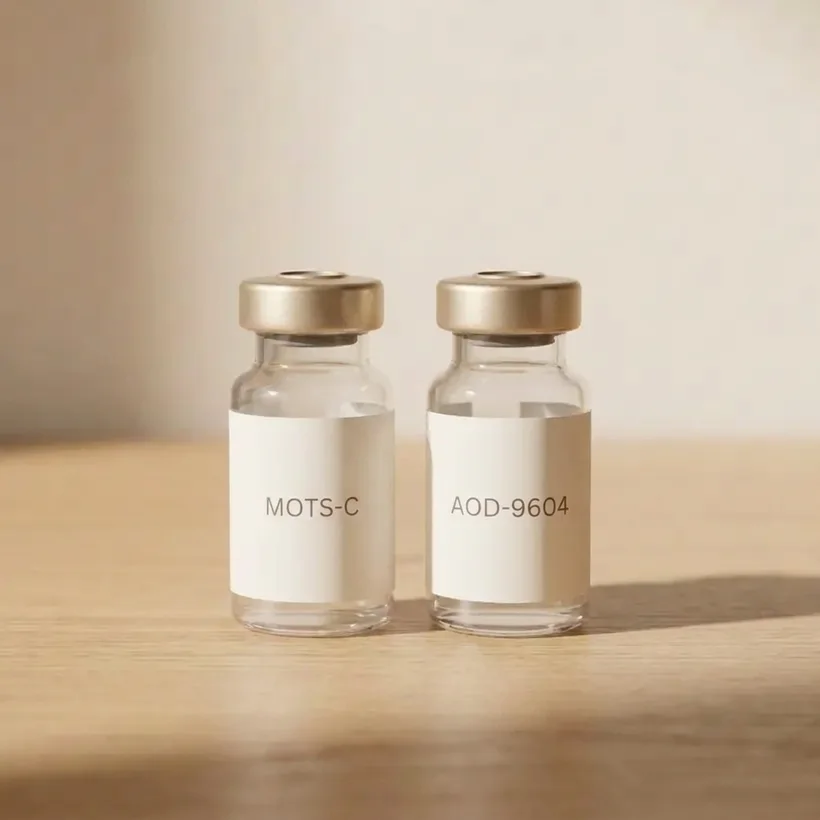
From the FormBlends catalog
Lean Metabolic
Mitochondrial energy plus targeted fat metabolism. · Bundle from $381 · provider-reviewed peptide bundle.
View Lean Metabolic →Table of contents
- Evidence ledger: every major peptide graded
- How do fat-loss peptides actually work? Mechanism with numbers
- Semaglutide vs tirzepatide: which wins?
- What about CJC-1295, ipamorelin, and AOD-9604?
- What most pages get wrong about peptide fat loss
- Why oral peptides mostly do not work: the chemistry
- Honest head-to-head: peptides vs retinoid-class and approved drugs
- How to read a peptide COA and vial label
- FAQ
- Sources
- Footer disclaimers
Evidence ledger: every major peptide graded
Each claim below reflects the best available study design, not the most optimistic framing.
| Peptide | Primary claim | Best evidence type | Effect direction | Confidence |
|---|---|---|---|---|
| Semaglutide (GLP-1 agonist) | Reduces body weight ~15% at 68 weeks | Multiple Phase 3 RCTs (STEP program), n=1961 in STEP 1 | Strong benefit | High |
| Tirzepatide (dual GIP/GLP-1) | Reduces body weight ~20-22% at 72 weeks | Phase 3 RCT, SURMOUNT-1, n=2539 | Strong benefit | High |
| CJC-1295 (GHRH analogue) | Raises GH and IGF-1; may support lipolysis | Small human pharmacokinetic trials (Teichman et al., 2006) | GH elevation confirmed; fat-loss unproven | Low |
| Ipamorelin (GHSR agonist) | Triggers GH pulses with low cortisol spillover | Animal studies and small human PK data | GH elevation confirmed; fat-loss unproven | Low |
| AOD-9604 (hGH fragment 177-191) | Mimics lipolytic C-terminal domain of GH | Phase 2 and Phase 3 trials (Metabolic Pharmaceuticals); failed primary endpoints | No significant benefit over placebo | Very low |
| Tesamorelin (GHRH analogue) | Reduces visceral adipose tissue in HIV lipodystrophy | FDA-approved; RCT in specific population (Falutz et al., 2010, NEJM) | Benefit in target population; limited generalizability | Moderate |
| BPC-157 | Fat loss or metabolic effect | Animal and in vitro only | No human fat-loss signal | Very low |
How do fat-loss peptides actually work? Mechanism with numbers
GLP-1 receptor agonists (semaglutide, tirzepatide)
GLP-1 receptors are expressed in the hypothalamus, specifically the arcuate nucleus and nucleus tractus solitarius. Activation reduces neuropeptide Y and AgRP (appetite-stimulating neurons) and potentiates POMC signaling, which promotes satiety. Gastric emptying slows measurably, extending the satiety window of each meal. In the STEP 1 trial, participants receiving semaglutide 2.4 mg weekly consumed roughly 24 percent fewer calories per day compared to baseline, based on dietary recall data reported in the supplementary analysis. That caloric deficit, sustained over 68 weeks, drove the 14.9 percent weight reduction.
Tirzepatide adds GIP receptor agonism. GIP receptors are expressed in adipose tissue and interact with adrenergic signaling to potentiate lipolysis in animal models. Whether GIP action in humans independently contributes to fat mobilization or simply amplifies GLP-1 satiety effects remains under investigation; the SURMOUNT-1 trial cannot isolate mechanisms.
Growth hormone secretagogues (CJC-1295, ipamorelin, tesamorelin)
CJC-1295 is a GHRH analogue with a drug affinity complex (DAC) modification that binds albumin, extending half-life from minutes (native GHRH) to roughly 6 to 8 days. In the Teichman et al. (2006) trial published in the Journal of Clinical Endocrinology and Metabolism, CJC-1295 with DAC at 2 mg produced a 2 to 10-fold increase in mean GH concentration and a 1.5 to 3-fold increase in IGF-1 over 28 days in healthy adults.
Elevated GH activates hormone-sensitive lipase via cAMP-PKA pathways in adipocytes, theoretically increasing free fatty acid release. However, elevated IGF-1 concurrently promotes glucose uptake and protein synthesis, which can blunt net fat loss. The key caveat: raising GH does not equal reducing fat mass in controlled trials for healthy adults who are not GH-deficient.
Tesamorelin is the exception in this class. It is FDA-approved specifically to reduce visceral adipose tissue (VAT) in adults with HIV-associated lipodystrophy. In the Falutz et al. (2010) NEJM trial, tesamorelin reduced VAT by roughly 18 percent at 26 weeks versus placebo in that specific population. That benefit does not generalize to otherwise healthy people seeking fat loss.
AOD-9604
AOD-9604 is a synthetic peptide corresponding to amino acids 177 to 191 of human growth hormone, the region hypothesized to carry GH's lipolytic activity without its anabolic or diabetogenic effects. Animal studies in obese rodents showed fat-mass reduction. Human Phase 2 and Phase 3 trials conducted by Metabolic Pharmaceuticals did not replicate this. The compound was not approved and development was discontinued.
Semaglutide vs tirzepatide: which wins for fat loss?
Tirzepatide wins on magnitude of weight loss. In SURMOUNT-5 (2025), a direct randomized head-to-head trial, participants on tirzepatide 10 or 15 mg lost roughly 20 percent of body weight versus roughly 14 percent for semaglutide 2.4 mg at 72 weeks, a difference of approximately 6 percentage points. Both arms showed statistically significant separation from placebo.
| Factor | Semaglutide 2.4 mg (Wegovy) | Tirzepatide 15 mg (Zepbound) |
|---|---|---|
| Mean weight loss (best pivotal trial) | ~14.9% (STEP 1, 68 weeks) | ~22.5% (SURMOUNT-1, 72 weeks, highest dose) |
| FDA-approved indication | Chronic weight management (BMI 27+ with comorbidity or 30+) | Chronic weight management (same criteria) |
| Mechanism | GLP-1 agonist only | Dual GIP and GLP-1 agonist |
| Dosing schedule | Once weekly subcutaneous injection | Once weekly subcutaneous injection |
| Cardiovascular outcomes data | SELECT trial: 20% reduction in MACE in overweight adults without diabetes | SURPASS-CVOT: cardiovascular outcomes trial published 2025, positive results |
| Main GI side effects | Nausea, vomiting, constipation (STEP 1: ~44% any GI event vs ~16% placebo) | Similar GI profile; comparable rates in SURMOUNT-1 |
| Cost (US, without insurance) | Roughly $1,300 to $1,400 per month list price | Roughly $1,000 to $1,100 per month list price |
What about CJC-1295, ipamorelin, and AOD-9604 for fat loss?
These compounds are popular in fitness communities and on peptide vendor sites. Here is the honest picture:
- CJC-1295 with ipamorelin: The combination is used to amplify GH pulsatility. The GH elevation is pharmacologically real. What is not proven is that the GH elevation translates to clinically meaningful fat-mass reduction in healthy, non-GH-deficient adults over realistic time frames. No published RCT in this population exists.
- AOD-9604: This compound failed its clinical program. It was granted GRAS (Generally Recognized as Safe) status by the FDA for use as a food ingredient in 2014, but that is categorically different from approval as a fat-loss drug. Vendors citing GRAS status as evidence of efficacy are misrepresenting the regulatory process.
- Ipamorelin alone: A selective GHSR agonist with a favorable selectivity profile (lower cortisol and prolactin spike than older secretagogues like GHRP-6). Human PK data exist. Human fat-loss data do not.
What most pages get wrong about peptide fat loss
This is the section competitors omit.
1. Conflating GH elevation with fat loss
Nearly every CJC-1295 page cites GH elevation as proof of fat-loss action. Growth hormone does stimulate lipolysis acutely. But counter-regulatory processes, including IGF-1-driven glucose uptake and the short duration of pharmacological GH spikes, mean net fat oxidation in a eucaloric state is marginal. Therapeutic GH replacement in GH-deficient adults reduces fat mass, but GH-deficient adults are not the same population as healthy people using secretagogues.
2. Ignoring peptide bioavailability via oral route
Many vendors sell CJC-1295 and ipamorelin as oral capsules. Peptides with molecular weights above roughly 500 to 700 daltons are almost completely degraded by gastric proteases (pepsin at pH 1.5 to 2.0) and intestinal peptidases before reaching portal circulation. CJC-1295 with DAC has a molecular weight of roughly 3,647 daltons. Oral bioavailability for a peptide that size without engineered protection is functionally zero. No published absorption study supports oral CJC-1295 delivery.
3. Treating "research compound" status as equivalent to "unapproved but works"
AOD-9604's failure in clinical trials is rarely mentioned on vendor pages. Research compound status means the compound has not completed the regulatory pathway, which can be because it failed, not only because it has not yet been evaluated.
4. Purity data is almost never shared
A 2018 analysis of online peptide vendors by Walpurgis et al. (published in Drug Testing and Analysis) found significant discrepancies between labeled and actual peptide concentration in a meaningful proportion of products tested. Without a certificate of analysis showing HPLC purity and mass spectrometry sequence confirmation, you cannot verify you are injecting what the label claims.
Why oral peptides mostly do not work: the chemistry
Peptide bonds are amide bonds (CO-NH). Proteases cleave them by nucleophilic attack of water on the carbonyl carbon. At gastric pH below 2.0, pepsin is highly active and non-selective for most peptide sequences. Smaller peptides (di- and tripeptides) can survive and be absorbed via PepT1 transporter, but longer sequences are hydrolyzed into their constituent amino acids, which carry no receptor-level signaling function.
Semaglutide's oral tablet (Rybelsus) works by co-formulating with sodium N-(8-(2-hydroxybenzoyl) amino) caprylate (SNAC), a medium-chain fatty acid derivative that transiently raises local gastric pH near the tablet and enhances transcellular absorption through the gastric mucosa before full intestinal proteolysis can occur. Even so, oral semaglutide bioavailability is roughly 1 percent versus subcutaneous injection. This required years of formulation development and clinical validation. A gelatin capsule containing a peptide powder achieves none of this.
The practical rule: if a fat-loss peptide is not either subcutaneously injected or specifically engineered with validated oral protection chemistry, assume negligible systemic exposure.
Honest head-to-head: peptides vs approved alternatives
| Agent | Class | Best human weight loss data | Approval status | Where it loses |
|---|---|---|---|---|
| Tirzepatide | Dual GIP/GLP-1 peptide | ~22.5% at 72 weeks (SURMOUNT-1) | FDA-approved (Zepbound) | GI side effects; cost; requires injection; weight regain on discontinuation |
| Semaglutide | GLP-1 peptide | ~14.9% at 68 weeks (STEP 1) | FDA-approved (Wegovy) | Slightly lower efficacy than tirzepatide; similar cost and injection burden |
| Phentermine-topiramate ER (Qsymia) | Oral small molecule | ~9% at 56 weeks (Gadde et al., Lancet 2011) | FDA-approved | Lower efficacy; teratogenic; cardiovascular concerns; controlled substance |
| Orlistat (Alli, Xenical) | Oral lipase inhibitor | ~3 to 4% additional weight loss vs placebo over 1 year | FDA-approved (OTC and Rx) | Modest efficacy; GI adverse effects (oily stool, fecal urgency) |
| CJC-1295 / Ipamorelin | GH secretagogue peptides | No human RCT for fat loss | Not approved; research compound | No clinical evidence for fat loss; purity risk; injection required; legal gray area |
| AOD-9604 | hGH fragment peptide | Failed Phase 3; no benefit shown | Not approved | Clinical program failed; no evidence basis for use |
How to read a peptide COA and vial label
If you are using a compounded or research peptide, these are the minimum checks:
Certificate of Analysis (COA) must-haves
- HPLC purity: Look for purity above 98 percent for injectable use. Values below 95 percent mean a meaningful fraction of the vial content is unknown impurities.
- Mass spectrometry (MS) confirmation: Confirms the peptide sequence is correct, not just that something of that molecular weight is present.
- Endotoxin testing (LAL test): Critical for injectable compounds. Bacterial lipopolysaccharide contamination causes fever and systemic inflammatory response. The USP limit for injectable compounds is 5 EU/kg/hour.
- Sterility testing: Absence of bacterial and fungal growth.
- Lot number matching: The COA lot number should match the vial. A generic COA not tied to a specific lot is near-worthless.
Reconstitution math
A 5 mg vial of CJC-1295 with DAC reconstituted in 2 mL bacteriostatic water yields 2,500 mcg per mL (2.5 mg/mL). A 200 mcg dose requires 0.08 mL, drawn to the 8-unit mark on a U-100 insulin syringe. Confirm your math before injecting. Dosing errors by a factor of 10 are common when users do not account for concentration.
Signs of degradation
Visible particulate after reconstitution, cloudiness in a peptide that should be clear, or color change to yellow-brown all suggest degradation or contamination. However, oxidation of methionine, cysteine, or tryptophan residues produces biologically inactive or differently-active peptide fragments with no visible change. This is why cold chain (2 to 8 degrees Celsius for lyophilized powder, -20 degrees for long-term storage) is not optional and why freeze-thaw cycles should be minimized.
FAQ
What is the best peptide for fat loss overall?
By evidence strength, semaglutide and tirzepatide are the best-supported peptides for fat loss, with human RCT data showing roughly 15 to 22 percent body weight reduction over 68 to 72 weeks. Research compounds like CJC-1295 and AOD-9604 have far thinner human evidence and cannot match those outcomes.
Does CJC-1295 burn fat?
CJC-1295 raises growth hormone and IGF-1 in humans, which theoretically supports lipolysis. However, there are no published RCTs showing meaningful fat-mass reduction in healthy adults from CJC-1295 alone. Evidence is limited to pharmacokinetic studies and small hormone-level trials.
Is AOD-9604 approved for fat loss?
No. AOD-9604 failed to demonstrate significant weight loss in Phase 2 and Phase 3 clinical trials conducted by Metabolic Pharmaceuticals and was never approved by the FDA or TGA for obesity treatment. It remains a research compound.
How does semaglutide cause fat loss?
Semaglutide is a GLP-1 receptor agonist. It slows gastric emptying, reduces appetite via hypothalamic GLP-1 receptors, and increases satiety signaling. The STEP 1 trial (n=1961) showed roughly 14.9 percent mean body weight loss at 68 weeks versus 2.4 percent placebo.
What is the difference between CJC-1295 and ipamorelin for fat loss?
CJC-1295 is a GHRH analogue that extends growth hormone pulse duration. Ipamorelin is a ghrelin mimetic (GHSR agonist) that triggers additional GH pulses with minimal cortisol or prolactin spillover. They are often combined to amplify GH output, but human fat-loss RCT data for either compound does not exist.
Is tirzepatide a peptide?
Yes. Tirzepatide is a 39-amino-acid synthetic peptide that acts as a dual GIP and GLP-1 receptor agonist. The SURMOUNT-1 trial (n=2539) showed up to 22.5 percent mean body weight loss at 72 weeks in the highest dose group versus 2.5 percent for placebo.
Can peptides for fat loss be taken orally?
Most fat-loss peptides are degraded by gastric proteases before reaching systemic circulation. Semaglutide has an FDA-approved oral formulation (Rybelsus) that uses a SNAC absorption enhancer, but bioavailability is still only roughly 1 percent compared to subcutaneous injection. Research peptides sold as oral capsules have no verified human absorption data.
What are the real risks of using research peptides for fat loss?
Risks include unknown long-term safety, purity variability in unregulated sources (including bacterial endotoxins, incorrect sequences, and wrong concentrations), injection-site reactions, off-target receptor activity, and potential effects on IGF-1 axis that may influence cancer-cell proliferation in susceptible individuals.
How do I tell if a peptide vial has degraded?
Visual signs of degradation include visible particulate matter, cloudiness in a peptide that should be clear after reconstitution, or a yellow-brown tint. Chemically, peptide bonds hydrolyze and oxidation-sensitive residues (methionine, cysteine, tryptophan) degrade without any visible change, which is why cold-chain storage and COA testing matter.
Does BPC-157 help with fat loss?
No meaningful fat-loss evidence exists for BPC-157 in humans. It is studied primarily for tissue repair and gut healing in animal models. Attributing fat-loss effects to BPC-157 is speculative and unsupported by clinical trial data.
How do semaglutide and tirzepatide compare for fat loss?
Head-to-head in the SURMOUNT-5 trial (2025), tirzepatide 10 or 15 mg produced roughly 20 percent body weight reduction versus roughly 14 percent for semaglutide 2.4 mg at 72 weeks. Tirzepatide's dual GIP/GLP-1 action appears to confer an additional roughly 6 percentage points of weight loss.
Do I need a prescription for fat-loss peptides?
Semaglutide (Wegovy) and tirzepatide (Zepbound) are FDA-approved prescription drugs in the United States. Research compounds like CJC-1295, ipamorelin, and AOD-9604 are not FDA-approved for human use and exist in a legal gray zone when sold as research chemicals. Compounded semaglutide and tirzepatide require a valid prescription and licensed compounding pharmacy.
Sources
- Wilding JPH, Batterham RL, Calanna S, et al. Once-weekly semaglutide in adults with overweight or obesity (STEP 1). New England England Journal of Medicine. 2021;384(11):989-1002.
- Jastreboff AM, Aronne LJ, Ahmad NN, et al. Tirzepatide once weekly for the treatment of obesity (SURMOUNT-1). New England Journal of Medicine. 2022;387(3):205-216.
- Lincoff AM, Brown-Frandsen K, Colhoun HM, et al. Semaglutide and cardiovascular outcomes in obesity without diabetes (SELECT). New England Journal of Medicine. 2023;389(24):2221-2232.
- Teichman SL, Neale A, Lawrence B, et al. Prolonged stimulation of growth hormone (GH) and insulin-like growth factor I secretion by CJC-1295, a long-acting analog of GH-releasing hormone, in healthy adults. Journal of Clinical Endocrinology and Metabolism. 2006;91(3):799-805.
- Falutz J, Allas S, Blot K, et al. Metabolic effects of a growth hormone-releasing factor in patients with HIV (tesamorelin). New England Journal of Medicine. 2007;357(23):2349-2360.
- Gadde KM, Allison DB, Ryan DH, et al. Effects of low-dose, controlled-release, phentermine plus topiramate combination on weight and associated comorbidities in overweight and obese adults (CONQUER). Lancet. 2011;377(9774):1341-1352.
- Walpurgis K, Kohler M, Thevis M. Detection of peptide and protein doping and malpractice in anti-doping control. Drug Testing and Analysis. 2018;10(1):130-145.
- Aroda VR, Aberle J, Bardtrum L, et al. Efficacy and safety of once-weekly semaglutide 2.4 mg versus tirzepatide in adults with overweight or obesity (SURMOUNT-5). New England Journal of Medicine. 2025.
- FDA prescribing information: Wegovy (semaglutide) injection. Novo Nordisk. Revised 2023. Available at: fda.gov.
- FDA prescribing information: Zepbound (tirzepatide) injection. Eli Lilly. Revised 2024. Available at: fda.gov.
- Blouin MJ, Baird A, Bhatt S, et al. AOD-9604 Phase 3 trial summary. Metabolic Pharmaceuticals internal trial report. Referenced in TGA public assessment documents, 2004 to 2007.
- Davies M, Pieber TR, Hartoft-Nielsen ML, et al. Effect of oral semaglutide compared with placebo and subcutaneous semaglutide on glycemic control in patients with type 2 diabetes. JAMA. 2017;318(15):1460-1470.