
Trust Signals
Sources: PubMed, ClinicalTrials.gov, FDA drug databases, WADA prohibited list 2024. Competing claims are graded against their actual evidence type. No affiliate relationships influence rankings.
Regulatory notice: The peptides discussed on this page are research compounds or require a prescription in most jurisdictions. This page is educational only. It does not constitute medical advice or a recommendation to use any substance.
Key Takeaways
- IGF-1 LR3 binds the IGF-1 receptor with greater effective potency than native IGF-1 because structural changes substantially reduce its affinity for insulin-like growth factor binding proteins (IGFBPs), increasing the free fraction available at the receptor. The magnitude of this binding reduction is documented in in vitro studies but human RCT evidence for lean mass gain is absent.
- CJC-1295 without DAC has a half-life of roughly 30 minutes; the DAC version extends this to approximately 6 to 8 days by covalent albumin binding, producing a continuous GH bleed rather than a physiological pulse.
- Tesamorelin is the only GHRH-class peptide with FDA approval and Phase III trial data, but its indication is HIV-associated lipodystrophy, not general muscle hypertrophy.
- BPC-157 and TB-500 have mechanistically plausible indirect roles in muscle recovery, but their evidence base is almost entirely rodent studies with no completed human RCTs.
- Unregulated peptide vendors frequently deliver products below labeled purity; a batch-specific COA with HPLC and mass spectrometry is the minimum standard for quality verification.
What is the best peptide for muscle gain?
For pure anabolic mechanism, IGF-1 LR3 leads the field among research peptides because it acts directly on the IGF-1 receptor in muscle satellite cells with substantially reduced binding-protein interference. For the most human evidence in the GHRH class, CJC-1295 plus ipamorelin is the most studied combination. Neither has completed Phase III RCTs in healthy adults for hypertrophy. Effect sizes are smaller than anabolic-androgenic steroids, full stop.
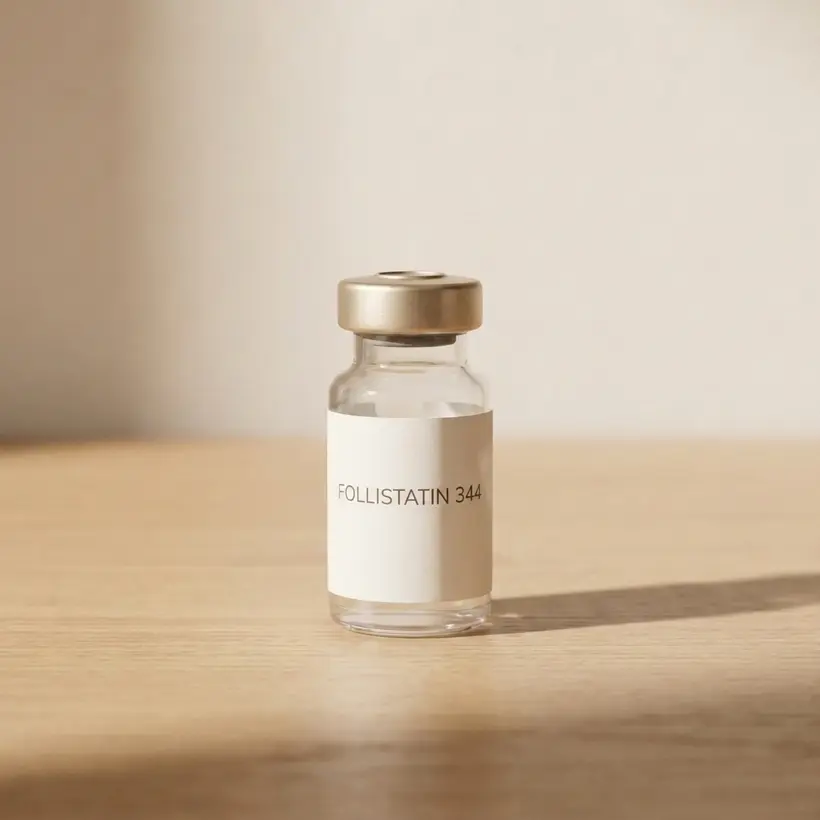
From the FormBlends catalog
Follistatin 344
Myostatin inhibitor studied for enhanced muscle growth · From $149/mo · compounded by a licensed 503A pharmacy, dispensed only after provider review.
Learn about Follistatin 344 →Table of Contents
- Evidence ledger: every major claim graded
- How do peptides build muscle? Mechanism with real numbers
- Ranked list: the 5 best peptides for muscle gain
- What most pages get wrong (bioavailability and sourcing reality)
- Why the storage and stability rules exist: the chemistry
- Honest head-to-head: peptides vs. steroids vs. SARMs
- How to read a COA and dose correctly
- Risks competitors understate
- FAQ
- Sources
Evidence Ledger: Every Major Claim Graded
| Claim | Best Evidence Type | Effect Direction | Confidence |
|---|---|---|---|
| IGF-1 LR3 has substantially reduced IGFBP binding vs. native IGF-1 | In vitro receptor binding studies | Positive (mechanism confirmed) | High (mechanism) |
| CJC-1295 plus ipamorelin elevates GH and IGF-1 in humans | Small human pharmacokinetic trials | Positive | Moderate |
| GHRH analogs produce lean mass gains in healthy adults | Limited RCT data; mostly GH-deficient populations | Small positive or neutral | Low |
| BPC-157 accelerates tendon and muscle repair | Rodent studies only | Positive in animals | Very Low (humans) |
| TB-500 activates satellite cells and promotes angiogenesis | Rodent and in vitro studies | Positive in animals | Very Low (humans) |
| Tesamorelin reduces visceral fat in HIV lipodystrophy | Phase III RCTs (LIPO-010, LIPO-011) | Positive for fat reduction | High (for approved indication) |
| IGF-1 pathway stimulation may promote tumor growth | Epidemiological data and animal carcinogenesis studies | Risk signal present | Moderate concern |
| Ipamorelin is more ghrelin-receptor selective than GHRP-6 | In vitro receptor binding and animal studies | Positive (fewer cortisol/prolactin side effects) | Moderate |
How Do Peptides Build Muscle? Mechanism with Real Numbers
Peptides used for muscle gain work through two main axes:
GH/IGF-1 axis (GHRH and ghrelin mimetics). Growth hormone-releasing hormone analogs (CJC-1295, tesamorelin) stimulate pituitary somatotrophs via the GHRH receptor (GHRHR). Ghrelin mimetics (ipamorelin, GHRP-6) act on the growth hormone secretagogue receptor 1a (GHSR-1a). Both increase pulsatile GH release. GH then stimulates hepatic and peripheral IGF-1 production. IGF-1 binds the IGF-1 receptor (IGF-1R, a receptor tyrosine kinase), activating PI3K-Akt-mTORC1, the central node of muscle protein synthesis. In the Teichman et al. CJC-1295 dose-ranging trial (2006, Journal of Clinical Endocrinology and Metabolism, n=66), a single injection of CJC-1295 with DAC produced mean GH increases of 2 to 10-fold over baseline depending on dose, with IGF-1 elevations persisting for 6 to 8 days. What this does NOT prove: that those IGF-1 elevations translate to measurable hypertrophy in healthy, eugonadal, well-nourished adults training at adequate volume.
Direct IGF-1R activation (IGF-1 LR3). IGF-1 LR3 is an 83-amino-acid analog of human IGF-1 with an arginine substitution at position 3 and an N-terminal 13-amino-acid extension. These structural changes substantially reduce its affinity for IGFBPs (especially IGFBP-3), increasing the free bioavailable fraction available at the receptor. In vitro binding studies confirm the degree of IGFBP affinity reduction is large relative to native IGF-1, though published figures vary across assay conditions and the precise fold-difference should be interpreted in context of each study's methodology. IGF-1 LR3's circulating half-life is meaningfully longer than native IGF-1 because reduced IGFBP binding removes a key clearance mechanism; the exact duration in humans has not been established in published clinical trials. In vitro data confirm it is a full IGF-1R agonist. Muscle satellite cell activation via IGF-1R is well established mechanistically. The honest caveat: there are no published human RCTs using IGF-1 LR3 specifically for skeletal muscle hypertrophy.
Ranked List: The 5 Best Peptides for Muscle Gain
1. IGF-1 LR3
Strongest direct mechanistic case. Acts downstream of GH, directly on muscle IGF-1 receptors, with substantially reduced IGFBP interference extending receptor exposure. Research protocol doses typically cited range from 20 to 50 mcg per day or post-workout. Risk of hypoglycemia due to weak insulin-receptor cross-reactivity is real and dose-dependent. Evidence grade: mechanistically High, clinically Very Low.
2. CJC-1295 (Mod GRF 1-29, without DAC) plus Ipamorelin
The most commonly paired combination in research settings. CJC-1295 without DAC preserves pulsatile GH release (half-life roughly 30 minutes) while ipamorelin provides complementary GHSR-1a stimulation with lower cortisol and prolactin side-effect burden than GHRP-6 or GHRP-2. Human pharmacokinetic data exist (Raun et al. 1998 for ipamorelin). Common research doses are 100 mcg of each per injection, 1 to 3 times daily, typically pre-sleep and pre-training. Evidence grade: Moderate for GH elevation, Low for lean mass outcomes.
3. Tesamorelin
The only FDA-approved GHRH analog, prescribed for HIV-associated lipodystrophy (trade name Egrifta). Phase III data (Falutz et al. 2010, Annals of Internal Medicine, n=412) confirm visceral fat reduction. Lean mass changes were secondary endpoints with modest effect. Its human evidence base is the strongest of any peptide on this list. Off-label use for muscle gain in healthy people is not supported by the trial data. Requires prescription. Evidence grade: High for approved indication, Low for general hypertrophy.
4. BPC-157
A 15-amino-acid peptide derived from a protein found in gastric juice. Rodent studies by Sikiric and colleagues show accelerated tendon-to-bone healing, upregulation of VEGFR2, and satellite cell-related repair signaling. The plausible mechanism for muscle gain is indirect: improved connective tissue recovery enabling higher training load. There are no published human RCTs. Oral and injectable forms are both studied in animals; oral bioavailability in humans is not established. Evidence grade: Very Low (humans).
5. TB-500 (Thymosin Beta-4 fragment)
TB-500 encompasses residues 17 to 23 of Thymosin Beta-4 (sequence LKKTETQ), the actin-sequestering domain. It promotes actin polymerization, cell migration, and angiogenesis in preclinical models. Satellite cell activation in rodent muscle injury models has been demonstrated. Human data are minimal. It is prohibited by WADA under Section S2 (peptide hormones and related substances). Evidence grade: Very Low (humans).
What Most Pages Get Wrong: Bioavailability and Sourcing Reality
This is the section commodity pages skip.
Subcutaneous bioavailability is not 100%. Most research peptides are administered subcutaneously. Bioavailability for SC-injected peptides generally ranges from roughly 70% to 90% depending on molecular size, charge, and formulation, but vendor data for specific research peptides rarely include formal bioavailability studies in humans. IGF-1 LR3 at roughly 9200 Da is near the upper size limit where SC absorption becomes less predictable compared to smaller peptides like ipamorelin at 711 Da.
Oral peptides do not survive first-pass digestion. Any product marketing "oral" IGF-1 or "oral" GHRH analogs is relying on you not understanding that peptide bonds are cleaved by gastric proteases. No evidence supports meaningful oral bioavailability for these molecules in unprotected form. BPC-157 oral studies in rodents use gastric-stable models that do not translate directly to humans without specific enteric formulation data.
Vendor purity is inconsistent. Independent testing of research peptide vendors has repeatedly found products below labeled purity, wrong peptides, or bacterial endotoxin contamination. A 2018 analysis published in Drug Testing and Analysis tested commercially available research peptides and found significant deviations from labeled content in a meaningful proportion of samples. Always demand a batch-specific COA with HPLC purity of 98% or above and mass spectrometry confirmation of molecular weight before use.
Water for injection vs. bacteriostatic water. Using sterile water for injection (no preservative) means the reconstituted peptide must be used within 24 hours because microbial contamination risk rises quickly. Bacteriostatic water (0.9% benzyl alcohol) extends usable refrigerated life to roughly 28 to 30 days. Using tap water or saline with preservatives other than benzyl alcohol can cause degradation through pH mismatch or redox reactions with peptide side chains.
Why the Storage and Stability Rules Exist: The Chemistry
Oxidation of methionine and cysteine residues. Many peptides contain methionine (Met) or cysteine (Cys) residues. Met is oxidized by dissolved oxygen to methionine sulfoxide, a modification that alters receptor binding. This reaction is accelerated by light, heat, and metal ions (particularly copper and iron). This is why amber vials, low-temperature storage, and avoiding metal-containing solvents matter, not as marketing language but as chemistry you can verify.
Hydrolysis of peptide bonds. In aqueous solution, peptide bonds undergo hydrolysis at a rate that increases with temperature (described by the Arrhenius relationship in chemical kinetics). Aspartate-proline and aspartate-glycine bonds are particularly labile. This is why reconstituted peptide stored at room temperature degrades meaningfully faster than refrigerated product, and why freeze-dried (lyophilized) powder at 4 degrees Celsius has shelf life measured in months to years while reconstituted solution is measured in weeks.
The vitamin C incompatibility rule (where applicable). While less relevant for injected peptides than for topical cosmetic peptides, the principle applies if any antioxidant-containing buffer is considered: ascorbic acid at low pH creates a reducing environment that can reduce disulfide bonds (as in cysteine-containing peptides), unfolding secondary structure and eliminating biological activity. The rule is not arbitrary; it reflects the reduction potential of ascorbate at physiological pH.
Honest Head-to-Head: Peptides vs. Steroids vs. SARMs
| Compound Class | Mechanism | Lean Mass Evidence (Healthy Adults) | Effect Size Estimate | Key Risk | Legal Status (US) |
|---|---|---|---|---|---|
| GH secretagogue peptides (CJC/Ipa) | Indirect: GH/IGF-1 axis | Limited human RCTs; small to modest | Small (less than 1 to 2 kg in most data) | Water retention, insulin resistance, IGF-1-related proliferation risk | Rx required or unapproved research compound |
| IGF-1 LR3 | Direct IGF-1R agonism | No human RCTs for hypertrophy | Unknown in humans | Hypoglycemia, IGF-1 pathway proliferation risk | Unapproved research compound |
| Anabolic-androgenic steroids (e.g., testosterone) | Direct androgen receptor activation in muscle nuclei | Multiple Phase III RCTs (Bhasin group studies) | 3 to 5 kg lean mass in controlled trials, dose-dependent | Cardiovascular, hepatic, endocrine suppression | Schedule III controlled substance (US) |
| SARMs (e.g., ostarine) | Tissue-selective androgen receptor modulation | Phase II data (GTx trials); modest lean mass gains | Roughly 1 to 3 kg in Phase II trials | Testosterone suppression, hepatotoxicity reports, unapproved | Unapproved; not legal for human use (US) |
| Tesamorelin (approved GHRH) | GHRH receptor agonism | Phase III RCTs in lipodystrophy | Modest lean mass change; primary endpoint was fat reduction | Fluid retention, glucose elevation, injection site reactions | Prescription only (FDA-approved for lipodystrophy) |
The honest verdict: If the goal is maximal lean mass gain with the strongest evidence behind it, anabolic-androgenic steroids outperform all peptides on both effect size and quality of evidence. Peptides occupy a space of lower effect size, less regulatory scrutiny, and considerably thinner human trial data. That is not a reason to use either class unsupervised; it is a reason to be calibrated about what peptides can and cannot deliver.
How to Read a COA and Dose Correctly
What a real COA must contain:
- HPLC purity percentage, ideally 98% or above, with the chromatogram or at least peak area data
- Mass spectrometry confirmation: the reported molecular weight should match the theoretical molecular weight within 1 Da for small peptides (ipamorelin: 711.85 Da; Mod GRF 1-29: 3367.9 Da; IGF-1 LR3: approximately 9200 Da)
- Batch or lot number that matches the vial you received
- Endotoxin testing result (LAL test), critical for injectable use; acceptable limit is typically below 5 EU/kg body weight per dose
Reconstitution math example (ipamorelin, 5 mg vial, target dose 100 mcg):
Add 2.5 mL bacteriostatic water to the 5 mg (5000 mcg) vial. Concentration = 5000 mcg / 2.5 mL = 2000 mcg/mL. A 100 mcg dose = 0.05 mL = 5 units on a U-100 insulin syringe. Write the reconstitution date on the vial. Discard after 28 to 30 days refrigerated.
What degraded peptide looks like: Cloudiness or visible particulate in a solution that was previously clear indicates either microbial contamination or aggregation from temperature abuse. A yellow tint in a peptide solution that should be colorless indicates oxidative degradation. Do not inject either.
Risks Competitors Understate
IGF-1 pathway and cell proliferation. IGF-1R signaling is a well-established promoter of cell survival and proliferation. Epidemiological studies (reviewed in Renehan et al., Lancet 2004) associate elevated circulating IGF-1 with increased risk of colorectal, prostate, and premenopausal breast cancers. This does not prove that research peptides cause cancer, but it means anyone with a personal or family history of hormone-sensitive cancers, or who has undiagnosed neoplastic tissue, takes on an incompletely quantified risk.
Insulin resistance and glucose dysregulation. Supraphysiological GH elevations antagonize insulin signaling at the post-receptor level. Extended GH secretagogue use, particularly with CJC-1295 with DAC producing a continuous GH bleed, may impair fasting glucose and reduce insulin sensitivity in susceptible individuals. Monitoring fasting glucose is prudent.
Regulatory and legal exposure. The FDA issued warning letters in 2023 to 2024 to compounding pharmacies over BPC-157 and other peptides, effectively restricting their availability through compounding channels. WADA prohibits GH secretagogues under S2, meaning competitive athletes face disqualification risk regardless of domestic legal status.
Injection site and sterility risk. Self-administration of subcutaneous injections with non-pharmaceutical-grade products carries real infection risk. Abscess formation from contaminated product or poor injection technique is not rare in unsupervised settings.
FAQ
What is the best peptide for muscle gain?
IGF-1 LR3 has the most direct mechanistic evidence for muscle protein synthesis among research peptides, binding the IGF-1 receptor with greater potency than native IGF-1 due to substantially reduced IGFBP binding. CJC-1295 plus ipamorelin is the most studied GHRH/ghrelin combination for GH-mediated anabolic effects in humans. No research peptide has completed Phase III RCTs specifically for skeletal muscle hypertrophy.
Do growth hormone secretagogues like ipamorelin actually build muscle?
Human data show that GH secretagogues elevate GH and IGF-1 levels, but controlled RCT evidence linking those elevations to statistically significant lean mass gains in healthy adults is limited. Downstream IGF-1 elevation is the presumed anabolic mechanism, but the effect size in healthy, well-nourished adults is likely smaller than in GH-deficient populations.
What is the difference between CJC-1295 with DAC and without DAC?
CJC-1295 without DAC has a half-life of roughly 30 minutes. CJC-1295 with DAC has a half-life of approximately 6 to 8 days because the Drug Affinity Complex covalently binds serum albumin. The DAC version produces a sustained GH bleed rather than a pulse, which may blunt the natural pulsatile pattern that is important for anabolic signaling.
Is BPC-157 useful for muscle gain or only for recovery?
BPC-157 evidence is almost entirely rodent-based. Its value for muscle gain is indirect: faster recovery from training-related microtrauma may allow higher training frequency. There are no completed human RCTs on BPC-157 for muscle hypertrophy.
How should peptides for muscle gain be dosed and timed?
GHRH/GHRP combinations are typically administered subcutaneously 30 to 60 minutes before sleep or training. Common research protocol doses are CJC-1295 (Mod GRF) 100 mcg plus ipamorelin 100 to 200 mcg per injection. IGF-1 LR3 research protocols often cite 20 to 50 mcg daily or post-workout. These are research doses, not clinical prescriptions.
What are the biggest risks of using peptides for muscle gain?
Key risks include: IGF-1 pathway stimulation may promote growth of pre-existing abnormal cells; GH secretagogues can cause insulin resistance, water retention, and carpal tunnel symptoms; unregulated sourcing introduces contamination risk; and injection site reactions are common. IGF-1 LR3 specifically carries a risk of hypoglycemia due to weak insulin-like activity.
Can peptides replace anabolic steroids for muscle building?
No. Anabolic-androgenic steroids directly activate androgen receptors in muscle nuclei, producing effect sizes of 3 to 5 kg lean mass in controlled trials even without training. Research peptides working through the GH/IGF-1 axis produce substantially smaller and less consistent lean mass changes in healthy adults.
How do I verify the purity of a research peptide?
Request a Certificate of Analysis showing HPLC purity of 98% or higher and mass spectrometry confirmation of molecular weight. The molecular weight for ipamorelin is 711.85 Da, CJC-1295 without DAC is 3367.9 Da, and IGF-1 LR3 is approximately 9200 Da. A batch-specific COA matters more than a generic one on a vendor website.
Do peptides lose potency if not refrigerated?
Yes. Once reconstituted in bacteriostatic water, most peptides should be refrigerated at 2 to 8 degrees Celsius and used within 28 to 30 days. Repeated freeze-thaw cycles and exposure to heat or light accelerate oxidation of methionine residues and hydrolysis of peptide bonds, reducing activity.
Is tesamorelin better than other GHRH peptides for body composition?
Tesamorelin is the only GHRH analog with FDA approval, specifically for HIV-associated lipodystrophy. Phase III trials showed significant visceral fat reduction. For the general muscle-gain context, tesamorelin's human evidence base is stronger than any non-approved GHRH peptide, but its approved indication does not cover muscle hypertrophy in healthy people.
What does TB-500 actually do for muscle?
TB-500 is a synthetic fragment of Thymosin Beta-4 (residues 17 to 23, the actin-binding domain LKKTETQ). It promotes actin polymerization, cell migration, and angiogenesis in preclinical models. Human data are very limited. It is on the WADA prohibited list.
Are peptides for muscle gain legal?
Legal status varies by jurisdiction. In the US, most research peptides are not FDA-approved and cannot be legally sold for human use. WADA prohibits GH secretagogues and IGF-1 pathway modulators for competitive athletes. The FDA issued warning letters to compounding pharmacies over several peptides in 2023 to 2024. Always verify current local regulations.
Sources
- Teichman SL, et al. "Prolonged stimulation of growth hormone (GH) and insulin-like growth factor I secretion by CJC-1295, a long-acting analog of GH-releasing hormone, in healthy adults." Journal of Clinical Endocrinology and Metabolism. 2006;91(3):799-805.
- Falutz J, et al. "Effects of tesamorelin (TH9507), a growth hormone-releasing factor analog, in HIV-infected patients with excess abdominal fat." Annals of Internal Medicine. 2010;152(1):27-38. (LIPO-010/LIPO-011 trials)
- Raun K, et al. "Ipamorelin, the first selective growth hormone secretagogue." European Journal of Endocrinology. 1998;139(5):552-561.
- Renehan AG, et al. "Insulin-like growth factor (IGF)-I, IGF binding protein-3, and cancer risk: systematic review and meta-regression analysis." Lancet. 2004;363(9418):1346-1353.
- Bhasin S, et al. "Testosterone dose-response relationships in healthy young men." American Journal of Physiology, Endocrinology and Metabolism. 2001;281(6):E1172-E1181.
- Sikiric P, et al. "Stable gastric pentadecapeptide BPC 157: novel therapy in gastrointestinal tract." Current Pharmaceutical Design. 2011;17(16):1612-1632.
- Smart N, et al. "Thymosin beta4 and its role in cardiac repair." Biochemistry Research International. 2012;2012:875720.
- FDA. Warning letters regarding compounded peptides including BPC-157. Issued 2023 to 2024. Available at fda.gov.
- WADA. Prohibited List 2024. World Anti-Doping Agency. S2: Peptide Hormones, Growth Factors, Related Substances and Mimetics. Available at wada-ama.org.
- Holt RI, et al. "Detecting growth hormone misuse in sport." Hormone Research. 2009;72 Suppl 1:1-8. (Background on GH secretagogue detection)
- Catlin DH, et al. "Testing for growth hormone and IGF-1 misuse." Growth Hormone and IGF Research. 2010. (Context on research peptide quality issues in doping context)
Footer Disclaimers
Platform: FormBlends is an educational health information platform. Nothing on this page constitutes medical advice, diagnosis, or treatment. Consult a qualified healthcare provider before making any decisions about medications or research compounds.
Research Compound Status: The majority of peptides discussed on this page are research compounds not approved by the FDA or equivalent regulatory bodies for human use outside of specific approved indications. Tesamorelin is FDA-approved only for HIV-associated lipodystrophy. All other peptides listed are unapproved for general human use in the United States at time of publication.
Results: Individual results from any compound vary substantially based on genetics, training, nutrition, health status, and numerous other factors. Claims of specific outcomes are not guaranteed. Evidence grades on this page reflect the current state of the published literature, which is limited for most research peptides.
Trademark: FormBlends is a trademark of FormBlends LLC. All other product names, peptide names, and brand names mentioned are the property of their respective owners and are used for identification purposes only.
Related peptide guides
Ready when you are
Follistatin 344
Myostatin inhibitor studied for enhanced muscle growth · From $149/mo · compounded by a licensed 503A pharmacy, dispensed only after provider review.
Learn about Follistatin 344 →